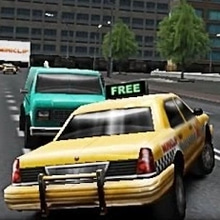
The meter clicks on and you suddenly remember how small a car can feel in a big city. Buildings lean over the street like curious giants, traffic lights blink their own rhythm, and the sidewalk is full of people who all look like they are in a hurry. Your cab is just one yellow box in all that noise, but in Cab Driver it becomes your whole world. As soon as the first passenger icon blinks on the map, your peaceful moment at the curb is over. Time to work. 🚕
You ease onto the road, maybe a little too fast at first, because it is tempting to slam the gas and pretend you are in a racing game. Then a car cuts across your lane, a bus stops right in front of you, and you realise this is not about pure speed. It is about threading your way through moving obstacles while someone in the back seat silently judges every decision you make. The city is not your enemy, but it is definitely not your friend either.
There is a simple ritual every ride follows. Spot the passenger on the mini map. Swing the cab around without crashing into half the neighborhood. Pull up close enough that they know you are there for them and not for the guy across the street. When they get in, something shifts. The ride stops being just your problem. Their schedule, their mood, their patience all climb into the car with you. Even if the game does not show their full faces, you can almost feel them leaning forward when you turn too sharply or hit the brakes like you are stomping on a bug.
The map in the corner becomes your second set of eyes. It shows you a simple destination marker, but the path between here and there is your job to figure out. You might follow the obvious route, turning when the roads line up neatly, or you might spot a side street that cuts off half a block. The temptation to improvise is strong. Take a shortcut and you might get there faster. Misjudge it and you end up stuck behind a slow truck while your imaginary passenger sighs in your head.
After a few rides, you start to feel the physics of the cab. It is not a featherweight sports car. It has weight, a little delay in its reactions. Tap the brake gently and it glides down to a smooth stop. Slam it late and the whole front dips, tires squeal, and you can practically hear your passenger thinking about walking the rest of the way. The steering has that slight floaty feeling that older arcade style games love, just enough looseness that you have to plan your turns instead of snapping the wheel at the last second.
There is a funny learning curve. At the beginning you probably overshoot everything. Corners, parking spots, even the first pick up point. You see the marker, panic, turn too hard and end up sideways like you tried to drift a taxi. It looks ridiculous, but that is part of the charm. You reverse, breathe, line up again and make a mental note to start slowing down just a tiny bit earlier next time. Over and over, those tiny corrections turn into real skill without you noticing.
What makes Cab Driver feel alive is that the city never sits still. Other vehicles are constantly doing their own thing, turning where you did not expect, stopping just a little earlier than you hoped. You cannot drive like the streets belong only to you. A van might block the lane right when you were lining up a perfect route. A car might angle into a turn and force you to brake even though the timer is ticking. Those moments are where your instincts kick in. Do you squeeze through a tiny gap and risk a collision, or do you back off, lose a few seconds and keep the ride clean. 🚦
Passengers notice this even if they do not speak. Smooth driving feels different. You get into a rhythm where your turns are round, your braking is soft, and you never jerk the cab around without a reason. The game rewards that with higher scores and better feedback. Rough driving, on the other hand, feels like dragging everyone inside the car through a washing machine. You can almost imagine them grabbing the handle by the window and promising themselves they will walk next time.
Each level sets a clear target: earn enough points before your shift ends. That number hangs over everything. If you want to hit it, you cannot just wander around. You start making little tactical decisions. Maybe you push a bit harder on the straight sections to save time. Maybe you take wide lines through corners so you can keep a bit of speed without scaring your passenger. It is a quiet balance between greed and caution. More speed could mean more rides, but crashes and sloppy parking will eat those points just as quickly.
There is a tiny thrill when you spot a passenger icon pop up just as you finish dropping someone off. You barely let the last one close the door before you are spinning the wheel and aiming for the next pick up. In those moments, the city feels like a living board game where each piece is another chance to grow your score. You stop seeing random streets and start recognizing patterns. This road leads to a long straight. That intersection always chokes traffic. That corner is the one you keep misjudging if you enter too fast.
After a while, you might notice your own driving personality showing through. Some players turn Cab Driver into a calm meditation, following imaginary traffic rules and braking early at every intersection. Others treat it like a stunt demo, dancing through gaps that barely exist and only lifting off the gas when a crash feels truly inevitable. The game does not force one style or the other; it simply feeds back the consequences. Careful drivers see steady points and happy passengers. Wild ones see bigger swings, fast wins and sudden, painful losses.
Even the way you park says something about you. Sliding perfectly into the destination zone with a neat stop feels strangely satisfying. It is a tiny moment, but finishing a ride cleanly makes the whole trip feel professional. Overshoot the marker, reverse awkwardly, nudge forward again, and you can almost see the passenger giving you that look in the rearview mirror. The game quietly teaches you that precision is not just for racing lines; it matters at five kilometers an hour too.
The city backdrop keeps everything from feeling repetitive. Streets twist and intersect in different ways, and even when you see a familiar block again it might be under different pressure. Maybe this time you have less time on the timer. Maybe traffic is heavier. Maybe you simply care more because you are one good ride away from hitting the points you need to clear the level. Context changes how you read the same turn, and Cab Driver uses that to squeeze more tension out of what could have been routine roads.
Because the game runs right in your browser on Kiz10, it has that instantly accessible energy. No garage full of menus, no complicated car upgrades to micro manage. You click play, the cab appears, and the next passenger is already waiting somewhere out there. It feels old school in a pleasant way, like the kind of game you launch “just for five minutes” and then suddenly realise you have been trying to beat your best run for half an hour.
What sticks with you after a session is not some huge storyline. It is the tiny moments. The time you squeezed through two cars with a sliver of space and still made the light. The ride where you did not hit anything, not even once, and felt like the smoothest driver in the city. The disastrous run where you took a wrong turn, panicked, and watched the timer drain while you circled the same block like a lost tourist. All of those become part of how you remember the game.
Little by little, Cab Driver stops feeling like a simple arcade distraction and starts feeling like a small driving lesson wrapped in a playful wrapper. It reminds you that being fast is not the same as being good, that reading the road is as important as pressing the pedals, and that somewhere in the back seat, someone always notices the way you drive. And when you log off, there is a decent chance you will see a real taxi out on the street and think for a second about whether that driver is also chasing a invisible score in their own head, hoping to finish the day with one more perfect ride. 🚖



 3.9 (61 votes)
 Share
Share
 Embed
Embed


