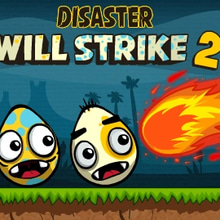
🌪️ Tap, crack, collapse The screen loads and you immediately know trouble is a tool. Disaster Will Strike 2 is a mischievous physics puzzle where your goal is delightfully simple and morally questionable in a cartoon way: use natural calamities to shatter every enemy egg on the map. Fortresses of glass, steel, wood, and stone stack into smug little puzzles. Your arsenal isn’t a hammer or a rope—it's earthquakes, hurricanes, swarms, landslides, and other environmental tantrums, each with a different personality. You don’t brute-force these levels; you compose them, one calamity at a time, until gravity signs your paperwork.
🧠 Brain meets brawn, then both meet gravity Each stage is a compact riddle. The eggs hide behind girders, under domes, or inside contraptions that look like they were designed by an engineer who drinks espresso through a megaphone. One well-placed quake might loosen a support; a gust can tilt a beam just enough to start a chain reaction; a rockslide can finish the job. It’s not about spamming power—it’s about sequencing. You will stare at a tower, mumble “if I pop the wind first, then the quake, then the swarm,” and then grin as the whole structure performs a slow-motion apology.
⚡ Disasters with personalities Earthquakes rumble with short, brutal honesty: tap and the ground shrugs, snapping fragile joints and nudging precarious stacks into motion. Wind acts like a mischievous stagehand, pushing planks, swinging bridges, and toppling vertical egos. Landslides introduce sudden weight where it hurts most, rolling boulders into places architects would prefer you didn’t. Swarms buzz like angry punctuation, cutting ropes, flicking switches, and flushing eggs out of safe corners. Later toys escalate the drama—sticky tar that changes friction, acidic messes that eat through material, controlled explosions that rewrite geometry with a smile. Every power has limits and advantages; learning the dialect of each is half the fun.
🏗️ Structures that think they’re clever Expect counterweights that flip your expectations, glass domes that only break if hit at just the right angle, bridges that pivot around pins like circus performers, and stacked planks tied together with ropes that look innocent until you sneeze in their general direction. Pipes carry marbles that tip scales; see-saws turn tiny nudges into enormous swings; balloons lift key blocks into inconvenient altitudes just when you were about to look smart. The joy is spotting the weak language in the design. Every contraption has a “tell”—a hinge that’s a little too central, a brace that’s doing too much work, a beam that trembles if you breathe on it. Find it, and the level folds.
🎮 Click, tap, orchestrate Controls are as clean as a blueprint: click or tap to select a disaster, aim its effect zone, and release. Drag to set wind direction, drop landslides where weight will matter, place quakes under load-bearing dreams. You get a limited number of uses for each power per stage, so wastefulness becomes education. The interface keeps count with polite icons, and the restart is instant—the game wants iteration, not punishment. On mobile, touch targeting is generous; on desktop, mouse precision feels surgical.
🔍 Read the room like a saboteur The puzzle isn’t “can I break this,” it’s “can I break exactly the right piece first.” Look at the foundation. Where is the center of mass. Which material fails first—glass, wood, steel. If a level opens with eggs in separate cells, don’t panic; isolate one side with a gust, then buckle the other with weight. If a protected egg sits under a dome, think leverage: punch a support on one corner, then add wind to roll the dome like a hat off a windy pier. Complex stages reward patience—watch the micro-wobbles after your first move, then layer the second disaster at the moment balance turns into ballet.
🧪 Tiny techniques the veterans swear by Angle wind slightly upward to turn horizontal beams into levers, not just trash. Use a gentle quake first to loosen joints, then a heavier effect to finish—two small shakes often outperform one big tantrum. Drop landslide rocks on hinges, not plates; hinges convey chaos to entire structures. Trigger swarms where rope meets tension; a single snip can beat five explosions. If a level has balloons, pop only one side and let asymmetry do your work. And when a tower refuses to obey, reverse your instinct: start at the top. Light pressure up high can cascade down into perfect failure.
🌏 Theme and vibe: Saturday-morning science The art is bright and readable: clear silhouettes, cheerful colors, and material textures that telegraph exactly how breakable they are. Sound design sells every choice—a chunky clatter when slabs settle, a smug glass “tink” before a magnificent shatter, a cozy rumble that vibrates like an honest earth tantrum. The music keeps your brain in the pocket, gently upbeat so you’ll restart without sighing. The eggs, bless them, are expressive in the seconds before defeat; it’s slapstick energy, never mean-spirited.
📈 Difficulty that climbs like a ladder with missing rungs Early levels teach vocabulary. Mid-game tests syntax: you’ll chain disasters in two- and three-step sentences where timing matters. Late-game asks for punctuation—precise taps mid-collapse, delayed gusts to redirect falling beams, perfectly timed swarms to cut a rope after a slab is already airborne. The curve is spicy, not cruel. A failed attempt is a lesson in disguise; you’ll restart with a new idea before the rubble stops bouncing.
🎯 Objectives beyond “break everything” Full clears often include optional goals—finish within a certain number of disasters, save a friendly egg, or snag a hidden star wedged between beams. These side challenges invite elegance: fewer moves, cleaner collapses, smarter timing. You’ll revisit earlier puzzles with newfound swagger, shaving inputs until your solution feels like a magic trick you can perform on command.
🏆 Replay bait and proud moments The instant restart and quick level loads make experimentation delightful. Try wind-first, then quake-first, time them differently, move the landslide one tile left—each variant produces new physics poetry. The best feeling isn’t just the shatter; it’s when a beam falls exactly where you predicted because you read the level like a map. Screenshots of ridiculous domino chains are practically a currency; you’ll invent “two-disaster clears” just to brag to yourself.
📱 Smooth anywhere On phones, the touch radius is honest, and zoom gestures let you study joints before you commit. On desktop, cursor precision and quick hotkeys make you feel like a structural engineer with a mischievous streak. Performance stays crisp even when half the map is learning about gravity at once. The UI never gets in the way; it’s all canvas, very little chrome.
🧭 The mindset that wins Think like a builder who wants to be caught by nobody. Measure angles by eye. Respect inertia—it’s your co-designer. When in doubt, lower the center of mass on your first move, then push sideways on your second. Celebrate close misses as data, not failure. And remember: disasters aren’t blunt force—they’re patient arguments with architecture.
💥 The collapse you’ll remember You place a quake exactly under the smug central column. The frame shivers, just a hair. A wind nudge tilts the top cap. You drop a single boulder on a hinge and time a swarm to snip the last rope the instant the left beam passes vertical. Everything unknots at once: dome rolls, brace slides, glass sings, eggs learn about hubris. Confetti brain, satisfied grin, next level. Disaster Will Strike 2 on Kiz10 turns chain reactions into a craft and chaos into a calculator you control with your thumb. It’s smart, replayable, and just destructive enough to make success feel wickedly earned.





 Share
Share
 Embed
Embed


