🎡 The Wheel Looks Cute Until It Starts Judging You
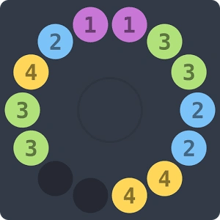
Dotowheel is one of those puzzle games that doesn’t need a huge tutorial speech to hook you. You see a circle. You see colored or numbered points sitting around it like they’re waiting for a party. You get an arrow that decides where the next piece will land. And immediately your brain goes, okay, I understand this… which is exactly when the game quietly starts building a trap out of your own optimism 😅.
The whole board is a wheel, and that changes how you think. There’s no comfortable grid where you can stash mistakes in a corner and pretend they don’t exist. Everything is connected. Every new dot you place takes up a precious slot around the circle. Every empty gap looks like relief. Every filled gap looks like danger. And the funniest part is how fast you go from relaxed to oddly serious. One moment you’re casually placing dots. The next you’re staring at the circle like it’s a vault lock and you’re trying to crack it with pure willpower.
On Kiz10, Dotowheel plays like a circular twist on classic merge and match logic. Your goal is to connect at least three equal points around the wheel so they join into a stronger one, pushing you toward higher and higher values. It’s simple to start, but it gets spicy fast because the wheel doesn’t forgive messy planning. Space is your real currency, and the game keeps asking a single rude question: are you placing this dot because it helps, or because you panicked?
🧲 Matching Three Is Easy, Keeping the Wheel Alive Is Not
The basic rule is friendly: match at least three equal points and they combine. That merge moment is the candy. It’s the satisfying click of progress, the tiny “yes!” that happens when your plan actually works. You’ll start aiming for those clean three-in-a-row setups, the kind that feel obvious and safe.
Then Dotowheel evolves into something more interesting. Because matching three is only the surface. The deeper challenge is creating merge opportunities without clogging the wheel. Sometimes you can place a dot that instantly completes a match and clears pressure. Other times you place a dot that doesn’t match anything right now, but it’s a seed for a future chain. That’s where the game gets addictive. You’re not just solving what you see. You’re solving what you’re about to create.
And yes, you’ll have those moments where you set up a perfect merge… except you accidentally block the final slot you needed. The wheel fills, your options shrink, and suddenly you’re doing damage control like a tiny disaster manager with a degree in regret. It’s fine. Everyone does it. The good news is the levels and runs are quick, so the game becomes a loop of learning and sharper decisions rather than a slow punishment.
🎯 The Arrow Is Your Best Friend and Your Worst Influence
The arrow is everything. It tells you where the next dot is going, and that small detail turns Dotowheel into a game of aiming and anticipation, not random luck. You’re constantly adjusting: if I place it here, I can connect three. If I place it there, I’ll open space for later. If I place it in that empty gap, I might survive the next few turns… but I might also ruin the only route to a big merge.
That’s the tension. The arrow makes you feel responsible, which makes every mistake feel personal 😂. You can’t blame the board. You chose that slot. You committed to that angle. You did this to yourself. But it also makes success feel earned. When you read the wheel correctly and set up a chain that merges multiple groups in a row, it feels like you just solved a moving puzzle with your fingertips.
🔁 Swaps: The “Okay, I’m Not Dead Yet” Button
Dotowheel gives you a lifeline that changes the whole psychology of the game: the ability to swap positions in tough situations. That sounds small, but it’s huge. It means a bad placement isn’t always the end. It means you can fix a wheel that’s about to lock up. It means you can turn a messy circle into a clean merge setup if you spot the right move.
But swaps are also dangerous because they tempt you into sloppy habits. You’ll start thinking, I can fix it later. And then later arrives, and you realize you should have fixed it earlier 😬. The smartest way to treat swaps is like a strategic tool, not a panic button. Save them for moments where a single rearrangement creates a big merge or opens multiple empty spaces. Use them to create breathing room, not to decorate the wheel with mistakes.
When you use a swap correctly, it feels incredible. You take a wheel that looks doomed, you shuffle a couple of points, and suddenly three sets connect, merge, and the circle clears like it took a deep breath. That’s the kind of comeback moment that keeps you replaying.
🔢 Chasing the Highest Number Without Losing Your Mind
There’s a classic puzzle-game itch here: go higher. Whatever number or value you’re building, you want the next one. Then the next. Then the “how am I even still alive” one. Dotowheel is built around score chasing, and it’s the good kind of score chasing where your score reflects your planning, not your patience for grinding.
The best runs usually look calm from the outside. You keep the wheel balanced. You avoid filling one side too heavily. You leave intentional gaps. You don’t place dots just because a slot is available. You place them because they belong there.
And then there are the chaotic runs, the ones where you’re barely surviving, swapping like a magician, pulling merges out of thin air, laughing because you absolutely should have lost five turns ago. Those runs are fun too. Dotowheel doesn’t demand perfect play; it rewards smart recovery. That’s why it works as a browser puzzle game on Kiz10: it’s quick, replayable, and it makes your brain feel awake without making you feel punished.
🧠 Tiny Tips You’ll Learn the Hard Way (Like Everyone Else)
You’ll naturally start developing habits. You’ll begin thinking in clusters instead of single moves. You’ll recognize when it’s worth delaying a merge to set up a bigger chain. You’ll learn to respect empty spaces like they’re gold. You’ll also learn that greed is the fastest way to fill the wheel. That one “extra” dot you place because it might help later? Sometimes it’s fine. Sometimes it’s the dot that ends the run.
Dotowheel’s charm is that it turns these lessons into instant feedback. When you plan well, the wheel stays open and your merges climb. When you plan poorly, the wheel tightens and your options evaporate. Simple, fair, and weirdly dramatic for a game about dots on a circle 😄.
If you enjoy number merge puzzles, match mechanics, and score-based brain games where each move matters, Dotowheel is a satisfying little challenge. It’s clean, it’s tense in a playful way, and it keeps pulling you back with that one thought that never dies: I can do a better run than that.



 4.1 (13 votes)
 Share
Share
 Embed
Embed