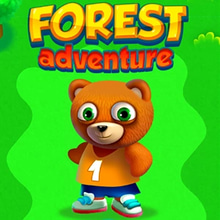
🌲🐻 A cute teddy, a forest that doesn’t care
Forest Adventure starts with an innocent vibe that lasts exactly long enough to trick you. A little teddy steps into the woods like it’s a peaceful walk… and then the forest shows its real personality. Everything is a threat. Not in a loud “boss fight” way, but in a quiet, immediate way: if you touch the wrong thing, it’s over. On Kiz10, this is an arcade-style survival runner where your best weapon is control. Not power. Not speed. Control. You’re steering the teddy through narrow lanes, sudden hazards, and nasty moving obstacles that appear like the forest is testing how quickly you can make a clean decision without panicking.
There’s a delicious tension baked into the movement. Hold to move, release to pause. That single mechanic changes everything. The game isn’t asking you to mash keys. It’s asking you to commit, then stop, then commit again at the exact right moment. It feels simple in your hands, but in your head it turns into constant micro-planning: “I go now… no, not now… okay, NOW.” 😅
🪵⚠️ Stop-and-go survival, the kind your brain remembers
The most unique feeling in Forest Adventure is how stopping is part of the strategy, not a failure. In many runner games, stopping means losing momentum. Here, stopping is how you stay alive. You release and the game freezes, like you’ve hit a tactical pause in the middle of a horror movie. It’s weirdly empowering. You can breathe. You can read the next hazard. You can choose your path instead of reacting late.
But then you press again and everything becomes real-time danger. Those moments where you unpause are the dramatic heartbeat of the game. You’re basically choosing when the world is allowed to move. That creates a clean rhythm: observe, commit, survive, repeat. The forest is busy, but you’re not helpless. You’re the one choosing the beats… if you don’t get greedy.
🌿🛣️ Two paths, one safe, one tempting
Forest Adventure loves giving you choices that feel like personality tests. You’ll hit splits where one route looks straightforward and safer, and the other route looks tighter, riskier, and often more rewarding. The “danger road” usually has the coins. And coins aren’t just decoration in this game, they’re future power. So you start making real decisions. Do you play safe and survive longer with fewer rewards, or do you gamble for coins because you want upgrades and you believe in your reflexes today?
That’s where the game gets addictive. It’s not only about reaching distance. It’s about choosing your risk. You can play like a cautious survivor, or like a chaotic collector who wants every coin and doesn’t mind living on the edge. The best runs happen when you switch styles at the right time, staying safe when the forest gets nasty, then grabbing coins when the openings are clean.
🪙🛡️ Coins that actually matter: upgrades and second chances
Coins feel good in Forest Adventure because they’re not empty points. They’re your way to buy survival tools. An extra life, a shield, energy that slows down time… the kind of upgrades that turn “one mistake and you’re done” into “okay, I can recover.” That’s huge in a game where obstacles are fatal and the pace ramps up. When you know you have a shield, you play differently. You’re still careful, but you’re not terrified. When you know you can slow time, you start looking at tight sections like puzzles instead of death sentences. When you have an extra life, you’re less afraid of experimenting with the riskier route.
And the psychological side is funny. The moment you have upgrades, you get confident. Then you get greedy. Then you take a stupid risk. Then your upgrade saves you. Then you feel like a genius even though you were absolutely about to ruin everything. Classic.
🐾⏱️ The forest gets faster when you get comfortable
A good runner doesn’t just get harder with more obstacles, it gets harder by changing the pace. Forest Adventure does that in a sneaky way. The farther you go, the more the teddy’s movement feels urgent. Your decision windows tighten. Your “safe pause” moments become more important, because once you commit, you need a clean line. It becomes less about reacting to one obstacle and more about chaining choices. One good move sets up the next. One sloppy move forces a messy correction, and messy corrections are how you get clipped.
This is where the game feels cinematic. You’ll have stretches where you’re threading through danger like a pro, stopping for half a beat, moving again, choosing the narrow lane, grabbing coins, unpausing at the perfect time… and your brain is screaming happily because it feels smooth. Then the forest throws a new timing pattern at you and you suddenly remember you’re mortal 😭🌲
😈🌰 The real enemy is “I think I can squeeze it”
Forest Adventure punishes one specific habit: the “I can make it” lie. You’ll see an opening and think it’s big enough. It’s not. Or it is, but only if you were perfectly aligned, and you weren’t, because you were thinking about coins. The game is fair, but it’s strict. You can’t half-commit. You either take the gap cleanly or you don’t take it at all.
That’s why the pause mechanic is so powerful. If you keep dying, the fix is usually not “be faster.” The fix is “pause earlier.” Stop before the danger, not inside it. Read the pattern. Choose the path. Then move.
🎒✨ The feeling of a clean run
When you get good at Forest Adventure, it stops feeling like chaos and starts feeling like a controlled sprint through a living obstacle course. You aren’t surviving randomly. You’re choosing when to move, when to wait, and when to risk the dangerous route for coins. That mastery is what keeps the game sticky. The runs are quick, the restarts are painless, and every death teaches you something specific. You start improving without realizing it. Your pauses become smarter. Your moves become cleaner. You stop dying to the same trap twice… then you die to a new one and pretend it was “information gathering.” 😅
Forest Adventure on Kiz10 is perfect if you like runner games, reflex survival, timing-based dodging, and upgrades-driven progress where coins actually help you go farther. It’s cute, but it’s not soft. It’s a calm-looking forest with sharp rules. Guide the teddy, pick your risks, buy your lifelines, and don’t trust the “easy” path unless you’re sure it’s not bait 🌲🐻🪙





 Share
Share
 Embed
Embed