The forest does not roar. It whispers. It clicks. It breathes through the needles at the tops of the pines, and somewhere between one breath and the next, you realize the dark is not empty. 99 long nights: two friends vs a forest deer is a survival horror that trades jump scares for a slow throb of dread you feel in your hands. You arrive with almost nothing, a weak flame, an axe that looks like it remembers better days, and a promise that the night will get longer, hungrier, and more personal. The rules are simple enough to say out loud: gather wood, keep the campfire burning, eat what you can, don’t wander too far, and never let the deer catch you. Living those rules is the hard part.
🔥 Embers and decisions
Everything circles the fire. In the first minutes you learn how quickly wood disappears when the air turns mean. You learn how the ring of light shrinks and swells like a heartbeat when you feed it or starve it. Every log you drop into the pit is a choice you can’t take back, because the same log might have been a barricade, a bridge, a last minute gamble to sprint deeper for one more mushroom. The glow is comfort and trap. Stand too close and your eyes forget how to read the dark. Stand too far and you hear the forest changing its mind about you.
🦌 The deer with three horns
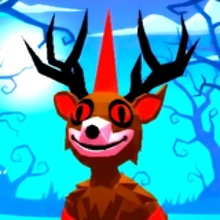
You meet it first as a rumor: prints that look wrong, a tree gouged higher than any normal rack could reach, a low chuff that might be wind or might be a throat that learned mimicry just for you. Then night three or four arrives, the fog sits heavy, and those three antler points shine for a breath in the firelight before disappearing between trunks like a door closing. The deer does not sprint unless you give it reason. It patrols. It listens. It learns your routes. When it decides you’re sloppy, it moves faster than memory. You cannot outmuscle it. You outthink it.
🪓 Steel that starts clumsy and ends like a promise
Upgrading the axe is not power fantasy; it is sanity. The first swing bites shallow. The second finally drops a limb. Later, after upgrades, your hands find a rhythm that turns gathering from panic into work. A sharper edge means fewer footsteps in one place, fewer seconds broadcasting where you are. Weight tuning changes the way your arm feels at the end of a long day. A hardened handle saves you from the worst kind of failure: the moment a tool breaks in the dark while something that hates you is close enough to hear your breath.
🌲 Foraging without getting lost
Daylight sits thin and nervous between nights. You fan out just far enough to matter, turning the map into a loop you can run with your eyes half closed. Berries lots of stem little pulp, mushrooms with collars you learn to trust, roots that give more energy than their dirt suggests. Your pockets hold barely enough for the evening and you make peace with that limit because greed is the most efficient way to die. The best players don’t harvest everything. They leave markers: a bright fern unplucked, a crooked sapling untouched, a scatter of stones that says this way home.
🧭 Two voices one plan
It is a game about friends even when you play solo, because the design keeps asking what you would do if you had someone to talk to. In co op, the rhythm is a relief. One tends fire. One sweeps the perimeter. You trade jobs without words. When the sound goes wrong a snapped twig that didn’t ask your permission you close ranks. You leave bundles in a stash you both know how to find. You joke to cut the fear, then you stop joking at the same time because the forest stopped thinking you’re funny. Losing sight of each other is the worst feeling in the game. Finding each other again near dawn is the best.
👂 Sound becomes your map
Footsteps matter. Yours crunch when you rush, hush when you time them with wind, vanish completely when you crouch on pine duff that drinks noise like rain. The deer’s gait is different from any other animal: heavy pause heavy pause sliding stop. Owls mark clean air. Insects cut out before company arrives. The campfire pops louder when logs are dry, softer when you fed it a damp branch in a hurry. Play with headphones and you start steering by noise, moving along safe choruses and halting when the forest forgets to sing.
🌘 The nightly loop that doesn’t feel like a loop
Night one is tutorial kindness. Night six asks if you really learned anything. By night fifteen the radius of safety you trusted suddenly feels too small. Nights twenty and thirty rewrite how you plan: wood runs become supply lines; you cache bundles under overhangs you can find by touch; you memorize three return routes because one will be blocked and one will be bait. The monster grows bolder, taking wider arcs, sniffing your old paths. The map grows stingier with food, pushing you out where the trees lean close and the ground lies.
🧠 Panic management is a mechanic
The game respects that fear is information. When your pulse spikes you make rules. Only run on sound cover. Only break branches in clusters so the noise hides inside noise. Only swing the axe when your back is to bark. Your rules turn into habit, and habit turns into relief. If you do panic, panic well. Sprint in spirals that overlap your own footsteps to blur the trail. Drop a decoy log and cut left while the clatter draws attention. Throw a half rotten branch on the fire and let the steam hide the shape of you for one free second you needed very much.
🕯️ Firecraft and paranoia
There is an art to the fire that the game teaches without lectures. Small flames are steady and stingy. Big flames throw light far but leave blind pockets close to the ring. Wind eats fuel faster and flips sparks into the brush unless you keep the pit tidy. Wet wood smokes and tells the whole county where you live. Dry kindling catches fast and argues with the night. The deer hates flame but loves the smell of your certainty. That is the paradox. Fire keeps you alive and points to you like a signal. Learn when to let it dim and when to shove three logs in and dare the dark to try you.
🗺️ Micro routes macro safety
The difference between dying on night fourteen and laughing on night thirty is often one rock. You pick a line from camp to the creek that touches four landmarks you can find by feel. You angle the path so a single fallen trunk can serve as both bridge and barricade. You carve a notch in a stump that your thumb finds in the dark and suddenly a blind turn becomes home. When you move with that kind of intention the forest gets smaller in a good way. You make the world livable by choosing where you will live inside it.
🥾 The friend you’re trying to find
The missing friend is not just an objective marker. It’s story. You catch signs in places that don’t make sense, a scarf at the wrong bend, a half built shelter that looks like your style but isn’t. You piece together a path that says they were learning the same lessons you learned, only alone. When you finally spot their silhouette in the gloss of early dawn, you move as if the deer is behind every tree, and maybe it is. Bringing them back feels heavier than gathering any log because it is a person you convinced to survive for one more night. And then ninety eight and ninety nine still wait.
📱 Controls built for quiet hands
Movement is gentle when you let it be. Thumb drift translates into a walk that makes no enemies. A firm push becomes a sprint that buys distance and debt. The axe swing rides your timing rather than your impatience; if you watch the arc you can hear the sound of a clean bite. UI stays out of the way. Indicators whisper instead of shout. The most important meter is the size of the fire and the sound it makes, which is exactly right for a game that lives in the space between hearing and seeing.
🎧 A soundtrack you don’t notice until you do
There’s music, but it’s a tide, not a trumpet. Low strings swell when fog thickens. A single wooden click repeats when patrols shift. At dawn, the track lifts like a chest that finally let go. SFX carry most of the weight: sap popping, needles hushing, hooves scuffing damp dirt. When the deer is near, there’s a faint breath like air moving through a hollow bone. You will learn to hate that sound and be grateful for it in the same moment.
🌟 Why it belongs in your Kiz10 rotation
Because survival here is not a checklist. It’s a relationship with a place that would prefer you left. Because fear is honest and progress is earned with observation instead of grind. Because two friends sharing silence around a small fire can feel braver than any arsenal. Because every night teaches something that makes the next night fair. And because the moment the deer steps into the edge of the light and tilts its head as if it is about to ask a question you know the answer to is the cleanest kind of horror there is.





 Share
Share
 Embed
Embed