🔥🌙 Campfire glow, small mysteries
The first thing you notice isn’t an objective; it’s the hush. Pines lean together like they’re swapping secrets, a kettle murmurs on the fire, and a paper lantern sighs every time the breeze remembers its job. 99 Nights in the Forest, the Story of a Deer invites you to slow down without getting bored—tiny quests, soft puzzles, and the kind of “ah, there it is” satisfaction that makes time fold politely. You’re not saving the world. You’re tidying it, one misplaced canteen and crooked map at a time, with a curious deer watching from the treeline like an unofficial supervisor.
🧭🍂 What “one location” really means
A single campsite sounds simple until you realize how much life fits inside a few circles of light. There’s the supply table with labels you’ll eventually learn by heart, the tent with an unruly zipper and exactly three mysteries, the little dock that never stops pretending it’s a stage, and the path where pinecones organize themselves into suspicious patterns. Day slips into blue hour, blue hour into night, and the same spot feels new every time because the details keep shifting their weight. You’re exploring a mood as much as a map.
🔎📦 Little quests, big dopamine
Each mission is a sentence you finish: find the compass, return it to the map board; gather the mugs, stack them near the kettle; nudge the cooler back under the table because chaos had opinions. It’s all action, no chore—pick up, place, repeat, and smile when the game answers with a soft chime or a gentle camera nod that means “good job, ranger.” Some tasks chain together in cheerful ways: you can’t hang the lantern until you fix the hook; you can’t fix the hook until you find the twine; you can’t find the twine until you notice the raccoon tried interior decorating. Nothing is cruel. Everything is a nudge.
🦌✨ The deer in the title (and in your head)
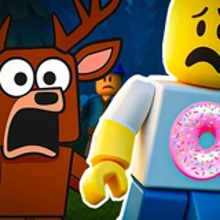
About that deer. It’s not a boss or a jump scare; it’s a vibe. Sometimes you’ll spot antlers just beyond the firelight, a silhouette that lingers while you figure out where the water filter belongs. Sometimes hoofprints appear near the woodpile like punctuation marks for your progress. You start narrating to it without meaning to—“I’m putting the flashlight back, okay?”—and the forest answers by feeling less empty. The deer is a story thread, thin and silver; tug it and the night hums.
🧠🎒 Brain-pleasing without brain-melting
This is low-stakes problem solving done right. Spatial memory gets a workout as you learn the campsite’s “homes”—canteens here, first-aid there, rope beside the stakes but never on top of them because that way madness lies. Attention to detail turns into quiet superpower: a mismatched mug pattern, a footprint pointing at a bush that wasn’t wiggling five minutes ago, a map pin slightly off-center because someone rushed. You feel clever for noticing, not punished for missing. And when you do miss? The game is patient. It waits, you breathe, then you see it.
🚶♀️🕹️ Movement that encourages wandering
On PC you drift with WASD like a stroll that keeps becoming purposeful; C drops you into a sit that changes the view and, occasionally, your plan; Shift is the moment you decide to jog because the kettle whistled and you suddenly care about mugs. Tab opens a pause menu that’s more like a breath—check progress, tweak comfort settings, glance at hints if you want a nudge. On mobile, the joystick and on-screen taps are as friendly as a trail map with doodles on it. Nothing in the control scheme gets between you and the satisfying thunk of “object meets rightful place.”
🕯️🔊 Sound as a compass
If you ever feel unsure, listen. The creek chatters louder near the dock; the kettle huffs when you’re pointing the right way; wind beads through the tarp in a tone that changes as you line up a lantern hook. The soundscape is more than vibe—it’s navigation. Footsteps on gravel tell you you’ve drifted toward the path; needles underfoot whisper when you’re near the pines; a curious snort announces the deer’s cameo and you pause, smiling, because of course it showed up the second you balanced the last stack of firewood.
🗺️🌧️ The campsite keeps secrets (polite ones)
Not everything is obvious at first pass. A folded map hides a checklist that adds just one more thing (the fun kind, not the groan kind). A crate under the table becomes a puzzle in three parts: slide, rotate, discover that someone hid trail markers in the bottom because organization is an aspiration. Weather drifts through like guest stars—mist that silvers the lantern, a drizzle that makes the tarp sing, a clear night so bright you find lost items by starlight alone. The location remains the same; the context keeps refreshing itself.
🌿🧩 Micro-habits that make you feel like a pro
Walk the perimeter first; you’ll catch outliers that would pull you into a loop otherwise. Group by material—metal with metal, fabric with fabric, wood with wood—and the campsite begins to tidy itself as if by spell. When you set something down, angle it the way it would naturally sit; the game rewards respect for objects with quick task resolutions. If you’re stuck, sit on the log for five seconds; the change in perspective is the hint system wearing a sweater. And whenever you complete a cluster of little tasks, give yourself a tiny ritual—tap the kettle, straighten a lantern—because games that honor rhythm feel better to play.
📸🎨 A postcard you keep editing
Pixel-warm visuals and gentle bloom turn chores into scenes. You’ll find yourself framing screenshots—a lantern mid-swing, mugs lined like choir members, the deer half-turned like a polite question. Colors read clearly even in low light; interactive objects hum with a subtle outline when your eye is honest. It’s pretty without being precious, inviting without becoming sticky-sweet. This is the rare place where “cozy” and “playable” meet on equal footing.
🎒🏆 Progress you can feel, not just see
Every mission completes with a tactile little flourish: a click, a glow, a note on your internal checklist crossing itself out. Strings of short quests turn into visible order—paths cleared, tables neat, tools where tools belong. You don’t grind; you accumulate peace. And while there’s no leaderboard shouting about who stacked mugs fastest, you will absolutely start racing yourself: last night took fifteen minutes, tonight took twelve, and tomorrow you’ll do it with style, because stylish tidying is still tidying.
🧡🎭 For everyone, really
Kids read the space like a scavenger hunt. Adults treat it like meditation with objectives. Streamers discover it’s perfect for “chat and chill” while giving viewers mini payoffs every ninety seconds. Accessibility is baked into the bones: readable interactions, forgiving timers (or none at all), language options tucked where you expect them, music volume that slides between “forest lullaby” and “my own thoughts.” It’s generous on purpose.
🏁🌌 The night you’ll remember
You place the last lantern and the whole campsite seems to exhale. The kettle quiets, the creek offers applause, and the deer steps into the half-light just long enough to nod in that deer way—no big speech, just agreement that order is nice. You sit (C, because you can), the camera settles into the kind of angle photographers call lucky, and a breeze nudges the map flat like the forest is signing off on your work. No fireworks, just rightness. Then a stray mug gleams near the dock and you laugh, stand, and go fetch it. Peace isn’t a finish line; it’s a loop.
Why it shines on Kiz10
Short, kind missions; intuitive controls on PC and mobile; a single location that refuses to get old; and progress that you can literally point at—this is the sweet spot for cozy players and curious kids alike. Dip in for five minutes or linger for an hour; either way, the campsite will remember you, the deer will approve, and your to-do list will feel lighter in the real world, too.





 Share
Share
 Embed
Embed