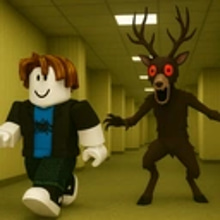
The light is wrong. Not dark, not safe—just a humming yellow that makes the air feel stale and watched. Deer Labyrinth drops you into the Backrooms with one clear rule find every button or stay here forever. A door is locked somewhere ahead. A deer you don’t fully see keeps changing the shape of your fear. Your task is simple to say and hard to do listen, hide, move, press, repeat. Every step is a small gamble, every click a coin toss with consequences.
Footsteps and fluorescents 👣💡
You learn the mood of the maze before you learn the map. Fluorescent lights buzz with different pitches, like a broken choir. The carpet eats sound unless you run. Distant thumps slide along the corridor and turn left when you pray they won’t. Corners arrive too often and never with enough certainty. The rooms repeat, and still something always looks off a stain that wasn’t there, a vent that rattles now, a shadow that has no author. That pattern, familiar but wrong, is the game’s first weapon.
The rules of the yellow sea 📜🟡
Your job is consistent even when the layout refuses to be. Buttons glow with a tired hope, tucked behind pillars, perched near ceiling ducts, hiding in dead-end cubbies that are only dead-ends until you press something. When you activate one, the world answers. Sometimes the lights flicker three short, one long. Sometimes a door unlatches far away and your blood gets loud because you suddenly care about running and the deer loves runners. You start to sketch rules that fit your hands no sprinting unless you’ve got cover in sight, no long straight lines without a pause, no pressing a button before you’ve found a place to disappear.
Listening is your strongest skill 🎧🫀
You stop hunting with eyes alone. Sound becomes a map. The deer’s hooves don’t always sound like hooves; sometimes it’s a soft scrape, sometimes a dull tap echoed by a vent that betrays a route you can’t see. If you can’t place the sound, you wait. The maze punishes impatience more than caution. As you progress, the soundscape thickens. Pipes gurgle, HVAC sighs, glass buzzes, and in that noise you learn to isolate the one thread that means move now. When you get good, you’ll start moving a half-second before your brain finds the reason. That half-second is survival.
Hiding and breathing 🗄️😮💨
Hiding isn’t just location. It’s posture. A low desk helps only if you approach it from a blind angle and leave no visible trail. A supply closet is safety only until you slam it in panic and give yourself away. The best hides are calm ones the corner that breaks line of sight and leaves you room to pivot, the dim alcove where the hum is loud enough to cover your breath. You will find certain spots you trust, tiny oases in an office that forgot it ever had people. Mark them in your head. You’ll pass them again. The maze likes to loop you back when you are most tired.
The thing with antlers 🦌🕯️
You rarely see it clearly and that’s why it works. Sometimes only antlers catch the light around old ductwork. Sometimes the silhouette is wrong and tall and you wonder if it is closer than it sounds. It does not sprint unless you earn it. It studies. If you get greedy with a button, it is already mid-turn. If you run the same route twice, it learns the pattern you taught it. The first time you feel it choose the other corridor—the one you were hoping to use—you understand that this isn’t a ghost train. It’s a hunter with a patient clock.
Buttons and breadcrumbs 🔴🚪
A good run begins with breadcrumb choices that aren’t obvious. You treat hallways as sentences and periods are places you can vanish. You note a fallen panel, a flicker loop, a coffee cup that shouldn’t be warm. Those are breadcrumbs you leave for yourself because the labyrinth wants to scramble your sense of direction. When you hit a button, you don’t celebrate. You freeze, listen for the deer's reply, and plan the next two turns. Doors open when you’ve earned them and they never open next to you. The distance between button and door is the game’s favorite punchline.
When the maze grows teeth 🧩⬆️
Later levels change the grammar. The floor tilts a whisper. The light color shifts toward sickly green. New props clutter sightlines filing cabinets, partitions, tall stacks of boxes just high enough to hide, just sharp enough to snag your sleeve and give your panic a sound. Some layouts add double-buttons that reset if you take too long to find their twin. Some add false buttons that hum wrong, a trap you hear only if you stop treating the maze like a hallway and start treating it like an instrument. The trick is to trust your notes more than the wallpaper.
Momentum versus panic 🏃♂️🧠
You cannot tiptoe forever. The timer isn’t on the screen; it’s in the way the world grows louder when you linger. Sit too long and the deer’s route compresses toward you, like the walls breathe in. Move too fast and you feed it a path it can read. The sweet spot is decisive patience—a walk that never hesitates at corners, a sprint that lasts three seconds and ends in a pre-planned shadow, a press that happens the moment your escape lane is already clear in your head.
What you learn without meaning to 🧭🧠
You’ll begin to count in weird ways. Three lights between turns. Five tiles across the safe room. Two breaths between footfalls that aren’t yours. You’ll stop staring down corridors and start scanning edges, like a photographer checking the frame for the thing that doesn’t belong. You’ll find yourself smiling, which feels wrong in a place like this, but it happens when you ghost past the deer so close you could name the dust on its flanks and it keeps walking because you became quiet enough to be architecture.
Why you keep going 😈➡️🚪
Because each level gives you just enough proof that you could be better. Because the maze is unfair only when you make it that way. Because the deer is terrifying, and beating something terrifying with simple tools—ears, timing, good choices—feels like clean oxygen. You’ll finish a run and immediately wonder where the next button hid, what you missed in that one side room, whether the flicker pattern meant something more. Horror turns into curiosity, and curiosity is how you escape a place designed to keep you.
Kiz10 convenience, Backrooms heart 🌐💛
It runs in your browser, it boots fast, and it respects short sessions. Ten minutes buys real progress, a new pattern learned, one extra door opened. Longer sits become a rhythm of listen, move, press that settles into your bones. Deer Labyrinth is compact, readable, and mean in the way good horror is mean it only hurts the parts you ignored. Bring attention, and it gives you exits.





 2 (170 votes)
 Share
Share
 Embed
Embed