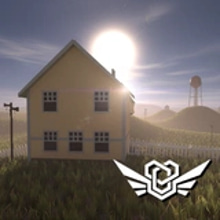
You know that feeling when something looks cheerful but your stomach doesn’t buy it? That’s Level 94: Motion in one sentence. You drop into a neighborhood that feels like a school project built by someone who smiled too hard. Green hills, little cardboard houses, bright daylight that never really warms you up. The sun is up, but it’s wrong. It’s stuck. And the “neighbors” are there… except they aren’t neighbors. They’re plastic figures, frozen like decorations, like props waiting for a scene that nobody told you about. You’re in a Backrooms survival horror situation where the environment pretends to be safe while quietly planning your worst night.
The loop is cruel in the simplest way: daytime is your chance to breathe, nighttime is your reminder that breathing is loud. During the day you’re not fighting bosses or collecting shiny trophies. You’re scavenging like your life depends on it, because it does. You search cardboard houses for essentials, you grab batteries like they’re gold, you hunt for Almond Water like it’s liquid sanity, and you make little decisions that feel small until the sun snaps out in an instant and your brain goes, oh… it’s already night. That is the genius of the tension here. The game doesn’t need to scream at you. It just changes the rules with a click, and suddenly every “I’ll just check one more house” becomes an expensive mistake.
Daytime in Level 94 feels like a strange shopping trip in a world made of paper. You move through streets that stretch too far, lawns that look soft but feel suspicious, and houses that are clearly not real homes. Cardboard corners. Flat textures. Doors that open like they’re part of a stage set. You start to recognize the rhythm: enter, scan, grab resources, keep your eyes moving, listen, leave. And listening matters more than you expect. The sound design isn’t decoration. It’s information. Footsteps, distant creaks, that tiny change in ambience that makes your skin tighten even if nothing is visible. Horror games love darkness, but this one loves the moment right before darkness, when you still have light and you still feel unsafe anyway.
Resource management is the quiet knife in the ribs. Batteries are not just “for your flashlight.” They’re your ability to say no to the dark. Stamina isn’t a number; it’s the difference between escaping a stiff doll and becoming part of the scenery. Sanity isn’t a cute feature; it’s the game watching you unravel and asking if you want to keep making decisions while your nerves are buzzing. You can play sloppy for a bit, sure, but the neighborhood has a way of punishing casual behavior. You learn to plan routes. You learn to leave certain houses for later. You learn that greedy looting is basically a love letter to whatever wakes up at night.
And then night hits. Not gradually. Not politely. It’s like someone flicks a switch and the entire world goes from “weird postcard” to “predator habitat.” The sun disappears in an instant, and the cheerful daytime vibe collapses like cardboard in rain. That’s when you stop feeling like an explorer and start feeling like prey. The same streets you walked confidently now feel too open. The hills feel like they’re hiding movement. The houses feel like the only real protection you have, and even that protection is a gamble.
The creatures aren’t just random monsters. They’re built around the idea that your body gives you away. The Animations are the nightmare version of a doll: stiff, faceless, jerky, and deeply wrong in motion. They don’t need to roar; their presence is enough. You see one and your instinct is immediate: run, break line of sight, don’t get trapped in a cute little dead-end yard like a fool. There’s a panic that comes from a thing that moves like it was animated at a lower frame rate than reality. It feels unnatural, and your brain treats unnatural movement as danger on sight.
Skin-Stealers add a different kind of fear: sound-based hunting. That turns the whole game into a quiet performance. Your breathing becomes dramatic. Your footsteps feel like betrayal. You start doing this ridiculous internal monologue like, okay, okay, don’t bump anything, don’t slam a door, don’t sprint unless you absolutely have to, because if you do, you’re basically ringing a dinner bell. Closets become your confession booth. You hide and you wait and you listen for heavy footsteps that say the hunter is close enough to ruin your night. It’s tense in the worst way because it’s so simple. Be quiet. Hide. Don’t be seen. And yet your hands still want to move, because humans hate stillness when they’re scared.
Smilers are the kind of horror that feels almost rude. You’re in darkness, you think you have a second, and then you see glowing teeth. Not a full face, not a full body, just that grin floating like the world is mocking you. The flashlight becomes more than light; it’s your “go away” button. But it’s also battery-dependent, which is hilarious in a cruel way. You have the tool to defend yourself, but using it drains your survival time. Every flash becomes a choice: scare the teeth now, or save power for later when you’re even more desperate. The game makes you negotiate with your own fear, and it never lets you feel like you chose perfectly.
The open world vibe is what makes the level feel like a trap you can’t fully map. It’s a neighborhood that goes on, grass and hills and roads that keep stretching, houses that repeat just enough to mess with your sense of direction. You think you remember where you are, then you realize the “landmark” you trusted is just another cardboard copy. You start inventing navigation tricks: counting turns, using odd objects as markers, remembering a certain house because it had a weird angle, then realizing you’re doing survival math in a place that shouldn’t exist. This is classic Backrooms energy: normal shapes, abnormal logic, and a slow erosion of confidence.
Story-wise, you’re not playing as some unstoppable soldier. You’re Chamomile, an art student, which is such a perfect choice because the whole level feels like a twisted art installation. Like somebody built a diorama of suburbia and then cursed it. The objective of repairing a projector fits that mood. A projector is a tool for revealing, for casting images, for turning light into meaning. In a level where the sun is fake and the night is instant, that idea hits harder. You’re trying to rebuild a device that might show you the truth, or at least show you a door out. It’s hopeful, but it’s also desperate. Because if you can’t restore it, you’re stuck living in a paper neighborhood where the rules change when the light dies.
What makes this kind of horror addictive is how it alternates confidence and humiliation. In the day, you feel capable. You plan. You loot efficiently. You think, I’ve got this. Then night comes and your confidence becomes comedy. You sprint across a yard, you hear something behind you, you turn too late, you slam into a corner like you forgot how corners work, and you’re suddenly hiding in a closet whispering apologies to the universe. Then you survive. You make it through. You crawl back into daylight and you feel that strange pride: I lived. I actually lived. And now you’re hooked, because your brain wants to prove you can do it cleaner next time.
If you’re playing this on Kiz10 because you love online horror games, survival horror loops, Backrooms vibes, stealth tension, and that stomach-dropping moment when a “safe” place flips into a hunting ground, Level 94 is basically built to mess with you in the best way. It’s not only about scares. It’s about habits. It teaches you caution during the day and discipline at night. It makes you respect sound. It makes you respect light. It makes you respect time. And it makes you laugh at yourself when you realize you just risked everything for one more battery like a raccoon in a haunted suburb. 😅
In the end, the cardboard world is the trick. It looks fragile, playful, harmless. But it’s not fragile. You are. The neighborhood isn’t pretending to be real because it wants to comfort you. It’s pretending because it wants you to relax. And the second you do, the sun drops, the creatures wake up, and the level reminds you what you really are here: a moving target in a place where even the sky refuses to behave. 🕯️🏠🌙





 Share
Share
 Embed
Embed