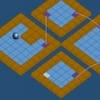
𝐂𝐥𝐢𝐜𝐤 𝐭𝐡𝐞 𝐠𝐫𝐨𝐮𝐧𝐝, 𝐚𝐧𝐝 𝐬𝐮𝐝𝐝𝐞𝐧𝐥𝐲 𝐠𝐫𝐚𝐯𝐢𝐭𝐲 𝐢𝐬 𝐲𝐨𝐮𝐫 𝐩𝐚𝐫𝐭𝐧𝐞𝐫 🎯🌍
Contour is one of those puzzle games that looks almost too simple when you first see it. There is a ball. There is a target. There is terrain between them. No giant menus, no dramatic hero, no nonsense trying to distract you from the actual idea. Then you click the land and everything changes. The ground rises or falls, the slope shifts, the ball starts rolling, and suddenly the whole level turns into a tiny argument between geometry, momentum, and your own confidence. Public descriptions of Contour consistently describe it as a puzzle game where you reshape the landscape to guide a rolling ball to the goal.
That single mechanic is the whole magic. You do not control the ball directly, which is exactly why the game feels smarter than it first appears. You control the world around it. That makes every click feel important. You are not pressing jump or steer or boost. You are redesigning gravity’s path and then letting the ball decide whether your idea was brilliant or completely ridiculous. Sometimes it is brilliant. Sometimes it is a very elegant disaster. Both are entertaining.
This is the kind of browser puzzle game that earns its personality through restraint. It trusts one mechanic enough to build an entire experience around it, and honestly, that confidence pays off. A ball rolling over land should not be this absorbing. But once the terrain starts responding to you, every hill becomes a decision, every valley becomes a trap, and every level starts looking like a problem that wants to be sculpted into submission.
𝐇𝐢𝐥𝐥𝐬 𝐚𝐫𝐞 𝐧𝐨𝐭 𝐝𝐞𝐜𝐨𝐫𝐚𝐭𝐢𝐨𝐧, 𝐭𝐡𝐞𝐲 𝐚𝐫𝐞 𝐭𝐡𝐞 𝐚𝐧𝐬𝐰𝐞𝐫 ⛰️🧠
What makes Contour special is that the level is never static. In a normal ball puzzle, the path already exists and your job is to react inside it. Here, the path is your job. You are making it. That changes the emotional feel of the entire game. A wall is not only an obstacle. It is a future ramp if you think correctly. A pit is not always failure. It might become momentum. A flat area is not safety. It might be the reason the ball never gets enough speed to reach the goal.
That flexibility is where the puzzle depth comes from. You begin to look at the terrain less like scenery and more like soft clay. Every click becomes a tiny act of engineering. Build a hill here, lower the ground there, let the ball roll, then watch what your own idea actually does in motion. It is a beautiful little loop because it makes the player feel inventive. You are not solving a fixed track. You are shaping one.
And because the game uses ball physics, the results always have a little unpredictability. Not unfair unpredictability, just enough to make the movement feel alive. A slope that seemed perfect might launch the ball too high. A shallow dip might slow it at the worst moment. A hill you made for speed might become a reckless little catapult. That is great design. It means the solution is not only visual. It is physical.
𝐆𝐫𝐚𝐯𝐢𝐭𝐲 𝐝𝐨𝐞𝐬 𝐧𝐨𝐭 𝐜𝐚𝐫𝐞 𝐚𝐛𝐨𝐮𝐭 𝐲𝐨𝐮𝐫 𝐩𝐥𝐚𝐧𝐬 ⚖️😅
Games like Contour are at their best when they let the player feel clever and foolish in equal measure. This one absolutely has that energy. You stare at a level, build what looks like a perfect route, release the ball in your head before the ball actually moves, and then reality shows up and does something much funnier. Maybe the ball gains too much speed. Maybe it gets stuck in a dip. Maybe it rolls beautifully for three seconds and then betrays you right near the goal. That constant gap between idea and outcome is where the game becomes addictive.
It also makes every success feel better. A level is not just completed. It is shaped into completion. That is a stronger reward than simply pressing the right sequence of buttons. When the ball finally rolls along the path you imagined, the result feels deserved in a very specific way. You did not brute-force the answer. You built it.
That kind of puzzle satisfaction is hard to fake. It is the reason these older browser physics games still hold up so well. They do not need excess. They only need a strong interaction and enough level design discipline to keep that interaction interesting. Contour clearly belongs to that tradition. External descriptions also note that the game revolves around morphing the ground and letting gravity take over, which is exactly the sort of simple phrasing that hides a lot of clever design underneath.
𝐄𝐯𝐞𝐫𝐲 𝐥𝐞𝐯𝐞𝐥 𝐟𝐞𝐞𝐥𝐬 𝐥𝐢𝐤𝐞 𝐚 𝐭𝐢𝐧𝐲 𝐞𝐱𝐩𝐞𝐫𝐢𝐦𝐞𝐧𝐭 🔬🔵
One of the nicest things about Contour is how naturally it creates experimentation. Failure never feels like a total waste because the game shows you something useful every time the ball moves. A bad route still teaches. A weird slope still reveals something. You are constantly learning how the terrain interacts with momentum, and that makes each restart feel productive instead of annoying.
That is probably why the game has such strong replay value. Public descriptions mention long level counts and even level-creation or editor features in some versions, which fits the game’s design perfectly because this is the sort of mechanic that rewards endless variation. A terrain-morphing system can generate a lot of interesting puzzle spaces without ever changing its core rule.
It also helps that the interface stays direct. Click, shape, watch, adjust. The loop is immediate. You are always one idea away from seeing what happens. That speed matters. It keeps the game lively, and it makes experimentation feel playful rather than technical. You are not building an engineering blueprint. You are poking the earth and watching a ball react. That childlike simplicity is part of the charm.
And then, somewhere in the middle of all that, the game quietly becomes a real challenge. You stop clicking randomly and start planning actual terrain logic. Now each raise or drop has intention. You begin thinking about launch angle, landing control, and speed retention like a tiny landscape architect with trust issues.
𝐖𝐡𝐲 𝐂𝐨𝐧𝐭𝐨𝐮𝐫 𝐰𝐨𝐫𝐤𝐬 𝐬𝐨 𝐰𝐞𝐥𝐥 𝐟𝐨𝐫 𝐊𝐢𝐳𝟏𝟎 🚀🕹️
Contour is exactly the kind of game that fits Kiz10’s puzzle lane beautifully. It has a clear hook, clean controls, physics-driven trial and error, and that lovely “one more level” quality that makes browser puzzle games so hard to leave. Kiz10 already features a strong group of related physics and ball-control puzzles such as Happy Glass, Fill The Glass With Juice, Road Digging Puzzle, Drop Ball Adventure, and 3D Maze Control, which makes Contour feel right at home in that clever, movement-based challenge space.
If you like games where logic and motion have to cooperate, Contour is a great fit. It is not loud. It is not flashy. It is just smart, tactile, and quietly absorbing. One moment you are raising a little hill out of curiosity. The next moment you are completely invested in whether that hill launches the ball with enough speed to clear the gap without turning the whole run into a cartoonish little failure.
That is the kind of puzzle game that lasts. Not because it shouts, but because it gives the player a world simple enough to understand and flexible enough to reshape. Contour turns the ground itself into the solution, and that is a wonderfully satisfying thing to plays with.



 2 (27 votes)
 Share
Share
 Embed
Embed