🏁🔥 THE START LIGHTS FEEL LIKE A DARE
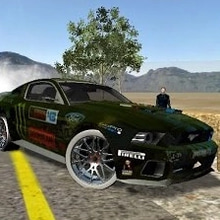
Mad Rush on Kiz10 drops you into a very specific kind of racing fantasy: no rivals rubbing doors, no long campaign cutscenes, no excuses. It’s you, a fast car, a lap timer, and a track that doesn’t care if you’re confident or terrified. The concept is pure time trial: drive as quickly as possible and finish the lap with your dignity still intact. Sounds easy until you realize how quickly “going fast” turns into “I can’t see the next turn because my brain is buffering.” That’s the whole hook. It’s simple, clean, and brutally honest.
Mad Rush feels like the type of 3D racing game you start for a quick run and then accidentally replay five times because you know you can do it cleaner. Your first lap is usually chaos. Not because the game is unfair, but because speed changes everything. Corners arrive faster than expected. Braking points feel shorter than your instincts want. And the moment you get comfortable, you hit a section that punishes comfort immediately. It’s a compact challenge that rewards attention and punishes lazy lines.
🚗💨 THE CAR IS FAST, BUT YOUR HANDS HAVE TO BE FASTER
The handling in Mad Rush is designed for arcade intensity. You’re not tuning suspension settings like a simulator. You’re driving with instinct and micro-corrections. The car wants to slide a bit when you overcommit, and it’s up to you to keep it pointed the right direction without turning every corner into a full panic wobble. This is where the game gets fun: it turns tiny inputs into big consequences. One small oversteer becomes a drift you didn’t ask for. One late brake becomes a wide turn that destroys your exit speed. One correction too many becomes a chain reaction where the car feels like it’s laughing at you.
But when you find the rhythm, it’s beautiful. You stop wrestling the steering and start guiding it. You begin setting up corners early. You aim for smooth arcs instead of desperate jerks. And suddenly the track feels wider, not because it changed, but because you’re arriving with more control.
🧠🛣️ THE TRACK IS A MEMORY GAME DISGUISED AS A RACE
Time trial racing always becomes personal because your opponent is your last run. Mad Rush makes you memorize the track naturally. You don’t study it like homework, you absorb it through repeated attempts. First you learn the obvious corners, the ones that bite you immediately. Then you learn the sneaky corners, the ones that look safe but tighten unexpectedly. Then you learn the real killers: the sections where you exit one turn and instantly need to set up the next, like the track is chaining mistakes together on purpose.
This is where lap time obsession kicks in. You’ll start noticing tiny details. That curb you clipped that threw your line off. That moment you hesitated on throttle. That time you braked too much and lost momentum for the entire next stretch. Mad Rush rewards players who treat the lap like one connected flow, not a series of separate moments. A clean lap isn’t “fast in parts.” A clean lap is smooth everywhere.
⏱️😅 SPEED FEELS AMAZING UNTIL IT FEELS EXPENSIVE
There’s a funny moment in Mad Rush when you finally feel fast. The car is flying. Your corners are cleaner. You’re thinking, okay, this is the run. And then your confidence becomes a tax. You push a little harder, you brake a little later, you take a corner a little sharper, and suddenly you’re off-line. Not by a lot. Just enough. And that tiny deviation is what ruins the lap because time trial games punish small errors more than big dramatic ones. Big crashes are obvious, you restart and accept it. Small errors are painful because you keep driving knowing you already lost the record by half a second, and half a second feels like an insult.
That’s the psychology of time trial racing, and Mad Rush leans into it perfectly. It makes you chase perfection without forcing you to be perfect. It keeps the goal clear: set the best time you can. Then beat it.
🌀🏁 CORNERS ARE WHERE THE RECORD IS MADE OR BURIED
If you want to understand Mad Rush, understand this: corners decide everything. Straights are for breathing and building speed. Corners are where you either keep that speed or kill it. The best laps are won by exit speed, not by how brave you felt on entry. That sounds boring, but it’s not. It’s satisfying because you can feel it. When you exit a corner clean, the car rockets forward and the next section becomes easier. When you exit messy, you spend the next ten seconds recovering, and your lap time bleeds out quietly.
The game encourages you to drive like a real time trial: brake earlier than your ego wants, turn in smoothly, and get on the throttle as soon as the car is pointed where it needs to go. That early throttle moment is pure joy. It feels like you solved the corner, not survived it.
🎬🚦 THAT CINEMATIC “JUST HOLD IT” FEELING
Mad Rush has a very cinematic vibe when you’re locked in. The car is moving fast enough that the track feels like it’s coming at you in waves. Your eyes are scanning ahead, your hands are doing small adjustments, and you’re living in that focused tunnel where the rest of the world disappears. You’re not thinking in words anymore. You’re thinking in motion. Slight left. Hold. Ease. Brake. Turn. Straighten. Go.
And then you mess up one corner and your inner monologue returns instantly, usually with a lot of sarcasm. Great. Perfect. Amazing. Why did I do that. 😭
That emotional swing is what makes the game replayable. It creates runs that feel like stories, even though it’s “just” a lap timer. You remember the lap where you almost had it. You remember the corner you always mess up. You remember the one section where you finally nailed the line and felt unstoppable. Those memories pull you back.
🔧💥 THE REAL CHALLENGE IS DRIVING CLEAN, NOT DRIVING LOUD
Mad Rush is the kind of racing game where the loudest driving isn’t the best driving. Sliding everywhere looks dramatic, but it costs time. Overcorrecting feels active, but it kills momentum. The best laps are quiet, controlled, almost boring to watch if you don’t understand racing. But to the player, it feels incredible because you’re controlling speed without losing it.
You’ll notice the game becomes easier when you stop trying to save every mistake aggressively. If you drift wide, don’t whip the car back violently. Reset gently. If you miss a line, accept it and focus on the next corner. A lot of lap time gets lost not from the first mistake, but from the panic reaction after it. Mad Rush punishes panic. It loves calm recovery.
🏆😈 WHY IT’S SO EASY TO GET STUCK PLAYING “ONE MORE LAP”
Because the improvement is measurable. Time trial games are addictive because they give you a number that represents your skill. Mad Rush keeps that number in your face, and your brain can’t ignore it. You’ll finish a lap and think, okay, I can shave a second by braking later there. Then you try it and you crash. Then you try again, slightly earlier, and it works. Then you realize you can shave another second by taking a different line in a different section. Now you’re optimizing. Now you’re in it.
And the best part is that the game doesn’t require a long commitment. Each run is short enough that repeating it feels natural. You’re not grinding; you’re refining. That’s the sweet spot for Kiz10 racing games: quick sessions that still feel meaningful.
🚗✨ THE TAKEAWAY
Mad Rush is a 3D racing time trial built around one simple pleasure: go fast and go clean. It’s arcade driving with enough precision to make improvement feel real. If you love record-chasing, tight laps, and that “just one more attempt” itch, this one delivers. Drives like a maniac if you want, but the fastest runs come from control, not chaos. And once you taste a clean lap, you’ll want it again. 🏁



 4.1 (55 votes)
 Share
Share
 Embed
Embed


