🪝 One tap, a hook, and suddenly flight
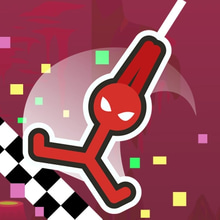
You tap. A tiny rope snaps to a peg. The stickman arcs like a question mark that already knows the answer. Super Stickman Hook turns simple taps into a dance with gravity: swing, release, catch, repeat. No storyline, no lecture—just you, a gummy-quick avatar, and levels that escalate from “oh, cute” to “I have become a trapeze.” The first time a clean release slings you across half the stage, you’ll grin without permission. The physics are honest and a little mischievous; your thumb learns the rhythm, and momentum does the rest.
🌪️ Momentum is the language, timing the grammar
Everything here is feel. Speed multiplies when you release at the bottom of your arc, height pops when you let go just after the midpoint, and forward carry becomes comedy if you hold a whisker too long. You start counting beats in your head: down-beat grab, up-beat fling, micro-glide, next hook. Let the rope lengthen, then tuck into a tight circle to build speed like you’re stirring the air. Tap late for a long sail, early for a fast snap. The game never lies; the rope behaves, the avatar rotates, and every success is traceable back to a clean decision you made in the last three seconds.
🎢 Levels that behave like playgrounds with opinions
Early stages are generous: wide pegs, low stakes, a friendly bounce ground that acts like a trampoline wearing training wheels. Then the designers start winking. Pegs go asymmetric so you can’t spam one rhythm; sticky walls catch bad lines and gift second chances; rubber bands launch you if you land them at speed. Later, you’ll see saws spinning like impatient fans, wind jets that nudge arcs into cheeky diagonals, and moving pegs that demand patience you swear you have. Some stages are vertical ascents where timing a late swing turns into free elevator. Others run like downhill tracks where the smartest move is to not grab anything at all until the last second. The surprise is how readable it all feels; after a few runs, the geometry starts whispering, and you actually listen.
🎯 Micro-tech that makes you look like a genius
Feather taps are your friend. Short-tap to “ghost grab”—briefly catch a peg just to bend your line, then release immediately for a slingshot you couldn’t have drawn with a ruler. Pre-load your swing by hooking slightly before you arrive; the rope tightens on contact and you enter the arc already hot. If you’re losing height, pump the swing: let the stickman stretch at the top, then tuck at the bottom to steal free speed from geometry. When a moving peg approaches, aim not at it but at where it will be; inertia plus timing equals a handshake you’ll brag about. And if you start over-rotating, tap a peg above you to “pin” the spin for half a beat and reset your line.
🧪 Obstacles that teach without scolding
Sawblades don’t exist to punish—they exist to sharpen lines. Wind vents whisper “later release” by nudging you early. Sticky jelly floors kill speed but save runs; land soft, bounce once, and roll into a peg with a short tap instead of panic mashing. Spring pads turn vertical losses into lateral wins if you angle the approach. The best trick is learning when to not hook at all: sometimes the fastest, safest path is a clean parabola that coasts under trouble and lines you up for a heroic last-second catch. The game rewards restraint as much as bravado.
🧠 Rhythm in your thumbs, not your head
You can “solve” a stage by thinking, but you beat it by feeling. Count quietly: one to drop, two to rise, three to release. Listen, too. The rope ping at max tension is a tiny metronome. The soft “thup” when your avatar hits a pad tells you whether you landed with or against momentum. Even the whoosh of air gets a little louder when you’re cooking, which is either artful sound design or your brain getting invested. Both are great.
🎨 Clean visuals that serve the flow
Backgrounds are simple on purpose—flat colors, playful gradients, soft parallax that suggests depth without stealing focus. Pegs pop with crisp silhouettes; hazards glow just enough to read in peripheral vision. Particles show your line with a brief, fading trail, a visual echo that helps you adjust the next swing without staring at the avatar’s elbows. The UI hangs back—just a progress bar and a subtle speed shimmer when you chain perfect releases. It looks chill even when your heart is sprinting.
🏆 Modes and goals for every mood
Core mode is a steady ladder of handcrafted stages—each one a new sentence in the language of swing. Time Trials remix favorite layouts with a timer that dares you to stop being precious and start being fast. Challenge sets throw in mutators: low-grav floaty runs, heavy-grav nail-biters, windstorm zigzags, or “no bounce” austerity where only clean hooks keep you alive. Daily runs seed the pegs differently for everyone; share a time, argue about the better line, promise yourself you’re done after one more attempt and then immediately stop keeping track.
🧰 Unlocks that tweak feel, not fairness
Skins are silly and satisfying—paperclip hero, ribbon scarf that trails your arc, neon wristband that brightens at top speed. None change physics; they change swagger. Cosmetic ropes add punctuation: dotted line for practice visualization, soft glow for night-ish stages, or a minimal thread that feels extra clean on PB attempts. Small accessibility toggles widen hook capture by a sliver in casual mode, add color-safe hazard tints, or flip to hold-to-hook for players who prefer a different cadence. The challenge remains; the entry gets friendlier.
💡 Habits of a player who rarely falls
Grab high, release low. If you must correct, tap a peg above your current arc rather than one behind; forward momentum hates backward anchors. Don’t chase pegs that slip past—commit to the next target and trust the parabola. On vertical climbs, alternate sides to keep your center beneath the peg; that reduces swing waste and turns sketchy hops into graceful ladders. If you bounce, let the first rebound settle the spin before tapping again; stacking inputs on a wobble only amplifies chaos. And when a stage tilts you, take one throwaway run where you deliberately over-release every swing. Overcorrecting on purpose resets your sense of where the sweet spot lives.
🎵 Sound as a quiet coach
Hooks click with a snappy tick. Perfect release windows give a friendly chime, not every time—just often enough to reward good instinct. Pads boing in two tones—low for energy gain, high for “oops, you were late.” Wind vents hiss louder at the edge of their push, a soft cue that you’re about to get nudged. None of it shouts; all of it guides. Headphones turn it into a tiny rhythm game wrapped in a grappling toy.
📈 From “made it” to “made it look easy”
Beating a stage is step one. Beating it without touching the floor feels like cheating the planet. Then you start chasing gold times, which unlock a different kind of joy—finding the no-hook lines, the two-grab shortcuts, the peg skip that turns a tricky sequence into a single heroic sling. You’ll replay a favorite just to feel that one perfect bottom-release into a long sail you swear could power a city if somebody built a generator for good vibes.
🌐 Why the swing belongs on Kiz10
Click, play, smile. No install, clean performance, inputs that respect last-frame decisions. Stages fit in a minute; obsession stretches them into evenings. Cloud saves remember which levels you golded and which laugh at you in your sleep. Sharing is easy: trade times, compare rope skins, brag about a line that looks illegal and is merely beautiful.
🏁 The release you’ll remember
Final peg, final breath. A saw turns lazily below like it’s reading a book. You drop into the arc, feel the rope tighten, hear that little peak-tension ding, and let go exactly when the world expects hesitation. The stickman sails, rotates once like punctuation, kisses the exit pad, and slides across the finish with the casual grace of someone who planned chaos into choreography. Super Stickman Hook on Kiz10 is that loop—tap, swing, release, grin—repeated until gravity feels like a partner and momentum feels like applause.



 2.5 (172 votes)
 Share
Share
 Embed
Embed


