The Warlock's Prisoner does not bother with a gentle introduction. You wake up on a stone floor, wrists aching, head heavy, and there is that awful moment when your eyes adjust and you realise the walls are not just damp stone. They are carved with symbols that pulse like veins under the skin of the dungeon. Somewhere close, a chain drags. Somewhere further, something breathes that is not quite human. For a second you stay completely still and hope this is a bad dream. It is not. 🕯️
You are locked in the heart of a warlock domain, and the place feels alive in the worst possible way. Torches burn with a color that is not entirely fire. Shadows hang in corners a little too long after the light moves. When you stand up, the room reacts. A distant door clanks. The floor shivers. It is as if the dungeon has just added you to its inventory. You are now one more thing to play with.
From the first steps, survival is not about sprinting blindly. It is about listening. You hear bone scraping stone in a nearby corridor. You catch a whisper in a language you should not understand and somehow still do. Every hallway has its own sound. Chains, dripping water, the soft drag of something that died a long time ago but never stopped walking. You learn quickly that sound is as important as sight here. If you hear metal, you slow down. If you hear nothing at all, you slow down even more.
Shadows, doors and the first choices 🕯️👁️
The early rooms are small tests disguised as simple spaces. A locked door with a missing handle. A faint symbol on the floor that only reacts when you step on it in the right order. A chest that looks helpful until you notice the scratch marks around it. This is not a place that hides traps behind big red signs. It hides them inside the kind of objects any normal person would touch without thinking.
You start to build small rules in your head. Never open anything without scanning the room first. Never trust an object that is perfectly clean in a place covered in dust. Never ignore a note, even if it looks like nonsense at first glance. The warlock seems to enjoy leaving hints that are almost helpful and almost mocking. A half burned page that talks about mirrors, a scribbled warning about footsteps that are not your own, a diagram that only makes sense three rooms later when you are desperate enough to remember it.
The undead that walk the warlock halls 🧟♂️🩸
You are not alone in the dungeon and the other residents are very clear about that. The undead do not sprint like action movie monsters. They shamble, lurch and sometimes just stand in the dark, waiting for you to step close enough for them to smell you. Their presence changes how you move. Corridors that would be simple in any other game become tight calculations. Do you risk crossing while that skeleton guard has its back turned, or do you wait for its slow patrol and slip behind it at the last second.
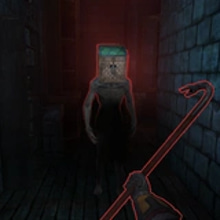
Combat here is not about feeling powerful. It is about getting out of a bad encounter still breathing. You find simple weapons and learn quickly that even crude tools matter. A heavy pipe lets you stun a crawling corpse just long enough to circle around it. A sharpened shard of metal can turn a desperate shove into a final blow. You do not walk into fights for fun. You fight when there is no other option, when a door is locked behind you and something hungry blocks the only exit. Those moments when you swing with your last bit of strength and actually win feel messy, noisy and very real.
Sometimes the smarter move is to run. Duck into a side passage. Slip around a pillar and let the undead shuffle past. Listen to their groans fade before you dare to move again. The game rewards that kind of caution. You start to see enemies not just as hit points but as moving puzzles. How close can you get without waking them. Which path lets you loop around instead of fighting three at once. That constant decision between confrontation and avoidance keeps your pulse a little higher than you would like.
Riddles in the dark and fragile clues 🧠🔑
Between combat and sneaking, The Warlock's Prisoner keeps dropping puzzles in your path. None of them feel like they were designed by a friendly game designer. They feel like the warlock is trying to prove a point. Doors locked by sigils that must be lit in a precise sequence. Statues that move when you are not looking. Mechanisms hidden behind walls that only respond if you place the right item in the right place.
You find scraps of information everywhere. A torn diary page that mentions three moons and one candle. A symbol scratched onto a bedframe that matches a pattern on the far side of the dungeon. At first, the clues seem disconnected. Later, when you are stuck in front of a door with no obvious key, those same fragments circle back in your mind and line up with a soft, awful click. The reward for paying attention is not just progress. It is the feeling that you outsmarted the warlock for a moment, and that feeling is addictive.
Of course, you will get puzzles wrong. You will pull the wrong lever, hear something heavy move in the dark and realise you just opened a path for the undead instead of a safe shortcut. You will misread a riddle, step on the wrong tile and trigger a trap that slams spikes out of the floor too close for comfort. The game makes those failures hurt just enough to stay in your memory, and that memory is what helps you solve the same kind of tricks later on.
The mirror that watches you back 🪞👁️
Somewhere in the warlock domain there is a mirror that is not just decoration. You can feel it before you find it. Rooms start reflecting light in strange ways, and shadows bend toward a direction that is not where the torch actually stands. When you finally step in front of that mirror, you see yourself, but the reflection is not quite right. The background shifts first. The cell behind you looks older or newer. The candles burn in a different pattern. Sometimes the reflection is delayed by a heartbeat, as if something on the other side is deciding whether to copy you or not.
The mirror becomes more than a creepy object. It is a mechanic, a clue board and a threat at the same time. Interacting with it can reveal hidden markings on the walls or show you paths that do not exist in the real corridor yet. But every use feels risky. Stay too long and the image seems to lean in, like the warlock himself is pressing against the other side of the glass to see what you will do. You start using the mirror in quick glances, snatching pieces of information and then stepping away before the air around it goes cold.
Later puzzles tie directly to the mirror. A sequence you must mimic, a figure in the reflection pointing at the one loose stone you never noticed, a moment where your mirrored self moves differently and you have to trust that version instead of your instincts. It is the kind of mechanic that gets under your skin, because you never fully trust what you are seeing again.
Tiny victories against a big darkness 🔦🗝️
What keeps you pushing forward in The Warlock's Prisoner is not a long list of stats. It is the accumulation of small victories. You remember the first time you slipped past an undead without letting it turn. The moment you solved a riddle with almost no health left and heard the heavy door unlock. The time you used a single item in two clever ways, first to distract a creature and later to complete a puzzle that seemed impossible from the start.
Those moments stack. At first you move like a scared prisoner, flinching at every sound. After a while, you start to feel more like a survivor who has decided that this dungeon is not allowed to keep you. That shift is subtle. You still get scared when something growls behind you. You still jump when a trap triggers unexpectedly. But between those spikes of fear, you see a calmer version of yourself emerging, someone who knows how far a torch will light the hall and how long you can run before stamina gives out.
The story grows quietly, through notes, environmental details and what the dungeon chooses to show you. You piece together hints about the warlock, about earlier prisoners, about the reason this place was built. None of it is comforting. All of it adds weight to your escape. You are not just trying to reach fresh air. You are trying to prove that whatever ritual the warlock started with you is going to fail.
Why this prison is so hard to walk away from 🎮💀
On Kiz10, The Warlock's Prisoner fits that strange itch for horror where you want to be scared but you also want to feel clever. It is not just jump scares and running. It is creeping through corridors, counting your steps, checking corners twice and smiling a little when you solve something the warlock clearly designed to make you panic. The mix of exploration, puzzle solving and fragile combat keeps each run tense without turning it into pure frustration.
You can drop in for a short session, explore a few rooms, grab some new clues and log out with one more piece of the puzzle in your head. Or you can stay longer, mapping sections of the dungeon in your memory, testing theories about how traps connect, and chasing that rush of finally opening a door that has mocked you for an hour. Every time you return, the question waits for you at the edge of the darkness. Will you escape this time, or will the warlock add one more restless soul to his domain.
If you enjoy horror adventures with survival elements, undead threats and puzzles that actually make you stop and think, The Warlock's Prisoner is the kind of game that will quietly keep you coming back. Light the torch, listen for footsteps, and keep one eye on the mirror. The dungeon is listening, and it is not used to losing.





 4.5 (155 votes)
 Share
Share
 Embed
Embed


