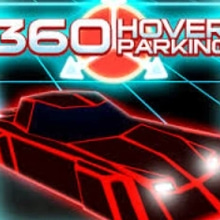
360 Hover Parking is the kind of driving game that looks calm until you realize it’s basically a mirror test for your patience. One moment you’re cruising like a champion, the next you’re inching forward at the speed of a cautious turtle, trying to line up your car perfectly while your brain whispers, don’t touch the cone, don’t touch the wall, don’t touch anything at all. On Kiz10.com, it lands in that satisfying precision zone where the thrill isn’t speed, it’s control. Smooth steering, gentle braking, clean angles, and that tiny “click” in your head when the vehicle settles into the parking space like it belongs there.
The big twist is in the name: 360. This isn’t a flat, one-camera parking challenge where you guess what’s happening behind you and hope for mercy. The game wants you to look around, to rotate, to actually understand the space you’re working with. That changes everything. Parking stops being a pure reaction test and becomes a spatial puzzle with wheels. You’re not only driving, you’re planning a route into a box while keeping your car’s corners safe, and your ego even safer.
There’s a special kind of pressure in parking games because mistakes feel personal. If you crash in a racing game, it’s chaos, noise, reset. If you scrape a wall in a parking game, it feels like you just ruined a perfect suit with a coffee spill. In 360 Hover Parking, you’ll catch yourself slowing down more than you think you should, because the game teaches you quickly that precision beats bravery. The car might feel floaty or “hover” smooth, but the environment doesn’t care. The parking bay is a strict judge with no sense of humor.
The best part is how the camera control turns into a skill of its own. At first you’ll spin the view too much, over-checking angles like you’re trying to prove you’re responsible. Then you’ll under-check and clip an obstacle you swear wasn’t there. Eventually you find a rhythm: rotate, set alignment, commit to a gentle entry, correct with tiny steering taps, and finish with a clean stop. When you get that rhythm, the whole game becomes oddly relaxing, like a tiny meditation where the mantra is “slow is fast.” 😅
And yes, there will be moments where you do everything right… and still feel like the car is slightly off-center. That’s when the game becomes dangerously addictive. You start chasing the perfect park, not just a pass. You’ll reverse a little, re-angle, pull forward, straighten again, and you’ll do it because you can feel the difference between “good enough” and “chef’s kiss.” A great parking simulator doesn’t just ask you to reach the bay, it invites you to master the bay.
The level layouts tend to lean into tight spaces, awkward approaches, and those annoying spots where the entrance angle is the entire challenge. Straight-in parking is easy; the game knows that. The real fun is the bay that sits behind a turn, or the path that forces you to approach from a weird side, or the obstacle placed exactly where your rear corner wants to swing. That’s where you start thinking like a real driver: set your angle early, don’t oversteer, and treat the car’s back end like it has a mind of its own. Because it kind of does.
What makes 360 Hover Parking feel modern is that hovering, gliding sensation. It’s less about gritty realism and more about clean movement, like the game wants the driving to feel smooth while the challenge comes from the geometry. You’re sliding through space, almost floating, but still dealing with hard limits. That contrast is fun. It’s like being given a sleek, futuristic car and then being told to park it in a space designed by someone who hates you. 🅿️😭
A sneaky part of parking games is how they train your attention without you noticing. You start paying attention to the car’s nose, then you learn the rear matters more. You begin noticing the turning radius. You learn that tiny corrections are stronger than big corrections. You stop “fixing” mistakes mid-turn and start preventing mistakes before they happen. That’s real progress, and it feels great because it’s visible. Your runs get cleaner. Your corrections get fewer. Your final alignment looks intentional instead of accidental.
If you want to play well, treat each attempt like a short sequence, not a single action. Step one: rotate the camera and actually study the parking bay. Step two: choose an approach line that keeps your swing wide enough. Step three: enter slowly, because speed doesn’t save you here, it only makes your mistake arrive faster. Step four: straighten earlier than you think, because late straightening is how cars end up diagonal like they’re protesting the concept of parking. And step five: stop cleanly. Not “kinda in.” In.
And when you fail, the good news is that parking games tend to make failure informative. You immediately see what went wrong. You turned too sharp. You approached too tight. You rotated the camera too late. You tried to correct while already committed to a bad angle. That means every retry isn’t a grind, it’s a quick lesson. Over a short session on Kiz10.com, you can actually feel your skill improving. The game starts as a test and becomes a flow.
360 Hover Parking is perfect if you enjoy precision driving, parking simulators, and those satisfying “I did it clean” moments. It’s not loud. It doesn’t need explosions. Its big reward is the calm confidence of pulling into a tricky space, perfectly aligned, with no bumps, no drama, and a finish that looks professional. And then, of course, you’ll do that dangerous thing where you say “last level” and immediately click again because you want one more perfect park. 🚗✨





 Share
Share
 Embed
Embed


