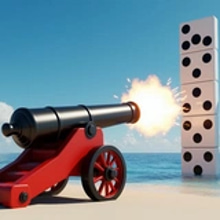
There is a special kind of silence that happens right before you fire the first shot. The cannon sits in front of you, a neat line of dominoes waits in the distance, and the level looks harmless for exactly one second. Then your brain starts asking questions. How hard should you pull the shot. Which angle will hit the first tile just right. Will the whole chain collapse in one glorious cascade or will a single stubborn piece stay standing and ruin your perfect run. A gun. Domino destruction. lives inside that tiny moment.
The concept sounds almost too simple. You have endless cores, a sturdy cannon, and a playground full of stacked tiles, blocks, and domino structures. Your only job is to knock every last piece to the floor. No time limit screaming at you, no complicated controls, just pure cause and effect. Put a core in the cannon, aim, fire, watch what happens, adjust, and try again. It feels strangely relaxing and weirdly intense at the same time, like popping bubble wrap while someone keeps score.
Domino cascades and clean hits 🎯
Once you fire the first core you understand that this is not just a mindless shooter. Every level is built around a chain reaction waiting to happen. Hit the lead domino at the right height and you get that satisfying ripple where tile after tile falls exactly in order. Miss by a little and the chain stutters, leaving a lonely survivor glaring at you from the far end of the setup. You can almost hear it asking seriously, that was your best shot.
The game rewards players who learn to see the invisible lines beneath the layout. A low hit might send the first row tumbling but leave a raised platform untouched. A higher shot might bounce a core into a side structure that tips everything at once. Some stages hide clever paths for energy to travel, using ramps, blocks, and stacked shapes to make the collapse feel like a tiny puzzle in motion. The fun comes from that small moment when you realise exactly which piece you need to strike to make everything fall.
Learning the language of angle and power 🧠
Controls stay friendly. You drag to set your aim, pull to feel the strength in the shot, and release when your nerves finally say yes. The important part is what happens in your head between those steps. After a few levels you stop firing randomly. You notice distances. You remember how far a medium strength shot travels. You recognise that a steep angle will arc the core upward before it drops into the structure.
Slowly you start treating each attempt like a test in geometry you actually want to pass. Where will the core land if you raise the muzzle just a little. How much force do you need if the first row is close but the vital domino sits higher up on a shelf. You start aiming at corners of platforms instead of the middle. You clip edges on purpose, hoping for ricochets that turn a single impact into a whole shower of chaos. When one of those trick shots works, it feels less like luck and more like you just spoke the physics language correctly.
Levels that nudge you into experiments 🎲
Early stages are generous and almost polite. A single stack of dominoes stands in full view, begging to be toppled. You can fire carelessly and still clear the level. Once the game knows you understand the basics, it begins to play with your expectations. Dominoes hide behind walls or sit behind small barriers. Some chains require you to hit a swinging object that will then crash into the tiles. Others place fragile support blocks under tall structures so that a shot at the base brings the entire tower down.
Instead of telling you exactly what to do, A gun. Domino destruction. invites experiments. Maybe you decide to shoot through a thin plank to reach the dominoes behind it. Maybe you try to knock a heavy cube sideways so it crushes several lines at once. Sometimes your ideas fail in spectacular slow motion, sending pieces flying but leaving one annoying tile still standing in a corner. You sit there for a second, half laughing, half annoyed, and then start rethinking your plan. That back and forth between inspiration and correction keeps the game lively.
The joy of endless ammo and clever failures 💥
Because you have an endless supply of cores, failure never feels final. Run out of clever ideas for one level and you can burn a few shots just to see what wild things the physics will do. You might discover that a direct hit on a certain block makes it bounce in a way you did not expect, or that a glancing shot across the top row sends tiles spinning farther than a straightforward impact.
Those unexpected reactions are half the charm. Maybe a core clips the corner of a domino and ricochets into a second stack you had not even planned to touch yet. Maybe you barely nudge the structure, only to watch it wobble for an uncomfortably long time before collapsing anyway at the last moment. These little surprises make each level feel like a miniature experiment instead of a strict exam. You are not just playing to win. You are playing to see what funny disaster you can cause next.
Calm focus with a bit of chaos 😄
Visually the game keeps things clean so your eyes can focus on the important parts. Dominoes stand out clearly against simple backgrounds. The cannon and cores are easy to read, and impacts feel strong without becoming visually overwhelming. The soundtrack and sound effects add to the mood without fighting for attention. The strongest audio moments arrive when pieces start to fall, that familiar clack and tumble of tiles piling into one another in waves.
The pace is whatever you want it to be. Some players will fire shots quickly, treating each level like a rapid challenge and clearing stages in fast bursts. Others will take a slower approach, lining up each aim carefully, watching replays in their head before committing. Both styles work because the design never punishes you with harsh timers. You are free to enjoy the simple pleasure of knocking things down at your own rhythm.
Perfect for short sessions on Kiz10 🎮
A gun. Domino destruction. fits naturally into the kind of quick play sessions that work so well on Kiz10. Each level is compact, with clear goals and instant feedback. You can load the game, clear a handful of stages, and close the tab feeling like you actually completed something, rather than leaving a huge quest unfinished. That makes it a great choice when you want a focused physics puzzle instead of a long grind.
At the same time, the progression gives you a reason to stay. New layouts keep arriving, each one introducing a slightly different trick. One level might lean on height, with tall stacks and dramatic falls. Another might emphasize distance, forcing you to arc shots across wide gaps. A later challenge might use tight enclosed spaces where only perfectly placed hits can reach the dominoes inside. Every fresh twist asks the same question in a new accent. Can you still find the one shot that brings everything down.
Why this domino shooter is so satisfying ⭐
There is something timeless about watching connected pieces collapse in sequence. The game taps into that universal fascination and adds just enough skill on top. You are not merely pressing a button that plays a prebuilt animation. You are the spark that decides where the chain starts, how strong it begins, and whether it reaches the final tile. When everything goes right, the fall looks beautiful. When something goes wrong, you know exactly which decision you want to change next time.
If you enjoy physics games that mix aim, timing, and chain reactions, A gun. Domino destruction. feels like a perfect match for your Kiz10 playlist. You get the satisfaction of accurate shots, the pleasure of watching clever setups crumble, and the freedom to experiment without pressure. Put a core in the cannon, breathe for a moment, and send it flying. Somewhere in that tumble of falling tiles is the exact kind of destruction your brain has been waiting to see.



















 Share
Share
 Embed
Embed