🌙 A nightmare with homework, guilt, and very bad vibes
Being Her Darkest Friend is not loud about what it is. It does not kick the door down with explosions or dramatic boss fights or some guy yelling that the world is ending in twelve seconds. It starts in a more dangerous way: quietly. A little too quietly. On Kiz10, the game is presented as a pixel-art nightmare adventure where Selina is trapped inside one of her own bad dreams, solving puzzles, trying to impress a teacher, and uncovering more about herself so she can wake up. That premise alone already feels slightly off in the best way, because it blends school anxiety, dream logic, and personal mystery into one uneasy little package. It is a puzzle adventure, yes, but it also feels like rummaging through someone’s private thoughts with a flashlight that keeps flickering.
That tone matters. A lot. Being Her Darkest Friend works because it understands that fear is not always about monsters jumping out of closets. Sometimes it is about embarrassment. Sometimes it is about memory. Sometimes it is about feeling trapped in a situation that should be normal, except everything is tilted just enough to feel wrong. A hallway can feel hostile. A conversation can feel like a trap. A simple task can suddenly carry the weight of a confession. This game leans into that sort of emotional weirdness, and the result is much more memorable than a generic horror setup full of noise and fake danger.
🕯️ Selina’s dream world is messy in a very human way
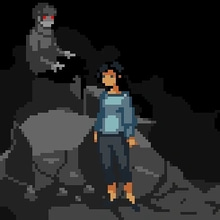
What really pulls you in is the atmosphere. The pixel art gives the whole experience a strange softness, but not a comforting one. More like an old memory you cannot fully trust. Shapes are simple, rooms feel intimate, and people look harmless right up until the moment they absolutely do not. There is a deliberate tension in that contrast. The game never has to scream to be unsettling. It just lets normal things sit there long enough for your brain to start asking suspicious questions.
And honestly, that is exactly the kind of mood this game needs. Because Being Her Darkest Friend is not about brute survival. It is about navigating Selina’s inner storm. Kiz10’s description hints at this clearly: the game is not only about escaping the nightmare, but also about discovering more things about Selina herself. That makes the journey feel personal instead of random. The puzzles are not just obstacles sitting in the way because video games are contractually obligated to place objects in your path. They feel connected to identity, to confusion, to insecurity, to the kinds of thoughts that get louder at night when your room is dark and your brain refuses to behave.
There is something deliciously uncomfortable about that. You are not just unlocking doors. You are peeling back layers. You are clicking through a dream that behaves like it knows more about its main character than she wants to admit.
🧩 Puzzles, awkward truths, and that one click that changes everything
The gameplay has that classic point and click pulse. You explore, inspect, test, combine, and occasionally stare at the screen with the face of someone who knows the answer is nearby but not where. Not yet. The puzzles are woven into the world in a way that feels natural for a dream game. That is the important part. In a stranger, colder game, a puzzle can feel mechanical. Here, it feels emotional. A locked path is not just a locked path. It is resistance. A clue is not merely a clue. It is a strange little crack in the dream’s surface.
Because the logic is dream-flavored, the game gets to be playful with expectations. Not unfair, just odd in a very deliberate way. You stop relying on rigid game habits and start paying attention to tone, context, and the feeling of a room. That shift is where the fun lives. You begin by solving problems. Then, somewhere along the line, you start reading the nightmare itself like it might be trying to confess something.
That makes every small breakthrough feel bigger than it should. Find the right object, say the right thing, trigger the right event, and suddenly the atmosphere changes. A room feels different. A character feels more suspicious. A harmless detail becomes loaded. The game is very good at those tiny pivots. It lets the tension build in fragments instead of giant obvious set pieces. One second you are following the rules. The next you realize the rules were only pretending to be rules.
🎭 School pressure has never looked this haunted
One of the smartest things about Being Her Darkest Friend is how it uses ordinary pressure as part of the horror. According to Kiz10’s own summary, Selina is trying to impress one of her teachers while moving through the nightmare. That detail sounds almost mundane at first, but in this kind of setting it becomes weirdly sharp. School stress in real life already has a surreal quality sometimes. Expectations. performance. awkward social tension. the constant background fear of doing the wrong thing at exactly the worst possible moment. Put all of that inside a dream, then add puzzles and creeping unease, and suddenly you have a much richer emotional texture than a standard spooky adventure.
That is probably why the game sticks. It feels personal in small, irritatingly accurate ways. Even when the nightmare drifts into stranger territory, there is still something relatable under the surface. Selina is not fighting dragons or saving a continent. She is trapped in a psychological mess where identity, pressure, and fear have blurred together into one haunted puzzle box. That is a very different kind of tension, and it gives the whole story a strange intimacy.
Also, let us be honest, there is something deeply effective about dream logic mixed with school logic. Both are irrational. Both can ruin your day. Both are full of corridors.
🖤 Why the game feels more intimate than flashy
Being Her Darkest Friend does not try to overpower you. That is part of its strength. It is not obsessed with spectacle. It wants you close. It wants you paying attention. It wants you to notice the mood of a room, the weird timing of an interaction, the small emotional bruises hidden inside its dialogue and imagery. That makes it feel handcrafted. Smaller, yes, but also sharper.
The pixel presentation helps. Kiz10 explicitly highlights the “fantastic pixel graphics,” and they really are important to the identity of the game. Pixel art in horror or surreal puzzle adventures does something special: it leaves just enough space for your imagination to participate. A fully detailed face tells you everything. A pixel face lets your brain make it worse. And brains, sadly, are very talented at making things worse.
It also gives the game a strange old-dream quality, like something you found hidden inside a forgotten folder on a computer that hums too loudly at night. That atmosphere suits the story perfectly. Nothing feels polished in a sterile way. It feels textured. Lived in. Slightly damaged.
🌫️ A dream you want to escape, but not too quickly
On Kiz10, Being Her Darkest Friend fits beautifully for players who love browser puzzle games, pixel adventures, point and click stories, and nightmare-flavored mysteries that care more about mood than brute-force scares. The official page frames it as a dream escape full of puzzles and personal discovery, and that combination is exactly what makes it stand out.
If you enjoy games where the unease creeps in slowly, where every room feels like it has a secret tucked under its tongue, and where the main mystery is tied to a character’s inner life instead of a random villain, this one has real pull. It feels awkward, haunted, thoughtful, and just strange enough to keep you leaning forward.
Being Her Darkest Friend is not trying to be the biggest game in the room. It is trying to be the one that lingers after the screen goes dark. The one that leaves behind a few unanswered feelings. The one that makes you think about dreams, memory, school pressure, and the odd little terrors people carry around without saying them out loud.
And really, that is much creepier than a monster with claws.





 Share
Share
 Embed
Embed