🛞🍽️ A toy car, a table, and a terrible idea that works
Car on the Table has one of those wonderfully direct names that instantly paints the whole situation in your head. There is a car. It is on a table. That already feels slightly wrong, which is a very good start for a browser driving game. Because the moment a tiny vehicle leaves the safe logic of roads and ends up racing across a desktop or tabletop full of random objects, the whole experience becomes more playful, more unstable, and way more fun than it has any right to be.
Kiz10’s live page describes it exactly in that spirit: a funny race on the desktop with a toy car where you collect all the coins in each level and dodge the objects. That summary is simple, but it quietly reveals everything that makes the game click. This is not about realistic driving. This is about miniature chaos. It is about speed in a place that was never meant to be a racetrack. It is about turning ordinary objects into obstacles, ramps, hazards, and tiny disasters waiting for one bad turn.
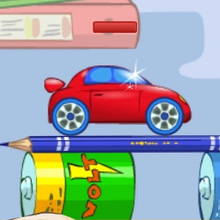
And honestly, that setup is brilliant. Regular racing games have highways, circuits, cities, dirt tracks. Car on the Table gives you everyday clutter and asks you to survive it with style. Suddenly a pencil, a cup, a book edge, or some random tabletop junk has more dramatic energy than an entire highway. That kind of scale shift gives the game its identity. You are not a powerful driver tearing through a giant world. You are a small one trying to stay alive in a world that looks normal until it absolutely does not.
🪙 Coins first, dignity later
The coin-collecting part is what turns Car on the Table from a neat little driving gimmick into a proper arcade challenge. Reaching the end would be one thing. Reaching the end while collecting every coin? That is where the greed kicks in, and greed always improves level design when used correctly. Kiz10’s description specifically points out that you must collect all the coins in each level while dodging objects, which means completion is not just about survival. It is about route quality.
That changes everything.
Now the table is no longer just a dangerous place to drive. It becomes a puzzle of movement. Which line gets the coins without smashing into clutter? Which risky route is worth it? Which safe path suddenly feels cowardly because there is a shiny coin trail calling your name from the dangerous side of the room? This is exactly how arcade driving games get under your skin. They give you a clear objective, then layer temptation all over it.
And toy-car games make that temptation even better because the environment feels so oddly personal. Missing a coin on a racetrack is fine. Missing a coin because you misjudged the gap between a mug and a stapler? That feels ridiculous in a way that is somehow more memorable. The tabletop setting turns every mistake into a tiny comedy scene. One second you are in control. The next second your car is pinned against some innocent household object that had no business becoming a major gameplay enemy.
📚 Ordinary objects become monsters
This is where Car on the Table gets its real flavor. The setting is not only decorative. It actively changes how the game feels. A normal room should be harmless. A table should be safe. But once you shrink the race down and put a toy car in the middle of that space, the most ordinary things suddenly become giant obstacles with attitude.
That is such a good trick.
A stack of books can feel like a wall. The edge of the table becomes a cliff with immediate emotional consequences. A cup might as well be a pillar from an ancient temple. The whole room stops behaving like background scenery and starts behaving like a track designed by someone who enjoys watching tiny vehicles panic. That playful exaggeration is exactly what gives the game its charm.
And because the car is small, every movement feels just a little more fragile. You are not bulldozing through the environment. You are navigating it. That means control matters. Precision matters. Judging distance matters. It also means the player is constantly switching between two instincts: the desire to go faster and the fear of launching off the table like a tiny plastic missile. Great tension. Very healthy for replay value 😅
⚖️ Speed matters, but control matters more
A lot of miniature driving games use speed as the headline, but the real skill usually lives somewhere quieter. Car on the Table should feel exactly like that. Yes, it is a race, and yes, fast movement is part of the thrill, but when you are driving across a cluttered tabletop, raw speed is only half the story. The other half is control. Tiny corrections. Clean turns. Knowing when to push and when to stop pretending you are invincible.
That balance is what makes the game more interesting than a straight line sprint. You are managing a toy car in an environment where objects are closer, lanes are stranger, and mistakes look much sillier. Every level becomes a small negotiation between momentum and caution. Go too slow, and the challenge loses its spark. Go too fast, and the table starts collecting your failures.
Kiz10’s broader driving catalog supports this kind of gameplay well. The site groups together driving games built around handling, obstacle avoidance, and balance rather than only pure speed, which places Car on the Table naturally in a more arcade-precision lane.
And that feels right. This is the kind of driving game where surviving the route cleanly is more satisfying than blindly flooring it. The best runs are not only the fastest ones. They are the ones where you collect everything, avoid the clutter, and make the table look less dangerous than it really is.
🧸 Why toy-car games are weirdly addictive
There is something about miniature vehicle games that always makes them more replayable than expected. Maybe it is the scale. Maybe it is the absurdity. Maybe it is the way familiar spaces become obstacle courses when viewed through toy-car logic. Whatever the reason, these games are excellent at creating that “one more try” mood.
Car on the Table fits that pattern perfectly. Kiz10’s page frames it as a toy-car desktop race with coin collection and object dodging, and that formula has exactly the right kind of stickiness. It starts simple, but each level invites cleaner movement, smarter routes, and fewer embarrassing crashes.
You tell yourself the next run will be smoother. You will grab all the coins this time. You will not clip the same stupid obstacle again. You will definitely not drive off the edge like a cartoon. Then the level begins, one weird tabletop turn appears, and suddenly your confidence has to negotiate with reality all over again.
That is the good stuff. Not giant drama. Not complexity for its own sake. Just a focused little driving game that understands how to make simple goals feel personal.
🏁 Why Car on the Table fits Kiz10 so well
On Kiz10, Car on the Table makes complete sense because the site already hosts toy-scale and physics-flavored driving games in similar spaces. Desktop Racing 3 is another Kiz10 title built around miniature cars on desks and crazy household-style surfaces, while newer entries like Burning Wheels Kitchen take toy cars into oversized everyday settings. That confirms Car on the Table belongs to a proven Kiz10 niche: small vehicles, oversized objects, and arcade driving through environments that were never meant to be race tracks.
That niche works because it blends speed with visual humor. The player gets the thrill of racing, but through a setup that feels playful rather than serious. Car on the Table captures that beautifully. A toy car, a tabletop, some coins, too many objects in the way, and a constant sense that one careless turn will turn the whole thing into a tiny plastic tragedy.
So yes, Car on the Table is a driving game. But more than that, it is a scale-shift adventure. It takes a familiar room, shrinks your world down to toy-car size, and turns everyday clutter into a full obstacle course. That is why it works. It feels light, fast, funny, and just dangerous enough to keep your hands honest. And once you start chasing cleaner runs across that ridiculous tabletop, it becomes very hard to leave the car parked.



 4.6 (25 votes)
 Share
Share
 Embed
Embed


