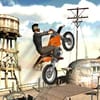
Dirt Bike 3D is one of those games that looks harmless for the first few seconds and then suddenly you realize you’re holding your breath while your bike hangs in the air over a gap 😅. You’re on a motocross-style machine, the track is floating or twisting in front of you and every jump can be the one that sends you back to the start. There’s no crowd, no commentator, just you, your bike and a long line of tricky platforms waiting to see if you mess up.
The idea is simple enough. You start at the beginning of a 3D circuit, hit the throttle and try to ride all the way to the finish flag. Between those two points there’s… a lot. Narrow beams, steep ramps, sudden drops, weird bumps that throw the bike off balance and obstacles that feel like they were placed there purely to bully you. If you fall, the game doesn’t negotiate: you restart the level and try again from scratch. That “all or nothing” style makes every meter feel important. 🏁
Controls are straightforward, but they still give you enough to think about. You steer the bike left and right, control your speed and adjust your balance in the air. Go too fast into a corner and you slide off. Go too slow up a ramp and you won’t clear the gap. The bike reacts with light arcade physics: not ultra realistic, but real enough that you can feel when you’ve committed to a bad jump the moment the wheels leave the ground. There’s a little “oh no” moment in your head as the bike tilts the wrong way. 😬
Because the game is in 3D, you see the track stretching out in front of you with full depth. That helps a lot when reading upcoming obstacles. You can see a big ramp from far away and mentally prepare for it, maybe slow down a bit so you land on the next platform instead of overshooting it. On other stages, the path snakes around with tight turns that only really make sense when you’re inside the level, learning it corner by corner. That process of recognizing a section and doing it cleaner on the next try is where a lot of the satisfaction comes from.
The stunts are not just decoration; they’re part of how you move. When you launch off a ramp, small tilts forward or backward change how you land. A controlled forward lean can help you hit the downslope smoothly, while a bad angle sends you bouncing sideways or straight into a crash. Sometimes you’ll throw in a little style just because it feels cool to see the bike twist in the air, but even then you’re always thinking about the landing. Flashy is fun, but if you don’t stick the landing, the track doesn’t care. 😎
Difficulty ramps up in that quiet, sneaky way. Early levels teach you basic things: don’t drive off the edge, take it easy on steep ramps, use the brakes. Then the circuits start adding weird combinations. A jump followed by a small platform, immediately followed by another jump. A floating beam with no guard rails on either side. A section where you have to slow down on purpose even though every instinct tells you to go faster. The game never needs a long tutorial text to explain anything. The track itself becomes the teacher.
Because falling means restarting, your mindset changes as you get deeper into a level. At the beginning, you might go full speed, just having fun. When you reach a hard section after thirty or forty seconds of riding, you suddenly become cautious. You check your angle twice, reduce speed, try to be clean instead of brave. And of course, sometimes the game punishes that fear with an awkward half-jump that doesn’t make it. Then you reload, sigh, and swear you’ll ride more confidently on the next attempt. 🔁
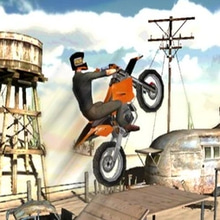
Visually, Dirt Bike 3D is all about clarity. The bike stands out from the track, the obstacles have shapes and colors that you can read quickly and the sky or background doesn’t distract you. That makes it easier to focus on the important stuff: edges, landings, ramps and any object that your front wheel really should not touch. The 3D view also helps you feel the height of certain jumps. Looking down from a high platform at the thin path below gives a tiny shot of fake vertigo that fits perfectly with a stunt game. 🌄
The sound and overall feedback help sell the ride. Engine noise responds to your speed, and the moment wheels hit the ground you get that small audio cue that tells you if the landing was smooth or rough. Crashes have a very clear sound too, and after a while you can almost hear them in your head before they happen. A badly angled jump usually “sounds wrong” before the game even plays the crash effect. You start to recognize danger with your ears as much as with your eyes.
What makes Dirt Bike 3D work well as a Kiz10 game is how easily it fits into short or long sessions. You can jump in, try a couple of levels, fail a few times and leave. Or you can get stuck on one especially nasty track and refuse to quit until you finally ride it perfectly from start to finish. There’s no long story to remember, no menus full of complicated options. You load, ride, crash, learn, repeat. That loop is simple, but it’s exactly the kind of loop that keeps stunt fans coming back.
Over time you build a small set of personal rules. Don’t accelerate blindly after a blind corner. Always check what’s after a ramp before going full speed. Use small corrections in mid-air instead of giant panic tilts. Tap the brake as a friend, not as a last resort. Those little lessons are not written anywhere in the interface, but you feel them. Each new level becomes a test of whether you actually learned anything from the last one or just got lucky. 🧠
For players who like dirt bike and motocross games, Dirt Bike 3D is a nice mix of challenge and accessibility. The 3D view makes tracks feel bigger, but the controls keep everything manageable even if you’re not a hardcore racing fan. If you enjoy doing risky jumps, threading your bike between obstacles and getting that small rush when you finally clear a section that looked impossible the first time, this game fits right into your Kiz10 favorites list. Just be ready to restart more than once… or twice… or ten times. That’s part of the fun. 🏍️💥



 4.7 (57 votes)
 Share
Share
 Embed
Embed