🛞😵💫 THE FIRST SECOND FEELS SAFE, THEN THE VEHICLE BETRAYS YOU
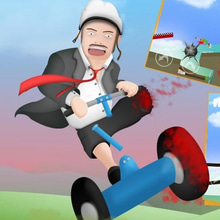
Happy Rider Wheels is one of those games that smiles at you like it’s friendly, then immediately turns the road into a comedy trap. You start with a rider and a vehicle that looks manageable, almost polite, and then the physics kicks in and you realize you’re not “driving” so much as negotiating with gravity. On Kiz10, this is a ragdoll physics driving challenge built around a simple dream: reach the finish. The catch is that your rider behaves like a loose puppet the moment the wheels touch anything uneven, and the course is basically made of uneven things. So yes, you’ll crash. A lot. The good news is that the crashes are part of the fun, and the best victories feel like you didn’t win a race, you survived a prank.
The core thrill is the fragile balance between control and chaos. You do have agency, which makes every mistake feel like it belongs to you (annoying), but the physics is wild enough that every bump can turn into a chain reaction. A tiny tap becomes a wobble. The wobble becomes a tilt. The tilt becomes a slow-motion “no no no” moment where you can see the disaster arriving but you still can’t stop it. That’s Happy Rider Wheels in a sentence: you are constantly one mistake away from a highlight reel you did not ask for.
🚗💀 IT’S NOT A RACE, IT’S AN OBSTACLE SURVIVAL TEST
If you try to play this like a normal racing game, you’ll suffer immediately. The track isn’t designed for speed-first thinking. It’s designed to make you choose between momentum and stability. Sometimes you need speed to climb a slope or clear a gap. Other times speed is exactly what flips you into a trap. The game keeps forcing that decision again and again, and that’s why it feels tense even when the controls are simple. The road asks questions quickly. Your vehicle answers loudly.
The hazards do the heavy lifting. You’ll run into ramps that look harmless until they launch you at a terrible angle. Drops that seem safe until your landing bounces and you lose control. Narrow sections that punish over-steering. Little bumps that don’t look like anything but somehow turn into a full flip. The funniest deaths are the ones caused by tiny stuff, because you’ll be thinking about the big trap ahead and then your wheel clips a small edge and your run turns into slapstick.
And it’s not only the obstacles. It’s the recovery. In a physics game, surviving the jump is step one, surviving the landing is step two, and surviving the recovery wobble is step three. Many players do step one perfectly and still lose on step three because they panic-correct. Happy Rider Wheels loves panic-corrections. It eats them for breakfast 😅.
😈🛑 THE GAME TEMPTS YOU INTO GREED
There’s a moment that always happens. You get a clean stretch, you feel confident, and your brain goes “I can full-send this.” That thought is dangerous here. Full-sending works sometimes, which is what makes it such a trap. You’ll have a run where you blast through a ramp and land clean and you feel like a genius. Then you try it again on the next ramp, and the landing is slightly different, and suddenly you’re upside down wondering why you trusted the universe.
The game is basically a personality test. Are you patient? Do you get excited and rush? Do you keep trying to brute force sections that clearly want finesse? The track is built to punish impatience in silly ways, but it also rewards calm control with this nice “flow” feeling where you’re gliding over hazards smoothly, keeping balance, and moving forward like you actually meant to do that.
🧠🛞 RAGDOLL PHYSICS THAT ARE FUNNY BUT STILL SKILL-BASED
The ragdoll element is what gives the game its identity. Your rider is not a stiff animation. The body reacts to impacts, tilts, and landings in exaggerated ways, and the comedy comes from how dramatic those reactions are. But there’s skill under the comedy. You can learn how to keep your rider stable. You can learn what angles are safe. You can learn how to “land flat” instead of landing on a corner and letting the physics spiral.
This is where the game becomes addictive. You’re not just laughing at crashes. You’re trying to crash less, or at least crash in a way that still lets you continue. The best players aren’t the ones who never wreck, they’re the ones who recover. They land weird, wobble, stabilize, and keep rolling. That recovery skill is basically the hidden progression system. Your hands start making smaller corrections. Your timing improves. Your confidence becomes practical instead of reckless.
🧩🚧 THE TRACK IS A PUZZLE MADE OF RAMPS AND REGRET
Even if the game looks chaotic, most sections have a “correct” approach. Not always one correct approach, but a reliable one. That’s why repeating attempts feels useful instead of pointless. You start reading the terrain like a puzzle. That ramp is safe if you approach straight. That drop is fine if you don’t accelerate mid-air. That narrow area is easier if you enter centered and avoid tiny steering flicks. The game teaches you through consequences, and the lessons stick because the consequences are usually hilarious.
You’ll also notice that many problems are solved by doing less. Not always, but often. Players tend to over-control in physics games. They see a wobble and they overreact. They steer hard, they accelerate hard, they try to “fix” the moment aggressively, and the physics punishes the aggression. The smart fix is gentle. A small correction early is better than a big correction late. Late corrections are violent. Early corrections are calm.
🎮😅 THE RESTART LOOP IS THE REAL DANGER
Happy Rider Wheels is perfect for Kiz10 because it respects your time. You crash, you restart, you’re back quickly. That instant loop makes it hard to quit because every failure feels like it was one tiny decision away from success. And because the game is funny, failure doesn’t feel like a wall. It feels like a joke you want to beat. You start saying things like “okay, now I know,” and you do another attempt, and another, and suddenly you’ve been playing far longer than you planned.
The best part is the emotional rollercoaster inside a single run. You’ll be calm, then panicked, then confident, then instantly humbled. It’s ridiculous, but it’s also satisfying when you finally clear a section that bullied you for ten attempts. That moment feels like you solved the track’s attitude.
🔥🏁 HOW TO GO FARTHER WITHOUT TURNING IT INTO A SLOW CRAWL
If you want better runs, focus on smooth inputs. Avoid sudden steering flicks unless the obstacle truly demands it. Use acceleration like a tool, not a habit. Many sections are easier if you let momentum carry you rather than forcing speed every second. When you land after a jump, give the vehicle a brief moment to settle before you correct hard. That tiny pause prevents the classic “landing wobble into flip” chain reaction.
Also, approach ramps straight. Angled ramps are where runs die. If you’re slightly diagonal, your landing becomes sideways, and sideways landings become spins. Keep the vehicle aligned before you launch. And don’t chase the perfect “fastest” line when you don’t know the section yet. Learn the safe line first. Then, once your hands understand the terrain, you can start pushing speed and getting fancy.
Happy Rider Wheels on Kiz10 is a ragdoll driving game that’s equal parts skill challenge and physics comedy. You’re not here to look elegant. You’re here to survive absurd obstacle tracks, manage unstable vehicles, and reach the finish while the game tries to turn you into a rolling disaster. And when you finally do reach the end, it feels less like a win and more like an escape you personally earned 😵💫🛞✨















 3.9 (47 votes)
 Share
Share
 Embed
Embed