The night was only supposed to be about bad acting and fake blood. A new camcorder, a group of friends, a half written script and a cheap plastic mask. That is all it takes to start Knife Man on Kiz10, and somehow it is enough to make your stomach twist before anything actually goes wrong.
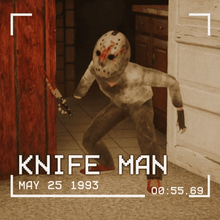
You are not the hero holding the knife. You are the one behind the lens. Every second of the game flows through the tiny viewfinder of a late 90s camera, tape rolling, red REC icon burning in the corner, grain crawling across the image like static snow. You are the person whose job is to “just film everything,” the invisible friend who sees the scene from the outside. And when the horror starts to slip from play acting into something sharper, you realise being behind the camera does not mean you are safe.
🎬 A home made horror script you have to shoot yourself
Knife Man is built like a low budget slasher set that never wraps. Your friends treat the whole thing as a fun weekend project. Somebody is directing, somebody is complaining about lines, somebody else is already wearing the costume before the first scene is blocked. You walk through living rooms, backyards and dim hallways with the camera up, framing your friends as they rehearse and improvise.
The story they are trying to tell is simple enough. A masked killer, a group of teens, a night that goes sideways. You hear them argue about angles and ideas, about whether a certain shot will look “scary enough” when they play it back. That casual chatter makes everything feel safe. Familiar. Normal.
But you are the only one who sees everything through the lens. You notice when something is off in the background. You catch shapes that nobody else seems to react to. Was that shadow by the door part of the plan Did someone move that prop between takes Or did the house just decide to rearrange itself You keep filming because that is what you are supposed to do, even when your gut whispers that the movie might not be the only horror being recorded.
📼 VHS grain, late 90s suburbs and analog unease
The whole game is drenched in nostalgia and discomfort at the same time. The image is soft, a little blurry, with scan lines and color bleed that shout “old tape” louder than any logo could. Light sources bloom too much, dark corners swallow detail, and every fast movement leaves a smear across the frame that makes your eyes work harder than they want to.
Environments feel like places you could actually have filmed in the 90s. A cluttered bedroom with posters peeling at the edges. A kitchen with harsh fluorescent lights. A garage full of boxes, tools and shadows that give you way too many hiding spots for a killer who is supposed to be “just acting.” The game leans into the mundane and lets the horror seep into it slowly.
The VHS filter is not just cosmetic. It becomes part of the tension. When your only view of a hallway is a noisy, low resolution image, your brain starts filling gaps with things that might not be there. Every patch of static could be a glitch or a clue. Every dark doorway might be empty or waiting. You are never entirely sure, and that uncertainty is exactly what the game wants.
🎛️ Directing chaos from behind the camera
You are not a passive witness. You are the camera operator and, in a strange way, the director. The game constantly asks you to make decisions about framing and timing. Do you stay close to your friends while they act out a scene, or do you step back to capture the whole room Do you keep the killer in the center of the frame, or do you pan slowly to reveal something they have not noticed yet
Basic actions like walking, running, jumping and crouching all become tools for cinematography. You duck to get a low angle that exaggerates a figure. You climb onto a chair to see over everyone’s heads. You lean into doorways to grab one more second of footage before you follow the group. Everything is filtered through the idea that you are making a movie, even when you are clearly just trying not to freak out.
Then there is zoom. A small wheel, a quiet whir, and suddenly the world feels both closer and much more dangerous. Zooming in on a face makes every expression feel heavy, like you are hunting for signs that something is wrong. Zooming in on the darkness at the end of a corridor feels like inviting trouble on purpose, challenging the game to show you something you do not want to see.
🔍 Record, preview, and the fear of what you might have missed
Knife Man plays a clever trick with its recording system. You do not just film and move on. You can pause the chaos, preview your footage and see how the scene actually turned out on tape. It sounds like a production feature, a convenience for a perfectionist director. It quickly becomes something else.
You replay a take to check composition and realize there was a shape in the mirror that nobody mentioned. You scrub back through a shot and notice a door slightly more open than it was when you walked past it in real time. You listen again to the audio and catch a whisper under the laughter that makes your skin crawl.
That preview function turns normal gameplay into a kind of investigative editing. After a big moment, your first instinct might be not to run forward but to stop and watch what you just captured. Did you get the important clue in frame Did the scene work as “cinema” and as survival at the same time The game quietly punishes players who never review their work by hiding hints inside those recordings.
The more you rely on this mechanic, the more paranoid you become. You start wondering if it is safer to keep the camera up at all times or to lower it and see with your own eyes. You question whether what you see on tape is the same reality your character is actually walking through. That little gap between filming and watching is where the psychological horror really lives.
🏃 Friends, footsteps and the moment the script slips
At the start, your friends are loud, clumsy and very human. They joke, they flub lines, they make fun of the mask, they argue about which scenes should be more “gory” when they edit the final cut. The group dynamic feels warm, maybe a little annoying, exactly like a real DIY film crew playing director for the first time.
As scenes stack up, the mood shifts. Someone is quieter than usual. Someone else seems a little too committed to their role. You start losing track of where everyone is in the house. The script you half remember from earlier conversations does not quite match what people are doing now. Are they improvising or ignoring the plan entirely
Footsteps in the distance stop sounding like friends moving between marks. They start sounding like something pacing, waiting for the camera to look away. The game never needs to flood the screen with jump scares. It just nudges the balance, scene by scene, until the act of walking into a new room feels like turning the page on a script you never saw the last rewrite for.
🧠 Pacing, clues and tension instead of cheap shocks
Knife Man cares more about rhythm than raw body count. It uses long stretches of wandering, framing and quiet conversation to build a baseline. The more familiar the locations become, the more any small change stands out. A moved chair, a stain that was not there before, a prop knife lying somewhere it should not be.
Clues are woven into these details. Some are obvious visual markers, framed by the game itself with lighting or sound. Others are subtle, tucked in the corner of a shot or only visible when you use zoom at just the right time. The horror comes from realizing how much you might have walked past without noticing on your first try.
The game rewards players who treat each sequence like a real production. Think about where to stand. Think about what the shot says. Think about what you might have to review later if something goes horribly wrong. Rushing ahead, pointing the camera vaguely in the direction of the action and hoping for the best is a recipe for missing the very thing that would have kept you alive.
🕹️ Handling the camera on keyboard or touch
On PC, every control is shaped around that camcorder fantasy. Standard WASD movement, space to hop over small obstacles, crouch to duck under cluttered spaces. The mouse controls your view and your zoom, letting you slowly push into a doorframe or snap from one character to another when things get chaotic.
Buttons let you start and stop recording, switch into preview mode and scrub through your footage. It feels less like playing a traditional shooter and more like learning a slightly cursed piece of film gear from a forgotten era. You get used to the weight of it, the way your movement slows when you are fully focused on what the lens sees, the way your awareness shifts between what is in front of you and what was just saved onto tape.
On mobile, touch controls echo the same ideas with virtual sticks and buttons, turning your screen into both your viewfinder and your editing station. Swipes direct the camera, taps manage zoom and interactions. Either way, the game keeps the scheme grounded and intuitive so you can stay inside the moment instead of fighting the UI.
👻 Why Knife Man feels at home on Kiz10
Kiz10 is full of horror games where you run from creatures in forests, hospitals and haunted schools. Knife Man twists the formula by giving you a role behind the camera and making filmmaking itself the core mechanic. Instead of just surviving the night, you are also trying to capture the night, to carve it into scenes and shots that tell a story.
That dual pressure makes every decision heavier. Do you follow the safest path, even if it means missing a dramatic angle Do you push closer to the threat just to see if you can frame it better Do you stop to preview a scene knowing that every second paused could give something else time to move
For players who love found footage movies, VHS aesthetics and slow burning psychological horror, Knife Man on Kiz10 feels like stepping inside the tape instead of just watching it. It is not about constant jump scares. It is about the quiet horror of realizing the film you are shooting might not end where you thought it would and that the camera never really blinks, even when you wish it would.





 2.5 (179 votes)
 Share
Share
 Embed
Embed


