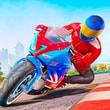
Moto Rush doesn’t bother with a story about why the road is broken or who forgot to finish all those bridges. It just drops you onto a narrow strip of asphalt, points a motorcycle straight ahead and says: keep going. That’s it. No laps, no finish line, just a long, risky line in front of you and a scoreboard waiting to see how far you can push your nerve 🏍️💥
The camera sits behind your bike so you see everything lined up against you: gaps in the road, raised platforms, ramps that look a little too steep to be legal, and the distant shimmer of whatever comes next. There’s something hypnotic about that view. The horizon never truly gets closer, but every meter you survive feels hard-earned, like you’re carving your name into the air one jump at a time.
Speed is the first thing that hits you. The bike isn’t sluggish; it lunges forward the second you give it room. At low speed, obstacles look manageable. You pick your line, hop a gap, land, breathe. Then the pace ramps up and the whole game tilts. Gaps arrive faster, ramps force split-second timing, and your brain has to work a beat ahead of your hands or you’re going over the edge in a very dramatic cartwheel. That curve from “this is chill” to “oh no oh no oh no” comes surprisingly fast.
The heart of Moto Rush is momentum. Jumps aren’t just about pressing the button at the last second; they’re about setting up enough speed that the bike actually makes it to the far side. Too slow and you drop like a rock between platforms. Too fast and you overshoot, smashing into the far edge or landing at an angle that sends your rider sliding across the road. The perfect jump is a small miracle: you leave the ramp cleanly, float for a breathless second, then kiss down on the landing strip like you planned it all along.
Because it’s an endless high-score game, the rules stay brutally simple: one mistake and the run ends. There’s no rewinding a bad landing, no safety net under those missing bridge sections. You watch your bike tumble into the void, your score freezes, and a tiny part of you immediately starts replaying the last three seconds in your head. You know exactly which moment killed you. That misjudged ramp. That unnecessary swerve. That half-second of daydreaming where your hands kept you straight instead of lining up properly.
Runs start to develop personalities. Some are “warm-ups”, where you know you’re still waking up and just let your reflexes stretch. Others feel special from the first jump; every landing is clean, every turn gentle, speed rising like a tide under your tires. Those are the attempts where you start getting greedy. You see the score climbing, you feel the run might become your new record, and suddenly the road feels tighter. Your hands tense. You overthink a jump you’ve done a hundred times and… well, you know how that story ends.
Visually, Moto Rush keeps things clean enough that your eyes never get lost, but there’s still a sense of depth you notice when the bike launches into the air. Bridges hang in the empty space like floating ribs, some closer, some farther, some offset just enough to make you move at the last moment. The 3D camera gives height to your mistakes. Falling isn’t just a fade-out; you watch the bike drop and your stomach does a tiny drop with it. When you land perfectly, the same perspective makes the success feel big, like you just threaded a needle at 200 km/h.
The controls are intentionally straightforward so the challenge lives in your timing, not in remembering button combinations. Accelerate, steer, jump. That’s the whole vocabulary. The nuance comes from how long you hold each input. Feathering the steering instead of yanking it at the last second. Tapping jump at the exact edge of a ramp, not two pixels earlier. Backing off the throttle just a little before a tricky sequence so you have more time to line up the bike. It’s the kind of game where mastering tiny habits turns average runs into ridiculous streaks.
As your score climbs and you start beating your own records, Moto Rush shifts from “try not to crash” to “optimize every moment”. You stop being satisfied with just surviving and start chasing flow. Flow is when the road stops feeling like separate obstacles and becomes a rhythm. Ramp, gap, curve, ramp. Your fingers move automatically, your eyes are scanning a little further ahead, and each successful landing feeds the next decision. You’re not reacting anymore; you’re predicting, and that’s when the score counter starts to feel like it’s melting upwards.
Failure never completely goes away, though. The game is built to eventually outrun your concentration. Maybe it’s a stingy sequence of small platforms, maybe it’s a nasty combination of a curve into a narrow jump, maybe you simply blink at the wrong time. But every failure plants tiny corrections in your muscle memory. Next time you recognize a particular pattern coming, there’s a little spark of déjà vu that whispers: last time, you flew off here. Not again. You shift slightly earlier, hit the jump cleaner, and the satisfaction of proving yourself wrong is almost better than the score.
Moto Rush works perfectly in quick bursts, which is exactly why it’s so dangerous to your free time. You tell yourself you’ll play one run while a page loads or a download finishes. The first attempt ends painfully early, so you go again. The second is better, but you clip a ramp and lose it. The third feels good, so you push harder. Before you notice, the short break turned into a personal high-score hunt, your fingers are locked into that endless runner trance, and your brain has quietly decided there’s no way you’re leaving without beating that number at the top of the screen.
If you like motorcycle games that strip away everything except speed, timing and nerve, Moto Rush settles into that sweet spot. No complex upgrades, no heavy menus, no long tutorials. Just a bike, a broken road, pure forward motion and your own stubborn refusal to crash. Every meter is borrowed time, every jump is a question: do you trust your momentum, or are you about to discover exactly how far you can fall?




 4 (8 votes)
 Share
Share
 Embed
Embed