🏀🌌 IT’S DARK, IT’S BRIGHT, AND YOUR SHOT HAS TO BE SMART
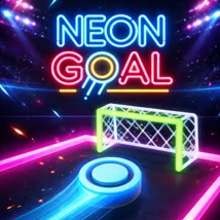
Neon Goal feels like someone took a tiny basketball hoop, locked it inside a futuristic arcade box, turned off every light except neon shapes, and then said: alright, score… but you only get a few tries. On Kiz10, it plays as a physics puzzle basketball game where your job isn’t to spam shots until one accidentally drops. Your job is to think, aim, and commit. Every level is basically a little glowing riddle: here’s the ball, here’s the goal, here are walls and weird blocks, now solve it with angles. If you miss too many times, you don’t “lose a life” in a dramatic way, you just feel that quiet sting of having to restart because you wasted throws like they were free. They are not free. 😅
The first few stages are friendly. You swipe, the ball arcs, it bounces, it goes in, you feel clever. Then the game starts introducing geometry that looks simple but behaves like a prank. Walls are placed to redirect you. Blocks sit exactly where your brain wants the “obvious” path to be. And suddenly you’re no longer playing a casual sports game. You’re playing physics chess with a basketball, inside a glowing void. Kind of beautiful, kind of rude.
🎯🖐️ SWIPE CONTROLS THAT LOOK EASY UNTIL YOU REALIZE THEY’RE YOUR WHOLE LIFE
Neon Goal is built around a simple input: touch or drag, set direction and power, release. That’s it. No complicated buttons, no weird combos. Which is perfect, because it means every mistake is clearly yours. The game gives you a clean physics system: gravity is predictable, bounces are consistent, and surfaces do what they should… as long as you stop panic-shooting.
The real skill is learning how much power you actually need. Too soft and the ball dies short. Too hard and you ricochet into a useless orbit, bouncing off everything like a pinball that hates you. The sweet spot is usually smaller than you expect. A lot of the best shots in Neon Goal aren’t massive launches, they’re controlled banks. A gentle angle, one clean bounce, a second bounce to correct the line, then the net. When you hit that kind of shot, it feels amazing because it looks accidental, but you know it wasn’t. Your brain did the math in a split second, and your hand executed it. 🧠🏀✨
🧱💥 EVERY BOUNCE IS A DECISION, NOT A SIDE EFFECT
This is where the game separates itself. In many casual basketball games, bouncing is just chaos. In Neon Goal, bouncing is the solution. You’re meant to use the walls like tools. The arena is basically a set of neon mirrors and bumpers that can redirect your shot if you approach them correctly.
You’ll start thinking in angles instead of straight lines. “If I bank off that wall at a shallow angle, it’ll slide into the lane.” “If I hit the block first, the rebound will line up.” “If I bounce once here, I can dodge that obstacle and still arrive with enough speed.” The ball’s path becomes something you sculpt rather than something you hope for. And that’s when the game gets addictive, because every level becomes a mini engineering problem with instant feedback.
Also, the game loves making you choose between a safe shot and a stylish shot. The safe shot might take two bounces and look boring. The stylish shot might be a wild bank off a corner that drops perfectly. You’ll go for the stylish shot more often than you should. That’s not strategy, that’s being human. 😅
⚡➡️ SPEED ZONES, DEFLECTORS, AND THE “WHY DID THAT WORK” MOMENTS
As levels ramp up, you’ll meet special blocks that change how the ball behaves. Some deflect hard, some feel like angled surfaces that force a new direction, and speed zones can launch your ball faster than you planned. These elements are where the puzzle side gets sharper, because now you’re not only aiming at the hoop, you’re aiming at a specific interaction. You’re trying to hit a surface in just the right place so the ball exits at the angle you need.
Speed zones are especially funny because they turn a gentle plan into a chaotic rocket if you hit them wrong. You’ll line up a perfect path, the ball touches an arrow boost, and suddenly it’s gone, bouncing off the ceiling like it escaped your control. Then you adjust, aim slightly lower, try again, and it works so cleanly you’ll stare for a second like you’re not sure you deserved that success. That’s the vibe: tiny adjustments, big results.
🪙✨ COINS, REWARDS, AND WHY YOU KEEP TRYING “ONE MORE TIME”
Neon Goal doesn’t only motivate you with “beat the level.” It also keeps a small reward loop running with coins. That sounds simple, but it matters because it gives you a reason to care about performance. You’re not just clearing, you’re collecting, optimizing, trying to finish in fewer throws. Even if nobody is watching, the game makes you want to do it clean. It’s the same feeling as getting three stars in a puzzle game. You technically finished, but… you didn’t finish the right way. 😈
And because levels are short, you can chase that perfect run without feeling trapped. One stage takes seconds, not minutes. That makes the retry loop feel fast and satisfying instead of frustrating. You miss, restart, tweak the angle, and instantly test again. It’s a rhythm game disguised as a physics game: aim, release, watch, learn, repeat.
🌀😵 THE LEVELS GET TRICKIER BECAUSE YOUR HABITS GET EXPOSED
The deeper you go, the more Neon Goal starts punishing the things you do without thinking. Shooting too hard. Aiming directly at the hoop instead of using walls. Wasting throws on “let me see what happens” experiments. The game teaches you to respect your limited attempts. It’s not harsh, it’s just honest: you have a handful of throws, so make them count.
That limited-throw system creates tension in a way that feels surprisingly intense for such a clean neon game. The arena looks calm, but your brain isn’t calm when you’re down to your last attempt. You’ll take extra time lining up the shot, your finger will hover, and you’ll feel that small pressure of knowing a bad swipe means restart. Then you release, the ball bounces, it kisses the rim, and for half a second your soul leaves your body. If it drops, you feel like a wizard. If it doesn’t, you immediately blame the wall, the physics, the universe, anything except your angle. 😅🏀
🌟🎮 WHY NEON GOAL WORKS SO WELL ON Kiz10
Because it’s quick, clean, and satisfying. The neon aesthetic makes it feel fresh, the physics makes it feel fair, and the short levels make it easy to play in bursts. You can jump in for five minutes and clear a handful of puzzles, or you can stay longer chasing perfect shots and clean clears. It’s the kind of game that looks simple but quietly builds real skill: angle reading, power control, planning bounces, and staying calm when you’re low on attempts.
If you want one simple approach that helps immediately: stop aiming at the hoop as your first instinct. Aim at the wall that will send you to the hoop. The game is called Neon Goal, but the real goal is learning the bounce. Once you start thinking that way, your shots get cleaner, your retries get fewer, and the neon arena starts feeling less like a trap and more like your playground. 🏀✨🧠











 2.5 (163 votes)
 Share
Share
 Embed
Embed