OFFICE CHAOS, ONE CRUMPLED HERO 🗑️📄
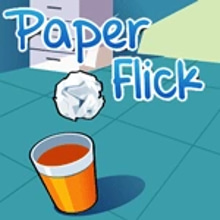
Paper Flick begins with a scene that feels weirdly universal: a desk, a bin, a bored little pause in the day, and a paper ball that suddenly becomes the most important object on Earth. It’s an arcade skill game, pure and simple, built around that satisfying finger-flick motion that looks easy until the ball kisses the rim, bounces out, and makes you question your entire sense of distance. On Kiz10, Paper Flick is the kind of game you boot up for a “quick try” and then keep playing because you’re convinced your next shot will be the clean one. The perfect one. The one that doesn’t wobble. The one that drops straight in like gravity is finally on your side.
It’s not a complicated game, and that’s exactly why it works. There’s no long setup, no story you need to memorize, no giant learning curve. The challenge is simple: aim, flick, score. But the simplicity is a trap, in the best possible way, because every miss feels personal. You didn’t lose to a boss. You lost to air, angle, and your own overconfidence. And somehow, that makes the rematch instant.
THE FLICK THAT LIVES BETWEEN CONFIDENCE AND PANIC 🎯😅
The core mechanic is all about reading space with your eyes and translating that into a quick, controlled motion. Too weak and the paper ball drops short, embarrassing and quiet. Too strong and it sails past like you’re trying to launch it into another department. The sweet spot sits in that narrow band where the ball arcs just right, dips at the last second, and lands with that soft little satisfaction that makes your brain go, yes, do that again.
What’s sneaky is how Paper Flick messes with your rhythm. After a couple of makes, you start feeling like you’ve “figured it out.” Your flick becomes faster. Your aim gets casual. You stop respecting the distance. Then the game humbles you with a miss that looks impossible to miss, the kind where you swear the ball was aligned perfectly and yet it still clips the rim and ricochets away like it has its own agenda. That’s when you start making tiny adjustments. A little higher. A little softer. A slightly different release. Suddenly, you’re treating a paper toss like precision sports, and it’s honestly hilarious how quickly you become invested.
WHY THE BIN FEELS LIKE A MOVING TARGET 🧠🗑️
Even when the basket is sitting there doing nothing, it never feels static. Your perception changes depending on your streak, your speed, and how recently you missed. After a clean shot, the bin feels huge. After a painful rim-out, it looks smaller, farther away, and slightly smug. Paper Flick lives on that psychological swing. It’s not just about mechanics; it’s about pressure. The moment you start chasing a streak, the air feels heavier. You can feel yourself rushing, trying to “keep it going,” and that’s when mistakes creep in.
There’s also a fun, stubborn truth: you can’t brute-force accuracy here. Spamming flicks doesn’t help. The game rewards that half-second of calm where you line up your aim, breathe, and flick with intent. It’s a tiny performance. A tiny ritual. And when you nail it, the simplicity becomes addictive rather than boring.
THE SOUND OF A PERFECT SHOT (YES, IT MATTERS) 🔊✨
A good toss game needs feedback that feels satisfying, and Paper Flick understands that. The sense of landing a clean shot is more than points. It’s the tiny emotional click: I did that. The best moments are the “nothing but net” style drops where the ball falls in cleanly without drama, like it was always meant to be there. The worst moments are the rim bounces that tease you, the ones that go in halfway and then pop out with cruel confidence. Those are the moments that turn a casual player into a determined one.
And once you’re determined, the game becomes this funny loop of micro-improvements. You start noticing patterns in your own mistakes. You flick too strong when you’re excited. You flick too weak when you’re trying to be careful. You aim too low when you’re rushing. It becomes less about luck and more about self-control, which is kind of wild for a paper ball in an office bin.
DIFFICULTY THAT FEELS LIKE A DARE 🔥📏
Paper Flick isn’t trying to overwhelm you with complexity, but it does know how to raise the stakes. As you get comfortable, you’ll feel the challenge ramp up, not necessarily through complicated rules, but through the pressure of consistency. Hitting one good shot is easy. Hitting ten in a row is a different beast. Streaks are where the game turns sharp, because they expose every tiny flaw in your timing and release. The game becomes a dare: can you keep your hands steady when your brain is already celebrating?
This is also where the game becomes oddly relaxing for some players. If you settle into a rhythm, it’s almost meditative. Aim, flick, watch the arc, adjust, repeat. It’s a simple loop that clears your head, right up until you miss and your relaxation transforms into dramatic, theatrical disappointment. Then you laugh at yourself, because… it’s a paper ball. And you go again.
THE LITTLE TRICKS THAT MAKE YOU BETTER 🧩👀
The fastest improvement happens when you stop flicking based on hope and start flicking based on visual checkpoints. Instead of thinking “throw it in,” you start thinking “hit that arc.” You watch where the ball peaks. You watch how it falls. You make small changes instead of big ones. If you miss short, don’t double your power like you’re angry at physics. Just nudge it. If you miss long, don’t slam the brakes and underthrow. Just soften the release a touch.
One surprisingly helpful habit is to take a tiny pause after a miss. Not a long pause, just a reset. The worst streak killers aren’t misses themselves, they’re revenge flicks. The angry “I’ll show you” toss that goes flying off target and makes you feel even worse. Paper Flick rewards calm confidence, not emotional flailing. Which is funny, because the entire concept is basically a bored office tantrum turned into a sport.
WHY IT’S PERFECT ON Kiz10 🚀📌
Paper Flick fits Kiz10 because it’s immediate and replayable. It loads fast, it makes sense instantly, and it gives you that classic arcade urge to beat your own score. It’s a skill game you can play for thirty seconds or thirty minutes, and both feel valid. If you like aim-and-shoot style challenges, precision timing, high score chases, and that satisfying “one more try” loop, Paper Flick is a clean pick.
And the best part is that it doesn’t need to be anything more than what it is. A paper ball. A bin. Your reflexes. Your patience. Your stubborn pride. That’s enough to create a tiny competitive drama that you can restart whenever you want, right on Kiz10.com.













 2.5 (12 votes)
 Share
Share
 Embed
Embed


