Mine, Craft and Build a World Made of Triangular Prisms
PrismCraft is a creative 3D sandbox adventure that completely changes the familiar block-building formula. Instead of exploring a world made from ordinary cubes, every piece of terrain is constructed from triangular prism blocks, giving mining, crafting and building a completely different geometric style.
Explore a mysterious voxel island, gather natural resources, destroy terrain, craft useful materials and place prism-shaped blocks to create structures that would be difficult to reproduce in a traditional cube-based building game.
The triangular geometry is not simply a visual effect. Diagonal surfaces allow you to create natural slopes, roofs, ramps and sharp architectural angles without relying entirely on conventional stair-shaped blocks. This makes PrismCraft especially interesting for players who enjoy experimenting with construction and discovering new ways to shape a sandbox world.
Explore a World Built from Triangular Blocks
At first glance, PrismCraft may look familiar to fans of voxel sandbox games. You can walk freely through a 3D environment, inspect the terrain, gather materials and change the world around you.
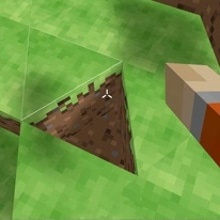
Look closer, however, and the difference becomes immediately obvious. The environment is formed from triangular prisms rather than square cubes.
This changes the appearance of hills, caves, holes, walls and buildings. Diagonal faces appear naturally throughout the terrain, creating landscapes with sharper angles and more unusual shapes.
- Explore a fully 3D voxel environment.
- Discover terrain constructed from triangular prisms.
- Search the island for natural resources.
- Explore caves and different terrain formations.
- Destroy parts of the environment.
- Collect materials for crafting and construction.
- Shape the world according to your own ideas.
Mine Resources from the Environment
Resource gathering is an essential part of PrismCraft. Explore the environment and break terrain blocks to obtain useful materials.
Trees, sand and other natural resources can be collected and transformed into materials that help you continue building.
Do not destroy terrain randomly if you already have a construction project in mind. Gather the materials you need first and preserve useful parts of the landscape that could become part of your final design.
Craft Useful Materials
Open the crafting and inventory interface to convert collected resources into new materials.
For example, wood can be transformed into planks and sand can be converted into glass. These crafted materials expand the possibilities available when designing buildings and experimenting with the triangular construction system.
The crafting system encourages exploration because the materials found around the world can become useful components rather than simply decorative objects.
- Gather resources from the island.
- Open the crafting interface.
- Turn raw materials into useful building components.
- Create wooden planks from collected wood.
- Produce glass from sand.
- Use crafted materials in your own constructions.
Build with Triangular Prism Blocks
Construction is where PrismCraft becomes very different from a conventional block-building sandbox.
Traditional cubes naturally create flat walls and 90-degree corners. Triangular prisms introduce diagonal surfaces directly into the building grid.
Place prisms next to one another and experiment with their orientation to create walls, slopes, roofs, elevated paths and unusual geometric structures.
The placement system automatically handles the orientation of triangular pieces so they can connect correctly within the grid. This allows prisms to fit together while still giving structures the distinctive angular appearance that defines the game.
Create Natural Ramps and Slopes
One of the biggest advantages of triangular construction is the ability to create slopes without needing traditional stair blocks.
Use the diagonal face of a prism as a natural ramp. Align several pieces and you can create smooth rising paths that become part of the structure itself.
This technique is useful for:
- Building ramps between different heights.
- Creating sloped entrances.
- Designing elevated walkways.
- Connecting multiple floors.
- Building defensive slopes.
- Creating more natural transitions across uneven terrain.
Design More Interesting Roofs
Triangular blocks are particularly useful when constructing roofs. Instead of building a stepped roof from several horizontal cube layers, you can use diagonal prism faces to create more direct slopes.
Align the triangular pieces carefully and experiment with different orientations. You can create pointed roofs, asymmetric designs and structures with angles that would require many additional blocks in a traditional cube world.
This is one of the best areas for experimenting with PrismCraft's unique geometry.
Build Without a Fixed Objective
PrismCraft is designed around sandbox freedom rather than a strict sequence of levels.
You are free to explore the island, gather resources and decide what you want to create. Build a small shelter, construct a large fortress, dig into the terrain or experiment with geometric shapes simply to understand how triangular blocks behave.
There is no need to follow one specific architectural style. The unusual building system encourages experimentation.
Switch Between Survival and Craft Modes
The current version allows you to switch between different gameplay approaches using the Tab key.
Survival mode emphasizes interacting with the world, gathering materials and working with the resources available around you.
Craft mode gives you an alternative way to concentrate on building and experimenting with the prism system.
Switching between the available modes can be useful when you want to move from exploration and resource gathering toward more focused construction.
Use Third-Person View
PrismCraft is primarily experienced from a first-person perspective, but you can also switch to a third-person camera.
Press F5 to change the perspective and see your character moving through the environment.
The unusual triangular theme extends even to the player model, making third-person view another way to appreciate how completely the game commits to its prism-based visual concept.
Experiment with the Triangular Grid
Building with triangles requires slightly different thinking than building with cubes.
Before creating a large structure, place several blocks near the ground and observe how their orientations connect. Understanding the geometry early will make larger construction projects much easier.
Try combining opposite orientations to create flatter surfaces, then rotate the construction pattern to produce ramps or angled walls.
The more you experiment with the grid, the easier it becomes to predict the final shape of your structures.
Use Diagonal Faces Efficiently
Do not treat every prism as though it were simply another cube. The diagonal face is the defining feature of the building system and can save both space and materials.
Use diagonal surfaces when designing:
- Roofs.
- Ramps.
- Sloped walls.
- Fortress defenses.
- Decorative architecture.
- Natural-looking terrain transitions.
- Angular entrances and corridors.
A structure designed specifically around triangular blocks will usually look much more interesting than one that simply attempts to imitate a cube-based building.
Explore Caves and Alter the Terrain
The prism system affects underground exploration as well as construction. Mining holes into triangular terrain creates different shapes and angles than you may expect from a normal voxel world.
Explore caves and dig through the landscape while paying attention to how the geometry changes around your character.
The game's collision system has been designed around these triangular spaces so the player can navigate terrain formed by the unusual prism grid.
Build a Shelter
If you want a simple first construction project, start with a small shelter.
Gather wood and other nearby materials, choose a relatively flat location and create a foundation. Once the walls are complete, use diagonal prism blocks to experiment with a sloped roof.
This small project teaches several important mechanics at once:
- Resource gathering.
- Block placement.
- Prism orientation.
- Crafting materials.
- Building diagonal surfaces.
After understanding these fundamentals, move toward larger and more ambitious designs.
Create Your Own Fortress
The prism geometry is ideal for experimenting with defensive architecture.
Build elevated walls, sloped entrances, observation platforms and unusual towers. Diagonal surfaces can create approaches that feel very different from traditional block-based forts.
Try combining vertical sections with triangular ramps to give your fortress several heights without filling the entire structure with staircase blocks.
Experiment Instead of Building Symmetrically
Perfect symmetry is not necessary in PrismCraft. In fact, the triangular geometry becomes especially interesting when you combine different orientations and angles.
Create asymmetrical roofs, offset towers or walls that gradually change direction. Small experiments can produce ideas for much larger projects.
If a design does not work, remove the blocks and rebuild it. Sandbox games reward experimentation more than perfection on the first attempt.
Main Objectives
- Explore the mysterious 3D island.
- Gather natural resources.
- Mine and destroy triangular prism blocks.
- Use collected materials for crafting.
- Create wooden planks, glass and other useful resources.
- Place triangular blocks to modify the world.
- Create ramps using diagonal prism faces.
- Design roofs and unusual structures.
- Explore caves and different terrain formations.
- Experiment with prism orientation.
- Switch between survival and craft modes.
- Build freely without a strict time limit.
- Create your own unique sandbox world.
PrismCraft Controls
Desktop Controls:
- WASD: Move through the world.
- Mouse: Look around and aim at blocks.
- Mouse buttons: Select, destroy or place blocks according to the active action.
- Spacebar: Jump.
- E: Open the inventory and crafting interface.
- Tab: Switch between Survival and Craft modes.
- F5: Switch between first-person and third-person views.
The game is an evolving HTML5 prototype, so controls and available features may change as new versions are released.
Tips for Building Better Structures
Learn the prism orientation first. Before starting a large house or fortress, place several triangular blocks next to each other and study how their diagonal faces connect.
Use triangles as triangles. Do not attempt to recreate every cube-building technique exactly. Use the sloped faces to create designs that take advantage of PrismCraft's unique geometry.
Gather materials before building. Collecting a useful stock of resources first lets you concentrate on construction without constantly stopping to search for more materials.
Use diagonal surfaces for roofs. One of the easiest ways to make a building look different is to create a naturally sloped roof from aligned prisms.
Create ramps instead of stairs. Diagonal blocks allow you to connect different heights naturally and can reduce the number of pieces required.
Experiment with third-person view. F5 can help you inspect your character and get another perspective on the environment.
Switch modes when useful. Use Tab when you want to alternate between survival-style progression and a more construction-focused experience.
Explore underground. The triangular terrain makes caves and excavations visually different from conventional cube worlds.
Do not be afraid to rebuild. The unusual geometry takes time to understand. Removing and repositioning a few prisms can completely change the appearance of a structure.
What Makes PrismCraft Different?
The central idea behind PrismCraft is extremely simple: what happens if a familiar voxel sandbox is rebuilt without cubes?
The answer changes far more than the appearance of the world. Triangular prisms affect terrain generation, collision, construction, block placement, architecture and even the shape of the user interface.
Hills become sharper. Excavated terrain creates unusual openings. Buildings naturally develop diagonal surfaces. Roofs and ramps can be constructed directly from the standard world geometry.
That makes PrismCraft more than a visual experiment. It asks players to reconsider building techniques they may already know and solve familiar sandbox problems with an entirely different geometric system.
Build Something That Cubes Cannot
The most interesting way to play PrismCraft is not simply recreating the same square house you would build in another voxel game.
Use the triangular blocks to design something that depends on their unusual geometry. Create steep roofs, sharp towers, angled fortifications, sloping entrances and structures where every prism contributes to the final silhouette.
PrismCraft combines mining, crafting, exploration and creative sandbox building with a unique triangular voxel system. Gather resources, understand the prism grid and discover how different a block-building world becomes when nothing has to remain square.





 2.5 (151 votes)
 Share
Share
 Embed
Embed