The first sound you hear is the crunch of runners over packed snow and the soft hiss of ice under your sled. Snow Road on Kiz10 does not waste time with long intros. One second you are staring at a quiet, pixelated winter landscape. The next, your sled is already flying down a glowing white track, the screen tilting forward like it wants to throw you straight into the cold.
This is an endless winter road, not a quiet ski resort. The hills roll and twist, the trees crowd closer than they should, and somewhere just out of view more obstacles are spawning like the mountain itself is trying to test you. Your goal is simple. Do not crash. Everything else is bonus. 🎿
❄️ A winter highway that never stops changing
Snow Road is built around that hypnotic feeling of an endless slope. The track stretches ahead in soft curves and sudden dips, covered in thick snow that looks harmless until you remember what waits inside it. Trees rise up like dark pillars, rocks sit buried where you least want them, and snowballs roll in from the sides as if some invisible prankster is throwing them just for you.
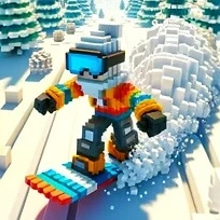
The world is 3D yet pixelated, a strange mix that feels retro and modern at the same time. Low poly trees, chunky hills and little dots of light in the distance create a cozy, almost toy like winter scene. Then the speed climbs and that cozy view becomes something you are reading in milliseconds. Where is the gap between those two pines. Is that a safe ridge or a bump that will launch you into a tree. Is that shadow hiding a rock.
Every run, the road reshapes itself. You might start in a gentle valley with a few lonely firs, then roll into a dense forest, then shoot out into a wide open slope that feels like a breath of air right before the game throws a wicked sequence of obstacles at you. You cannot memorize a perfect route. You have to actually play, really look, and react in the moment.
🛷 Sled controls that feel simple until the speed hits
On the surface, the controls could not be more basic. Move left, move right, keep the sled on its feet. No gear shifts, no heavy drift keypad, no gigantic button layout. You tilt or tap to swing the sled across the snow and that is it. This is exactly why the game is so dangerous for your free time.
At low speed, that simplicity feels relaxing. You slide calmly along, weaving between a few trees, enjoying the way the track rises and falls like a gentle roller coaster. You start thinking this is easy. Then the game quietly presses the fast forward button.
The sled begins to pick up speed. The distance between obstacles shrinks. Tiny little adjustments that were fine a moment ago suddenly fling you too far, too fast. You realise you have to stop oversteering and start making tiny, measured corrections. Your thumb or finger hovers close but not tense, ready for microscopic nudges rather than big swipes.
The best advice Snow Road ever gives you is baked into its design. Stay near the center. From there you can lean left or right at the last second, reading upcoming dangers from the widest possible angle. Hugging the sides might look tempting when you see a clear patch, but the center is where you get time to think. In a game where the road moves this quickly, those extra milliseconds feel like forever.
🎁 Gifts, new sleds and the urge to go again
It would be enough if Snow Road was just an endless obstacle course, but there is always something sparkling on the track. Gift boxes sit in risky spots, floating like little rewards for anyone brave or foolish enough to chase them. You see one on the far left, right after a narrow tree gap, and you instantly have a choice. Play safe and stick to your line, or cut across the slope, skim hazardously close to a trunk and grab the prize.
Collecting these boxes is how you unlock more sleds. Each new ride comes with its own personality. One model might feel light and twitchy, perfect for players who live for last second dodges. Another might track more smoothly, absorbing quick corrections without wobbling all over the road. Maybe you unlock a heavy sled that loves straight lines and demands more room to turn, which forces you to read the slope further ahead.
You start doing that mental math players know too well. If I take the risk and survive, I get closer to that new sled I want. If I crash, the run is over but at least I know where the danger sits for next time. The unlocks give your failures meaning. Even a short run contributes something to your long term progress.
Once you find a favorite sled, you become a little protective. You notice how it reacts to small bumps, how early it wants to begin a turn, how hard you can push it when the speed gets wild. Runs start to feel personal. You are not just piloting a generic object. You are riding your sled, the one you unlocked, the one you keep picking because it fits your style.
🌨️ Obstacles that turn the slope into a rhythm game
Trees are the basic heartbeat of the track. Alone, they are easy to dodge. In clusters, they turn the slope into a slalom that forces your eyes and fingers into perfect sync. Rocks add a low, solid threat. They sit where you might want to cut a line short, punishing lazy diagonals. Snowballs roll across or down the hill, adding motion inside motion that tests whether you can track two moving things at once.
Sometimes the terrain itself is the problem. The road drops away faster than you expect, a hill crest hiding a new crowd of obstacles just on the other side. Slopes tilt slightly so that if you are not paying attention, gravity encourages you toward the side with more danger. There might be sudden ridges that nudge you sideways, little surprise bumps that only a focused player notices in time.
You start to feel like you are playing a rhythm game disguised as a driving game. Your eyes read patterns, your hands respond in beats. Left, small right, tiny left again, hold center, big lean to avoid a rock at the last second. When you get it right, it is not just survival. It is flow. You feel yourself sliding through a perfect sequence without a single panicked jerk.
Of course, the game never lets you live in that flow for long without testing it. Pace increases. Gaps narrow. A snowball appears in the exact line you have been trusting for the last ten seconds. You either adapt or crash. Both outcomes are fun, but only one keeps the run alive.
⛄ The mood of a quiet blizzard with arcade adrenaline
Visually and tonally, Snow Road walks a nice line between cozy and intense. The winter world is charming, almost peaceful if you ignore the part where you are hurtling down it at unsafe speeds. There is something oddly soothing about the repeating hills and pixelated trees, like a holiday postcard animated and set on fast forward.
Yet underneath that softness, the game is pure arcade urgency. No story cutscenes, no long menus. You spawn, you slide, you react, you crash, you restart. A run might last a few seconds or several minutes, but it always ends with you thinking I can definitely do better than that.
The combination makes the game surprisingly flexible. You can treat it as a chill five minute break, enjoying the winter vibes and not worrying too much about distance. Or you can go full score hunter, memorizing how the difficulty ramps, practicing sliding near the center line, and pushing your personal best further each session.
Because it lives on Kiz10, there is zero friction. No installs, no updates to manage. You click play and the mountain is waiting, fresh snow laid out like it was poured just for your sled.
🎮 Pick up and play controls for any device
On desktop, keyboard or simple left right inputs give you all you need. Tap lightly to nudge the sled back to the center, hold a bit longer to carve a wide arc around a cluster of trees. The camera gives you just enough view ahead to plan, but never so much that the slope feels slow. You truly do feel like you are racing to stay ahead of what the game is drawing in front of you.
On mobile, tilt or on screen arrows translate the same mechanics to your thumbs. The game works perfectly as a one hand experience. Phone in one palm, thumb steering you through a blizzard of obstacles while you tell yourself this is the last run and absolutely do not mean it.
Because the controls are so minimal, anyone can understand them in seconds. The challenge comes from discipline. Can you resist overcorrecting when the sled drifts near a tree. Can you stay near the center instead of hugging the safe looking edge. Can you stay relaxed when the speed climbs and the white blur of the snow starts to feel a little too real.
🏔️ Why Snow Road clicks for arcade and winter fans on Kiz10
If you like endless runners and winter games, Snow Road feels like they shook hands and decided to share one sled. It has the classic arcade loop of simple input and increasing difficulty, mixed with a specific seasonal charm that makes every crash land in a puff of snow instead of frustration.
Runs are short, rewards are clear and the road never quite looks the same twice. You log in to Kiz10, bang out a few attempts, unlock a new sled and suddenly the game has convinced you to stay a little longer to see how that new ride feels at high speed.
Snow Road is not pretending to be a realistic simulator. It is here to remind you that sometimes all you need for a good time is a fast sled, a dangerous hill and just enough control to believe that this next run might finally be the one where you thread every gap like a winter racing legend.



 2 (159 votes)
 Share
Share
 Embed
Embed