🌊🫧 Down here, silence is a weapon
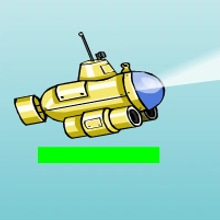
Submarine Hunter drops you into that eerie underwater mindset where everything important happens without noise. You’re not racing on asphalt, you’re stalking through pressure, darkness, and distance. The surface world is loud and dramatic, sure, but the real fight is under it, where a single blip on sonar can mean a win, a trap, or a torpedo headed for your face. On Kiz10, this plays like a naval combat hunting game built on patience, timing, and that delicious paranoia of never fully knowing what’s just beyond your vision.
At first, it feels simple: find targets, sink them, survive. Then you realize the ocean isn’t a flat map, it’s a layered problem. Depth matters. Angles matter. Speed matters. You can’t just point at an enemy and expect success. You have to set up the shot, manage your approach, and commit at the right moment, because torpedoes don’t care if you “almost” lined it up. They hit or they don’t. And the best part is how the game makes you feel clever for being calm. When you win, it’s not because you spammed. It’s because you hunted.
🧭📡 Sonar reading is basically learning a new language
The heartbeat of Submarine Hunter is detection. Your sonar is your eyes, and it’s not generous. A dot appears, then disappears, then reappears in a slightly different position and your brain starts doing that quiet math automatically. Is it moving toward me or away from me? Is it fast? Is it bait? Is it safe to surface, or will that turn me into a bright, easy target? This is where the game gets addictive, because it rewards the player who treats every blip like information instead of panic.
You’ll notice a funny shift after a few minutes. You stop chasing dots like a confused puppy and start predicting paths like a hunter. You begin to steer not toward where the enemy is, but where it will be. You stop firing the moment you see movement and start waiting for the moment the enemy commits to a line. That patience feels powerful, and it’s rare in browser action games. Submarine Hunter makes patience feel like speed, because the right shot saves you time, ammo, and risk.
🐟⚙️ Depth control, the invisible lever that decides everything
A submarine game without depth is just a boat game wearing a costume. Here, depth is survival and strategy at the same time. Staying deep makes you safer, but it can also make you slower to react. Surfacing can give you better angles, but it can also get you punished if you surface at the wrong time. That push and pull becomes the tension you live in. You’ll have moments where you feel safe in the depths, then you realize the target is slipping away and you have to rise. You’ll have moments where you rise confidently, then you see danger approaching and you dive like the ocean just screamed your name.
The clever part is how this changes your decision-making. You’re not just aiming a weapon, you’re managing a position in 3D space. When you start using depth proactively, the game feels smoother. Dive to break pursuit. Rise just enough to get a clean angle. Drop again before retaliation. It becomes a rhythm of appear and vanish, like underwater guerrilla tactics.
🎯💥 Torpedoes feel slow… until they feel inevitable
Torpedoes in a good submarine hunting game are satisfying because they demand commitment. You can’t instantly “undo” a bad shot. You choose a direction, you launch, and then you watch, waiting for the impact like you’re holding your breath in real life. The tension is in that travel time. If your aim is clean, the torpedo’s path feels like destiny. If your aim is sloppy, it feels like you just threw expensive hope into the sea.
And when you land a hit, it’s pure payoff. There’s a special joy in sinking a target you tracked properly, not because the explosion is flashy, but because your prediction was right. You read the movement, you chose the angle, you timed the launch, and the ocean finally agrees with you. That’s the kind of satisfaction that keeps players coming back on Kiz10, because each win feels earned, not gifted.
🧠😬 The real enemy is “rush brain”
Submarine Hunter punishes rushing in a very polite, cruel way. If you chase too aggressively, you expose yourself. If you fire too quickly, you waste shots and reveal your position. If you stay in one place too long, you invite trouble. The game doesn’t need to scream at you. It just lets consequences arrive. That’s why the best players feel almost quiet while playing. They’re not frantic. They’re controlled. They move with intention.
There’s also the classic trap: greed. You land a hit, you get excited, you push forward to finish the target fast, and suddenly you’re in a risky position with poor escape options. The ocean loves that mistake. The smarter play is often to reposition first, then finish the job from a safer lane. It feels slower, but it wins more consistently. Submarine Hunter is one of those games that rewards the boring smart choice, which is exactly why it feels satisfying when you start playing well.
🌑🦈 Underwater combat is a mind game more than a gunfight
The deeper you get into the rhythm, the more the game stops feeling like “shooting” and starts feeling like “hunting.” You’re reading patterns. You’re deciding when to engage and when to hide. You’re creating angles instead of forcing them. Even when the screen looks calm, your brain is active, scanning for threats and opportunities. That’s the best kind of tension, because it doesn’t burn you out, it pulls you in.
And when things get chaotic, when multiple threats seem to exist at once, the game becomes a test of composure. Do you fire immediately, or do you reposition and take the safer shot? Do you dive deep and reset, or do you stay shallow and risk being seen? Those choices are what make each run feel different, even if the goal is always the same: hunt, sink, survive.
🏁🌊 Why Submarine Hunter works on Kiz10
Submarine Hunter is built for that perfect loop of quick sessions and stubborn replays. It’s easy to understand, but hard to master because mastery isn’t about memorizing buttons, it’s about controlling yourself. Staying calm, reading sonar, choosing depth intelligently, and firing when you actually have the shot. The ocean theme makes it feel cinematic without needing a giant story, and the gameplay creates tension through distance and timing instead of cheap surprises.
If you like war games, naval combat, torpedo action, and the slow-burn thrill of stalking a target before striking, this one hits. It’s not loud power fantasy. It’s quiet predator fantasy. And once you get a taste of landing a perfect torpedo after a clean sonar read, you’ll want that feeling again, because it doesn’t feel like luck. It feels like you earned the ocean for a moment. 🌊🎯🫧





 Share
Share
 Embed
Embed


