🧟♂️🕹️ Retro panic with a shotgun heartbeat
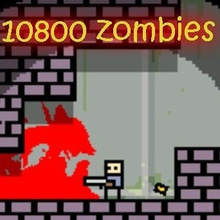
10800 Zombies is the kind of game that doesn’t waste your time explaining why the world is awful. It just drops you into it. You’re trapped in a labyrinth that feels like an old-school arcade nightmare, the walls are tight, the exits are never where you want them, and the zombies are already moving like they smelled fear. This is a classic retro action shooter with simple controls and brutal consequences: run, aim, shoot, keep moving, and try not to get boxed in by the slowest enemy you’ve ever met… until it suddenly isn’t slow anymore because there are ten of them.
On Kiz10, it hits that perfect “one more run” addiction because everything is immediate. No long load, no complicated menu trees, no twenty-minute tutorial telling you what a zombie is. You learn by doing. You learn by failing. You learn by realizing that your biggest enemy isn’t always the horde… it’s the corner you walked into without a plan.
🔫⚡ Shooting is easy, surviving is the skill
The gunplay is intentionally straightforward, and that’s what makes it sharp. You’re not managing recoil patterns like a modern tactical FPS. You’re not crafting attachments. You’re not negotiating with a complex stamina meter. You’re simply trying to keep a clean line of fire while moving through corridors that love turning into traps.
The first few encounters feel manageable. You pop a zombie, you take a breath, you step forward. Then you see two more. Then four. Then the space gets smaller and your brain starts counting paths like a stressed-out navigator. This is where 10800 Zombies becomes fun in a very specific way. It rewards players who can stay calm while everything is closing in. It’s not about being the fastest shooter, it’s about being the smartest mover. You can have perfect aim and still lose if you don’t control your position. In a tight maze, space is your real health bar.
🏚️🧠 The maze is the boss fight
The labyrinth design is what gives the game its personality. A wide arena shooter lets you kite enemies in circles forever. Here, the walls force decisions. Do you push forward into an unknown corridor, or backtrack and risk waking up more trouble behind you? Do you clear a section thoroughly, or sprint through and hope you can escape before the swarm catches up? Every turn is a small gamble.
You’ll start memorizing the “feel” of danger zones. Long hallways can be safe if you have distance, but terrifying if the end is blocked. Narrow bends are risky because you can’t see what’s coming. Dead ends are basically comedy, because you will enter one by accident at least once, then immediately understand what regret tastes like.
The funniest part is how your mind changes as you play. Early on, you move like a tourist. Later, you move like someone who has lived in this maze for years, suspicious of every corner, constantly planning a route that always includes an escape option.
💀🍀 The moment you stop moving, the game starts winning
A lot of zombie games let you camp, reload, and relax. 10800 Zombies feels like it hates that idea. It wants motion. It wants momentum. If you stop for too long, the enemies don’t politely wait. They compress the space around you until your aiming doesn’t matter anymore. You’re not losing because you can’t shoot. You’re losing because you ran out of room to exist.
So the game teaches a simple survival rule: keep the map flowing. Clear a lane, move to the next lane, don’t let the horde close the doors behind you. If you feel pressure, don’t panic-shoot harder, reposition smarter. Create distance. Use corners to funnel enemies into a line instead of letting them spread around you. Keep the fight on your terms, even if your terms are basically “please give me two seconds of breathing room.”
🧩🔦 Small choices, big consequences
The most satisfying runs come from tiny smart decisions. Turning left instead of right at the right moment. Clearing the nearest zombie first instead of the furthest one. Choosing to retreat early rather than retreat late. Those small moves compound into survival.
And the game has that old-school honesty where you know when you made the mistake. You’ll feel it instantly. You’ll take one wrong turn and your brain will go quiet for a second like, “Oh. That was bad.” Then you’ll scramble to fix it. Sometimes you will. Sometimes you’ll get cornered and the run ends quickly, not because the game is unfair, but because you broke the rule: you walked into a trap without an exit.
It’s weirdly addictive because failure feels instructional. You don’t rage at random. You replay with a new plan. That’s the kind of loop that makes retro shooters timeless.
😅🔥 The arcade curse: “I can do better than that”
10800 Zombies doesn’t need a deep story to keep you playing because it runs on pride. You die, and it’s close. Or you die, and it’s embarrassing. Either way, you immediately believe you can do it cleaner. You believe you can move smoother, shoot less wastefully, avoid that same corridor, hold your space better, survive longer.
That belief is the real engine of the game. It’s an arcade mindset: the run is short, the feedback is instant, and improvement is visible. You start noticing that you’re not panicking as much. You’re turning earlier. You’re controlling the horde instead of letting it control you. The maze stops feeling like a prison and starts feeling like a map you can read. That shift is satisfying in a way modern games sometimes forget.
🎮🧟 Why it still works on Kiz10
On Kiz10, 10800 Zombies feels like a compact survival shooter you can jump into anytime. It’s fast, readable, and tense without needing complicated systems. The retro style keeps it clean, and the maze structure keeps it stressful in the best way. It’s a game about awareness, movement, and pressure, with zombies acting like a timer that you can’t pause.
If you like classic arcade action, top-down survival vibes, or any zombie game where the real challenge is staying calm while the walls close in, this one delivers that sharp, old-school thrill. You’ll start a run thinking it’s just a quick play, then you’ll lose once and realize the maze owes you an apology. It won’t apologize. So you’ll play again.





 4.6 (28 votes)
 Share
Share
 Embed
Embed