🚑💨 The siren is on, your hands are shaking, and the city does not care
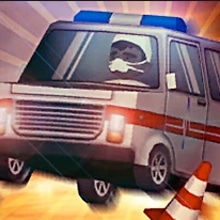
Ambulance Rush 3D has the kind of premise that sounds heroic until you’re actually in it. You’re behind the wheel of an ambulance, the siren is screaming like it’s trying to chew through the air, and somewhere in the back there’s a patient who really, really doesn’t need you bouncing off every curb like you’re playing bumper cars. This is a 3D rescue driving game that turns “get to the hospital” into a small personal crisis. You don’t just need speed. You need control. And that’s the whole hook: the fastest path is often the path that breaks your run.
The first moments feel simple. You accelerate, you aim for the road, you start weaving. Then the game’s personality shows up. Cars aren’t politely arranged for you. Corners aren’t forgiving. Parking isn’t optional. And suddenly you’re doing that driver thing where your eyes are scanning three layers ahead while your brain is shouting two different instructions at once: go faster, but don’t crash. It’s tense in the fun way, the kind of tension that makes you lean forward and whisper “okay okay okay” even though nobody can hear you.
🏙️🚦 Traffic is the real enemy, not the clock
Most people assume the timer is the big pressure, but the real pressure is the city. Traffic patterns create micro-traps everywhere. A lane looks open until a car slides into it. A turn looks safe until you take it wide and realize the ambulance has the turning radius of a stubborn refrigerator. There’s a constant push and pull between urgency and precision. If you rush blindly, you smack into vehicles and barriers, lose time recovering, and arrive late anyway. If you play too carefully, you crawl through opportunities and the mission slips away. The game lives in that uncomfortable sweet spot where you have to drive like someone who’s calm, but also extremely late.
And it’s not just about dodging. It’s about reading space. You start noticing which gaps are real gaps and which are traps that close the moment you commit. You learn to avoid sharp steering at full speed because the ambulance doesn’t glide; it snaps, and snaps lead to clips, and clips lead to that tiny pause where you correct your angle while the timer laughs quietly in the corner.
🧠🚑 Smooth driving feels like skill, chaotic driving feels like debt
There’s a rhythm to winning in Ambulance Rush 3D. A good run doesn’t look dramatic. It looks confident. You accelerate cleanly, you brake before you turn instead of during it, you pick lanes early, you avoid unnecessary zigzags. The ambulance feels heavier than a normal car, and if you treat it like a sports car the game will punish you with the most humiliating kind of crash: the slow, dumb one where you didn’t even mean to hit anything, you just turned too late and clipped a corner because you got greedy.
What makes the gameplay satisfying is that you can feel yourself improving. At first you’ll oversteer, then you’ll understeer, then eventually you start guiding the vehicle instead of fighting it. The steering stops being a panic tool and becomes a precision tool. You’ll still make mistakes, because everyone does, but the mistakes shrink. Instead of bouncing off walls, you start missing them by inches. And that’s a real upgrade in a driving game: not more speed, just better control under pressure.
🏥🅿️ The hospital isn’t the finish line, it’s the final boss
Here’s the part people forget: you don’t just arrive. You have to park. Parking in an ambulance game sounds like a small detail until it’s the detail that ruins your best run. You’ll have an amazing sprint through the city, you’ll feel like a hero, and then you’ll swing into the hospital area at a bad angle and suddenly you’re doing awkward little corrections like a driver who definitely did not practice reverse parking.
This is where the game turns from “drive fast” to “drive smart.” The best approach is usually the calm approach. You set up your angle early. You slow down before the final turn. You line up the ambulance with the space instead of forcing the space to accept you. Because forcing it is how you clip the edge, bounce, lose alignment, and watch precious seconds disappear while you try to straighten out. Parking is the moment the game asks, are you actually in control, or were you just lucky for thirty seconds?
😬💥 The funniest fails happen when you feel confident
There’s a specific kind of crash that only happens in emergency driving games: the confidence crash. You’re doing great, you’re threading through traffic, you’re feeling the rhythm, and then you try one risky squeeze between vehicles because you think you can. The ambulance doesn’t fit. Or it fits, but barely, and the slightest tap throws your line off. Or you make it through and immediately hit a barrier on the exit because you were already celebrating. Those moments sting, but they’re also what makes you replay. You know exactly why you failed. It wasn’t random. It was you choosing bravado over control.
And that’s why it stays addictive. You don’t feel cheated, you feel challenged. You feel like the game is saying, do it again, but cleaner. So you do. Then you do it again. Then again. Because the difference between a messy run and a great run is often just one decision: brake half a second earlier, take the corner wider, pick the lane sooner, stop zigzagging like you’re trying to draw lightning bolts on the road.
🚦🧩 Tiny decisions stack into big results
Ambulance Rush 3D is full of micro-decisions that add up. Do you take the inside line and risk clipping traffic, or take the outside line and risk losing time? Do you brake hard to stay safe, or brake gently to keep speed and stability? Do you correct steering immediately, or let the vehicle settle so you don’t overcorrect into a worse angle? The best players aren’t necessarily the fastest clickers. They’re the ones who stay composed when something unexpected happens. A car blocks the lane, you don’t panic-swerve; you shift smoothly. A turn is tighter than expected, you don’t yank the wheel; you slow and commit.
That’s why it feels like a real skill game despite the simple goal. It’s not a long simulation with endless buttons. It’s an arcade rescue driving challenge that rewards smart lines and controlled speed. You’re not memorizing a map as much as you’re learning a style of driving: smooth, decisive, and always thinking one move ahead.
🚑✨ The “hero fantasy” is real, but it’s earned
When you finally get a run where everything clicks, it feels great. Not because you pressed a lot of buttons, but because you kept your head. You stayed fast without being reckless. You handled traffic like it was part of the puzzle. You parked cleanly without turning the final seconds into a circus. It feels earned, and that’s the best kind of browser driving game feeling: quick to start, hard to perfect, and always one more attempt away from a better run.
If you like 3D driving games, rescue missions, ambulance simulator vibes, and high-pressure parking challenges, Ambulance Rush 3D is exactly that cocktail. Speed, control, traffic reading, and a final parking moments that tests whether you really deserve the siren. 🚑💨🏥





 Share
Share
 Embed
Embed


