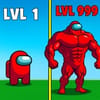
A tiny red crewmate drops from the sky like a candy with legs, blinks, and lands on your board with a soft plop. Before you can say “sus,” a second one arrives. You slide them together, they fuse with a fizzy pop, and—bam—new form, bigger grin, louder swagger. Amogus Evolution lives in that satisfying click between “almost” and “aha,” a merge-idle obsession where the screen becomes a petri dish of upgrades, chain reactions, and ridiculous personalities vying for top spot. You’re not just combining shapes; you’re composing momentum—one neat merge at a time—while the global counter tick-tock-ticks toward your next breakthrough.
The early game is pure sugar. Tap to spawn, drag to merge, watch the board glow as two identicals become a fresh tier with better income and a new hat that absolutely wasn’t OSHA-approved. Coins drizzle in even when you pause to admire the chaos; invest and the drizzle turns into a pleasant rain. Within minutes, the playfield hums like a tiny city. You’ll notice the choreography: low tiers feed mids, mids chain to highs, highs spit out bonuses that let you pull off audacious, screen-clearing combos. It’s a loop with rhythm—spawn, stack, slide, boom—and it never stops teasing the next improvement.
But this isn’t just cozy merging. This is a race. Real players crowd the leaderboard, names flashing up the board like stock tickers on a caffeinated afternoon. Every efficient merge feels like passing someone on the highway. The match timer purrs. Do you bank coins for a bulk buy? Do you roll the shop for a better spawn tier? Do you sell a clutter tile to free the killer lane you’ve been eyeing for 30 seconds? Decisions arrive quick, but the best ones feel calm—small, crisp moves that unlock big, noisy moments. When your board erupts into three successive evolutions and the announcer drops a smug “legendary,” you’ll grin like you planned it all along. Maybe you did.
Evolutions are the game’s comedy channel. They don’t just look different; they play different. A jet-pack tier sprays coins on landing. A scientist tier doubles the output of its neighbors if you align tiles like a neat little chemistry joke. A cosmic tier periodically duplicates the lowest tier you own, backfilling your pipeline so merges keep flowing while you chase the next shiny icon. None of it is homework; you feel the behavior in your fingertips, and the board starts to look less like clutter and more like a factory line you engineered for mischief. When two buffed tiers touch, the fireworks earn their own soundtrack. 🎆
Power-ups arrive like helpful gremlins. A magnet pulls matching tiers into a lane you carved, then you slide once and watch a domino of merges snap into place. A freeze buys ten honest seconds to think, great for setting up triple chains. A multiply token turns your next merge into a two-for-one evolution—evil, delightful, dangerous if wasted. The clever play isn’t hoarding; it’s timing. Pop magnet right before a spawn burst, freeze while you line up a six-merge symphony, multiply on a bottleneck tier to skip a plateau. Eventually you’ll stop reading tooltips and start hearing the right moment in the hum of your board. That’s the addiction talking, and it’s right.
The shop is where discipline beats greed. Yes, you can spam low tiers and stitch your way upward, but smart players angle for spawn upgrades that raise your floor. A board full of mid tiers is quieter, tidier, and far deadlier than a crowded mess. Permanent boosts nudge playstyle rather than breaking it: a mild spawn accelerator that favors streaks, a compact board extender that adds one precious column, a coin interest perk that turns idling into strategy instead of absence. Cosmetics add swagger—a neon trail when you hit mega-merge, goofy hats on evolved tiers, a background that shimmers with each chain—but the real flex is efficiency you can feel in your wrists.
Then there’s the chaos of events. Hourly sprints with random mutators—mirrored boards, slippery tiles, fog—reward adaptability with rare shards. Weekend boss waves drop hazard tiles you have to work around while still evolving like a champion; beat them and your tiers gain a temporary aura that doubles value for a minute of glorious nonsense. Seasonal cups rewrite the meta entirely: maybe magnets are scarce and freezes are plentiful, so you build lanes and play chess with time. The rules keep changing just enough to keep you hungry, and Kiz10’s instant start makes “one run” a very polite lie.
Multiplayer matchups feel like twin-stick Tetris with manners. You’re not directly sabotaging strangers, but your speed sends ghost pressure into the pool: hit a milestone and the room’s spawn rate surges, gifting opportunities and punishing hesitation. The scoreboard updates in bright, rude ticks; seeing a rival leapfrog you by a single merge is catnip. You chase, tighten your lines, pop a risky multiply, and decide whether that was genius or a learning moment. Either way, the run tells a story: decisions stacked into outcomes, luck bent into strategy, strategy disguised as luck. 🧠⚡
Sound is a secret coach. Merges clap in satisfying intervals—tiny, warm thwips for low tiers, chesty pops for high. Coin pickup chimes modulate as your income climbs, a musical hint to upgrade spawn. Power-ups have signatures: magnet hums in a rising tone that makes you hurry, freeze lands with a crystalline hush, multiply clicks twice like a dare. If you play with headphones you’ll start responding by ear, not eye, and that’s when your scores run away from your old bests. The board glows, yes, but the beat is what makes your fingers smarter.
Now for the part your future self will thank you for: micro-habits. Keep a “merge lane” clear along one edge; it turns chaos into conveyor belt. Park twins—two of a kind—one tile apart so a fresh spawn can complete the trio without sliding across the world. Cull or sell awkward singles early; space is value. Use freeze to plan, not to panic; if you’re already flailing, you’ve missed the best window. And when the board feels cursed, stop. Spawn once, merge once, breathe, and rebuild rhythm. The game rewards steadiness more than frenzy, even when frenzy looks cooler on a replay. 😅
Progression tastes like momentum. New max tiers unlock silly, wonderful models that make you cackle. Prestige resets wipe the board, bless your next run with multipliers, and remind you that the fun isn’t the finish line—it’s the slope of improvement. Titles and frames wrap your name on the leaderboard; nothing toxic, just a little gleam that says you solved the puzzle faster today than yesterday. You’ll start thinking in runs, not minutes: this will be the magnet run, the no-freeze run, the high-floor experiment with spawn three. Each identity trains a different muscle, and all of them make the next climb easier.
Why does it stick? Because every merge is a tiny story with a punchline. Because the board feels better the cleaner you think. Because rivals turn numbers into drama. Because “last Amogus” is both a goal and a punchline you want to hear yourself deliver. Mostly because Amogus Evolution respects the most important truth about merge-idle games: the best ones make you feel clever every thirty seconds. Slide, snap, glow, grin—repeat until the leaderboard blinks and your name sits higher than it has any right to. Then do it again, a little faster, a lot tidier, and infinitely louder.





 2.5 (173 votes)
 Share
Share
 Embed
Embed