🧗 Spawn Point Jitters
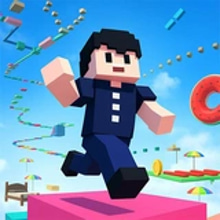
You appear on a sunlit platform with the skyline stacked like toy blocks, a gentle hum in the air, and a first gap that looks small until you step toward it. Block Jumper doesn’t waste breath explaining what a jump is. It lets your knees learn it. The first hop is a handshake, the second is a promise, and by the third you’re already scanning ahead for a rhythm you can trust. This is a 3D platformer about feeling the floor and believing, for a second at a time, that gravity can be negotiated with if you ask nicely and time your takeoff like you mean it. The world doesn’t push—you rise to meet it, one clean arc at a time. 🟦
🎯 Timing Is The Whole Conversation
Blocks spin, belts whir, fans thump, and somewhere inside the noise is a steady beat that belongs to you. Land too early and your shoes kiss a corner that refuses to hold you. Land too late and the block you aimed for is already leaving, polite but unavailable. The trick is to see motion as music. Rotating prisms become metronomes, pistons become kick drums, and your jump button turns into a snare hit that has to fire on count four, not “whenever.” The moment your eyes start counting instead of flinching, sections that looked rude become choreography. You aren’t improvising anymore—you’re playing along. 🕰️
🌀 Boosts, Bonks, And Borrowed Speed
Boost pads throw you forward with a gleeful shove that turns plans into reactions and reactions into grins. Trampolines give you air you didn’t strictly earn and then ask if you can do something intelligent with it. Elastic tiles stretch the landing into a bounce that only looks chaotic until you lean into it. Even the “gotcha” hazards are teachers in loud costumes. A swinging hammer that once felt unfair reveals it’s perfectly fair when you take one breath longer, then slide through the pocket it leaves behind. That’s the language of Block Jumper: gain speed where the course offers it, spend it where the course dares you, and never confuse noise for threat. ⚡
🏞️ Worlds With Weather And Mood
Daylight districts paint crisp shadows you can use as rulers. Neon towers swap depth cues for glow, teaching you to trust silhouettes more than texture. Forest terraces whisper with leaf rustle and soften edges just enough to make you respect distance again. Canyon scaffolds put the sky in your peripheral and remind you that looking down is optional but sometimes useful. Each zone tweaks your instincts without scolding them. Secret prizes hide where curiosity naturally lingers—a waterfall that booms a bit too loudly, a fan column that puffs in a suspicious pattern, a lonely ledge that turns into a stair if you commit to a diagonal you’ve never tried. 🌇
🚀 Verticality, One Breath At A Time
“Up” is the thesis. Wall studs ask for toe-tap ladders that feel like punctuation marks. Spiral towers feed you tiny rest platforms so you can reset the camera and your pulse. Midair control is real but modest—tiny nudges, not miracles—so the satisfaction comes from honest alignment rather than acrobatics you can’t repeat. The best climbs read like sentences with commas where the game wants you to breathe. Jump, tilt, catch, plant, go. When you thread four boosts into a clean mount and stick a top lip with a quiet “of course,” it’s not luck—it’s literacy. 🧭
🧠 Micro Tech That Changes Everything
Small habits become superpowers. Feather the jump at the lip and the engine gifts you an extra inch of arc. Slide the camera a hair before takeoff and suddenly that suspicious gap is a solved angle. On conveyors, shorter hops keep friction loyal; on ice, landing flat prevents the “comedy pirouette” that steals seconds and pride. None of this appears in a menu. You discover it by failing loudly and then landing softly, by paying attention to how the world talks back when your timing is almost right. The result is a private toolkit that makes tough rooms feel like old friends. 🛠️
🧩 Routes Inside The Obvious Route
The line the lights suggest is just the invitation. A gutter along the edge becomes a safer rim run for nervous hearts. A diagonal on a pillar shaves two steps if you’re brave enough to take off late. A slanted wall that used to bounce you into trouble becomes a ramp if you kiss it at the correct angle and let it carry you sideways. Once you start seeing these micro-lines, you replay for the pleasure of a cleaner sentence rather than the number at the finish. And yes, the number drops anyway. 🏁
💎 Coins, Cosmetics, Confidence
Coins sit where a designer thinks your best line lives, and following them is a lesson disguised as greed. Spend them on sneakers that puff tiny trails, jackets that flutter during long hangs, and colorways that make your avatar look like a decision you’re proud of. Stats don’t change—swagger does. And swagger matters more than we pretend, because the bolder you feel, the more often you choose the high route, and the high route tends to be the faster one once your hands learn its grammar. ✨
🎮 Hands, Camera, Trust
WASD steers with firm edges that respect tiny corrections. Space answers promptly but not impatiently; hold too long and you’ll balloon, tap too quickly and you’ll clip, so your thumb develops taste. The mouse gives perspective without wrestling for control, and the scroll zoom becomes a tool, not a toy—tight for threading interiors, wide for reading big sets. Pressing P to open the menu is a breather, not a break; you step out, tweak a setting, step back in, and the checkpoint waits like a friend who kept your place in line. Controls disappear so decisions can glow. 🎛️
🔁 Tumble, Think, Try Again
Failure sounds like a polite puff and feels like a bow you take before the next attempt. Checkpoints are generous without letting you brute force a section by chance. The loop is whisper-quick: miss, respawn, apply the tiny adjustment your eyes promised your hands, nail it, move on. The game respects your time by turning downtime into almost nothing and respects your brain by letting each mistake be a specific clue instead of a vague insult. That’s why stubborn rooms stop feeling hostile and start feeling like gym equipment that finally agreed to help. 🔄
🎧 Sound That Hears Your Footsteps
Percussive clicks under conveyor belts nudge your cadence, fans whoosh with an honest swell that previews lift, and the landing thud sits in the mix like a soft stamp of approval. The soundtrack gives you groove without nagging, rising when you’re flowing, stepping back when you need to hear counts in your head. After a good run you’ll catch yourself tapping the table in the same rhythm your shoes kept on the neon stairs. That’s not an accident. That’s design. 🎵
🦾 Tips From Future You
There is a version of you a few sessions ahead who knows three things: set your camera before the jump rather than during it, breathe before moving elements instead of chasing them, and trust short hops more than heroic ones. Short hops win races. Short hops turn “barely” into “obviously.” Short hops keep you in the pocket where timing and intention shake hands and agree to behave. Future you also saves a little patience for coin detours, because the best cosmetics are hidden behind lines that teach speed by accident. 🌟
🏆 The Run That Sticks In Your Head
It won’t be the fastest time on the board. It will be the one where you rode a fan column like a rumor, threaded a hammer gap without flinching, skimmed a coin trail midair because it lined up with your best arc, and climbed a spiral without stopping to beg the camera for help. The banner flashed, sure, but the memory that lingers is the minute where input and world agreed on everything. Block Jumper lives for that minute and hands you another shot at it every time you press restart. Up is still the only direction that matters, and now you know the beat.



 4 (155 votes)
 Share
Share
 Embed
Embed


