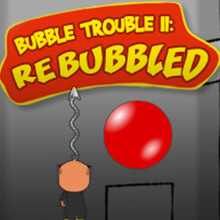
The first thing you see in Bubble Trouble 2: Rebubbled on Kiz10 is not a menu or a long story. It is a tiny devil in a trench coat, standing under a perfectly round bubble that really should not be that threatening. Then it drops, bounces, and suddenly the entire room feels like a death trap. One tap of the harpoon, the bubble splits into two smaller ones, and right there the game tells you its whole personality in a single moment. Nothing ever really goes away. It just gets faster, smaller, and harder to dodge.
You do not pilot a spaceship or a tank. You are just this little trench coat demon, sliding left and right across the floor with arrow keys, eyes locked upward like a paranoid cat watching a ceiling fan. The weapon in your hands is a harpoon gun that shoots straight up when you hit SPACE. No fancy arcs, no homing shots, just a clean vertical line of danger that pierces bubbles and then snaps back. It feels simple until you are trapped between four bouncing bubbles and every shot you take could either save you or ricochet your problems into a new corner of the screen.
😈 Devil in a Trench Coat Problems
There is something instantly iconic about this tiny devil hero. He is small, sure, but he moves with that twitchy urgency of someone who knows the sky is not safe. Each level drops him into a new arena dotted with platforms, ledges, and just enough weird geometry to make you ask if the designer was trying to help you or set you up. Your job is always the same: clear the room of bubbles without letting a single one touch you.
The devil is quick but not superhuman. When you commit to a direction, there is the tiniest delay before you can swap sides again, which means mindless zigzagging will get you cornered faster than anything. You start to feel the weight of his little coat as you slide under falling arcs, your thumb hovering over the shoot button, waiting for the perfect second to send a harpoon straight through a bouncing threat. Every survival run becomes a weird little dance where you are always one badly timed step away from a cartoonishly brutal ending.
🎈 Bubble Physics and Harpoon Panic
The real star of Bubble Trouble 2 is the way the bubbles move. They are not static targets waiting for you to line up a shot. They bounce, arc, clip platforms and reverse direction in a pattern that feels predictable until you get cocky. Hit a big one and it splits into two medium bubbles. Shoot those and you get four smaller ones ricocheting around the stage like rubber bullets. Pop those again and now you have tiny, furious orbs that seem to live for the chance to tag your head.
This split mechanic is what turns the classic arcade bubble shooter formula into something much more tense. You are constantly asking yourself if taking the shot right now will make things better or worse. Sometimes the correct move is to hold fire, kite a big bubble toward a clear area and only then harpoon it so the split pieces have room to bounce without immediately trapping you. Other times you need to shred a cluster fast before the stage turns into a pinball machine with you as the unlucky flipper.
The harpoon itself adds its own layer of panic. While it is in the air, you cannot fire another shot, so a missed harpoon leaves you exposed for a heartbeat that feels way too long. Watching a bubble skim just above your idle line of rope is the exact kind of moment that makes you want to yell at your keyboard, then restart and try again.
🪜 Platforms, Power ups and Close Calls
Stages are built like tiny puzzles. Some are open arenas, huge domes where bubbles have space to bounce high and wide. Others cram platforms at awkward heights, creating pockets where bubbles can get stuck in nasty loops above your head. You learn to respect those layouts fast. That safe looking ledge might be your best shelter or the reason a bubble suddenly drops onto you from a weird angle you were not watching.
Power ups drift into the chaos like little gifts from the arcade gods. Maybe you grab a shot that cuts bubbles more efficiently, or a bonus that slows down the entire field just long enough for you to breathe. Sometimes you snag a shield that buys you a second chance when a misjudged dodge goes wrong. The thrill of catching one of these items at the exact moment your screen is almost overflowing with trouble is huge. You go from doomed to dangerous in half a second, carving through the mess you helped create.
But power ups are never guaranteed, and reaching them can be risky. Do you break your safe pattern just to chase one Do you squeeze under a low bouncing orb because that glowing icon looks like salvation Or do you trust your own movement and keep playing it clean These tiny, constant decisions are what keep each level feeling fresh, even when the goal never changes.
🤝 Double Trouble in Cooperative Mode
Single player is intense. Cooperative multiplayer is pure controlled chaos. Bubble Trouble 2 lets two players share the same screen, each controlling their own devil with a harpoon, and that is where friendships go from “we got this” to “why did you shoot that one here” in about two minutes.
On paper, having a second harpoon in the arena should make things easier. Two lines of fire, twice the coverage. In reality, what usually happens is that one player splits a bubble at just the wrong height and sends a tiny fragment bouncing directly into the other player’s path. Or both of you decide to stand under the same bubble, shoot at the same time, and suddenly there are a dozen smaller orbs raining down on the exact platform you are fighting over.
The magic of co op is learning to sync with each other. One player might focus on controlling the left side of the screen while the other patrols the right. You start calling out which bubble you are about to pop so the other person can prepare for the split. You warn each other about stray orbs drifting down from higher platforms. When it works, it feels like performing a two person stunt show with bubbles exploding in perfect rhythm around you. When it fails, you both get flattened in the funniest way possible and instantly hit restart to try again.
🎮 Tiny Controls Big Precision
Controls could not be simpler, and that is exactly why Bubble Trouble 2 hits so hard as an arcade action game. On keyboard you move with the ARROW KEYS, sliding your devil left and right along the floor, and you shoot with SPACE. That is it. No weapon wheel, no giant HUD. You have horizontal movement and vertical fire, and the rest is pure timing and positioning.
Because the input is so straightforward, the game becomes all about your sense of rhythm. You start to feel the arc of each bubble, the moment when it hangs in the air just long enough for a perfect shot, the exact second when it lands low enough to be dangerous. Good players do not mash the shoot button. They tap once, precisely, and move before the harpoon even returns, already sliding toward the next safe pocket on the stage.
Play long enough and you will catch yourself doing tiny, advanced tricks without thinking about them. You will duck under a bubble, fire on the way out, and keep moving as if you planned it hours ago. You will bait a large orb into the corner just to split it where the pieces are easy to manage. You will stop seeing individual bubbles and instead see patterns, threats and openings like a chessboard made of rubber.
🏆 High Scores, Arcade Brain and Endless “One More Try”
What really sinks its claws into you is the classic score chase. Every bubble you destroy, every level you clear without losing a life, pushes your total higher. That number at the top of the screen becomes a tiny, glowing dare from your past self. Can you beat it Can you reach one more stage without getting tagged Can you replay an old level and finish it cleaner, faster, with fewer panicky scrambles into the corners
Arcade games live or die on that “one more try” feeling, and Bubble Trouble 2: Rebubbled has it in buckets. Runs are short enough that you never feel stuck, but intense enough that a single mistake is memorable. You will remember the exact bubble that ended a good streak, the way it bounced off a platform and clipped you on its way down. You will load the level again just to prove to yourself that you can dodge that particular pattern next time.
As the difficulty climbs, the game never pretends to be fair in a gentle way. It throws more bubbles, faster arcs and trickier layouts at you because it knows you have been training for them without noticing. Somewhere between your first clumsy stage and your twentieth close call, your brain quietly switched into arcade mode. You read trajectories faster, you slide cleaner, you trust that little devil in the trench coat to be exactly where you need him, when you need him.
✨ Why Bubble Trouble 2 feels perfect on Kiz10
On Kiz10, Bubble Trouble 2: Rebubbled is that game you open “just to check it out” and then realize half an hour vanished while you were dodging glowing spheres like your life depended on it. It keeps everything essential about a classic arcade bubble game: simple controls, tight levels, brutal collisions and that addictive split mechanic that turns every victory into a new threat.
It also fits every kind of player skill. Newcomers can enjoy the basic thrill of popping big bubbles and watching them shrink into harmless pieces. Veterans will chase perfect clears, flawless dodging and co op records with their friends. Because it runs directly in your browser, you can jump in for a quick level or sink into a long session trying to master the later stages without installing anything.
If you love old school arcade energy, tense bubble physics and that tiny rush you get when a harpoon shot threads perfectly between two deadly orbs, Bubble Trouble 2: Rebubbled on Kiz10 is exactly the kind of game that will sit in the back of your mind, waiting for you to say, “Okay, one more run.”











 Share
Share
 Embed
Embed


