🟡 The Yellow Path Looks Simple Until It Starts Moving
Color Connect Brain Puzzle has that sneaky first impression where you think, alright, I get it, connect the thing, move on. Then you realize the maze is not just sitting there politely waiting for you. The space is alive. Cubes slide, timing windows open and shut, and your “easy connection” turns into this tiny, intense moment of decision where your finger hesitates for half a second and your brain goes please do not mess this up.
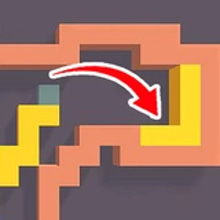
The goal is clear enough to feel satisfying: create a route through a 3D labyrinth and link the yellow tunnel by stopping moving cubes exactly when you need them. The catch is brutal in a clean arcade way. One small misstep, one accidental bump into a pink obstacle, and it is game over. Not a dramatic cutscene, not a long lecture, just that instant reset that makes you go… okay. Again. I can do it. I swear.
⏱️ Timing Is the Real Controller
This is not the kind of puzzle game where you can overthink for ten minutes and feel smart. You can think, sure, but you have to think fast. The moving cubes are basically asking you a question in real time: now or not now. And it is weirdly personal because the answer depends on your rhythm, not on some hidden trick.
At first you will play like a polite beginner. You will wait too long. You will stop cubes too late. You will watch the perfect alignment drift away like a bus you missed by one second. Then your gamer brain wakes up and you start feeling the tempo. You start predicting where the cube will be in the next moment, not where it is right now. That shift is everything. It turns the game from “reaction speed” into “reaction speed plus confidence,” which is a dangerous combo because confidence is how you start rushing.
And rushing is how you touch the pink obstacles. The game does not forgive panic. It does not hate you, it just calmly removes you from existence and lets you try again.
🧩 A Logic Puzzle Wearing an Arcade Jacket
Under the clean visuals, there is a real logic layer. You are not just stopping one cube. You are building a sequence. A route. A chain of decisions that has to make sense in space. You might need one cube to lock in early so another cube has time to slide into position. You might need to delay a stop because the next segment would otherwise block your own path. It is the kind of puzzle design that feels simple when you watch someone else do it, then you try it and suddenly your hands forget how time works.
There is also that satisfying moment when you see the route in your head before it happens. You stare at the maze, your eyes follow the imaginary yellow line, and you think, okay, I know the order. Then you execute… and your timing is a little off… and your beautiful mental plan becomes a comedy. Not a sad comedy, more like the kind where you laugh because you know exactly what you did wrong.
💗 Pink Obstacles, Pink Regret
The pink obstacles are the game’s way of saying, you can be fast, but you cannot be sloppy. They sit there like bright little consequences. And because they are pink, your eyes always notice them a split second late, which is honestly evil design in the most charming arcade way.
You will have moments where you are one cube away from completing the connection and your body starts celebrating early. That is the moment you drift too close to pink. That is the moment you clip it. That is the moment you stare at the screen like it betrayed you, even though you were the one steering your own disaster.
What makes this fun instead of frustrating is the restart speed. You fail, you instantly want another try. The game knows it. It is built for that loop. Fail fast, learn fast, do the same level again but with a slightly better brain.
🌀 The 3D Maze Makes Your Eyes Work Overtime
Because it is 3D, you are not just solving a flat grid. Depth matters. Angles matter. The maze feels like a little toy world where pieces slide with clean motion and you have to read distance quickly. Sometimes the correct move is not hard logically, it is hard visually. You misjudge a gap. You think you have room. You do not. Pink obstacle says hello. Goodbye.
Then you start getting sharper. You begin scanning for the safe corridor. You notice how far a cube travels before it cycles back. You spot the “deadly edge” where a stop would trap you. And you get that small, quiet satisfaction of competence. Like, yeah, okay, I am actually learning this.
It turns into a rhythm of watching patterns. The moving cubes become predictable, but only if you pay attention. And paying attention is the real challenge because the game is trying to pull your eyes everywhere at once.
😅 The Funny Part Is How Your Finger Betrays You
Let’s talk about the tiny human drama of timing puzzles. You know what you want to do. Your brain gives the command. Stop it now. And then your finger goes, hmm, maybe a millisecond later would be safer. That millisecond is how the whole thing collapses.
You will blame your device. You will blame your hand. You will blame the cube for moving too confidently. Then you will try again and nail it perfectly and suddenly you are like, see, I am a professional. I have never failed in my life. Ten seconds later you fail again because you got cocky. The emotional arc is fast here. It goes from calm to chaos to pride to embarrassment in the time it takes a cube to slide across a lane.
That is why it feels alive. It is not a boring logic test. It is a logic test with personality.
🎯 Small Wins Feel Weirdly Big
When you finally connect that yellow tunnel, the satisfaction hits hard. It is not fireworks, it is more like your brain unclenches. You did it. You saw the route, you timed the stops, you avoided pink, and now the path is complete. It feels like closing a circuit. Like finishing a sentence that was stuck in your throat.
And the levels get progressively harder, so you do not stay comfortable. The game keeps adding pressure. Tighter timing. More movement. More chances to overcorrect. The difficulty curve is the kind that makes you say “one more level” and then realize you have been saying that for a while.
🧠 Reaction Speed Meets Planning, and They Argue
There is a funny tug of war inside your head while playing. One side wants to plan carefully, watch the movement pattern, pick the clean moment. The other side wants to just go, just tap, just stop it, we can fix it later. The game rewards the first side, but the second side is loud. Especially when you are close to finishing.
So the best runs happen when you find the balance. You plan enough to know the route, then you trust your instincts for timing. You stop hesitating. You stop rushing. You become smooth. And smooth is dangerous because smooth makes you feel like nothing can touch you, which is when pink obstacles start feeling very interested in your personal space.
🎮 Why It Hits So Well on Kiz10
This is exactly the kind of free online puzzle game that works on Kiz10 because it is instant. No long setup. No complicated systems. Just you, a clean 3D maze, a moving cube, and a decision that has to be made now.
If you like brain games, timing challenges, logic puzzles, and those satisfying “connect the route” moments where everything snaps into place, Color Connect Brain Puzzle is a great little obsession. It will test your patience without feeling slow, and it will test your reflexes without turning into chaos soup. And when you finally start nailing the timing, you will feel that quiet pride that only a good puzzle game can give you.
Play it on Kiz10, keep your eyes sharp, keep your timing cleaner than your confidence, and remember the golden rule: the pink obstacles are not decorations. They are consequences.














 Share
Share
 Embed
Embed


