🟦🟢🔺 The simplest rule with the meanest timing
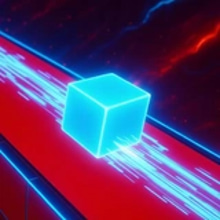
Fit In looks almost too clean at first. A shape. A lane. A wall with a cutout. You think, alright, this is going to be one of those calm little reflex games. Then the speed hits you. The wall rushes in like it has somewhere important to be, and your tiny shape suddenly feels like a fragile secret you must protect with perfect timing. You are not steering left and right for fancy reasons. You are surviving. You are matching geometry on instinct, flipping from square to circle to triangle in that tiny window between “I saw it” and “I am already crashing.” 😅
It is an endless runner style arcade loop, but instead of dodging obstacles, you become the answer. That is the hook. The obstacle is not something you avoid, it is something you fit into. And the second you understand that, the game turns into a strange little obsession.
⚡🧠 Your fingers react first, your brain catches up later
Most games give you time to think. Fit In does not really do that. It gives you a heartbeat. You see the opening. You feel the choice. You switch. If you hesitate, you lose. If you overthink, you lose. If you get cocky and switch too early, yep, you lose again.
There is a sweet spot where you stop “deciding” and start responding. Square appears, you become square. Circle appears, you become circle. Triangle appears, you become triangle. It sounds mechanical when you say it out loud, but in practice it feels like juggling in a windstorm. Your mind starts running predictions, little micro guesses about what might come next. And sometimes you guess right and feel like a wizard. Other times you guess wrong and faceplant into a wall like a confused piece of plastic. 😭
🧱🚪 The walls are basically questions you must answer instantly
Every barrier is a question with three possible answers, and the game asks them faster and faster until you start laughing at how serious you are taking basic shapes. The openings look obvious, but the trick is the tempo. That tempo keeps tightening. The pace ramps up in a way that feels sneaky. You do not notice you are going faster until you realize you are not blinking.
What makes it fun is how clean the feedback is. If you fail, you know why. Wrong shape. Late switch. Early switch. It is brutally fair. That fairness makes you want to retry, because you do not feel cheated. You feel challenged. The game is basically saying, you can do this, you just did not do it yet.
🔄🎯 Switching feels easy until it suddenly becomes choreography
At low speed, switching is casual. At high speed, switching becomes rhythm. You start building a muscle memory pattern, and your hands start moving with the beat of the obstacles. It is not music, but it feels musical anyway. Switch. Hold. Switch. Panic switch. Recover. Switch again. 😵💫
And there is a specific moment you will recognize if you play long enough. The moment you stop thinking of the shapes as “square, circle, triangle” and start thinking of them as “mode one, mode two, mode three.” That is when you level up. Because now you are not translating visuals into words. You are reacting directly to form. It is faster, smoother, almost automatic, like your eyes are speaking directly to your fingers.
🏃♂️💨 Endless runner energy without the usual distractions
Fit In is endless, which means the real opponent is you. Your focus. Your consistency. Your ability to stay sharp when you are already doing well. That is the funny thing about high score games. The better you play, the more pressure you create for yourself.
You get into a good run and suddenly every wall feels louder. Your mind starts whispering, do not mess up now. And that whisper is dangerous, because it pulls you out of flow. The game becomes a tug of war between calm and panic. The best scores happen when you stay calm, even when the speed is ridiculous. You treat every wall like it is just the next one, not “the wall that could ruin everything.” Easy to say, hard to do. 😅
🧊🔥 The speed curve is where the real drama lives
The acceleration is the whole story. Early on, you are learning. Mid run, you are adapting. Late run, you are basically surviving on pure reflex and stubbornness. The time you have to react shrinks until the openings feel like they appear inside your face.
And yet, that is what makes the game addictive. It creates that thrilling edge where you are not sure if you are in control anymore, but you are still somehow doing it. You will have moments where you switch perfectly three times in a row at top speed and your body does a tiny celebration all on its own. Like, yes, I am still alive. I am still fitting. I am still winning. 🎉
Then you fail on the next wall because you blinked. That is also part of it. The game keeps you humble.
🌀😅 Failure is instant, but it never feels heavy
One error and you start over, which sounds harsh, but it works here because the loop is so fast. Restarting is not a punishment, it is a dare. You are back in instantly, chasing the run you just lost, trying to prove you can get back there and go farther.
And because the concept is so simple, each attempt feels like practice with real progress. You get sharper. Your timing improves. You start recognizing the moment to switch, not too early, not too late, right in that satisfying middle where everything clicks.
👀🧩 Focus turns into a weird kind of relaxation
This might sound backwards, but once you get into flow, Fit In can feel calming. Not calm like a slow game, calm like a laser beam. Your thoughts get quiet. You are only watching shapes and responding. No distractions. No complicated objectives. Just pure concentration.
It is the kind of casual arcade game you can play for a minute and feel awake, or play for longer and fall into that trance where the outside world disappears. Then you crash, the spell breaks, and you realize you were holding your breath for no reason. 😮💨
That is good game design. It pulls focus without demanding a huge time commitment.
🏆⚙️ The high score chase and the little tricks you learn
If you want better scores, you learn to stop flinching. You learn to switch with confidence, not desperation. You learn to keep your eyes slightly ahead, reading the opening early without switching early. That difference matters.
You also learn not to get greedy. When you are close to your best score, your hands get jumpy. You start switching too soon because you are trying to be “ready.” But readiness in Fit In is patience. Let the shape be what it is until the last clean moment, then commit. That tiny discipline is what separates a good run from a great one.
🌐🚀 Why Fit In works so well on Kiz10
Fit In is pure browser friendly speed. It is an arcade reflex game that loads fast, explains itself instantly, and keeps you chasing one more attempt without needing anything extra. It is perfect for short breaks, long score hunts, and those moments where you want a simple challenge that still feels intense.
If you love endless runner style pressure, quick reaction puzzles, and clean geometry gameplay where your brain is the engine, Fit In delivers. Start a run on Kiz10, match the shapes, and see how long you can stay perfect when the walls stop asking politely. 🟦🟢🔺





 3.5 (154 votes)
 Share
Share
 Embed
Embed


