❄️ White noise and a red flame
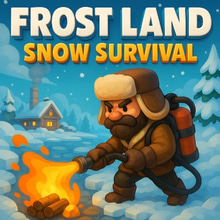
The first sound you learn to love in Frost Land Snow Survival is not music. It is the hiss of a pilot light, a small defiant whisper against a world made of ice. You step outside your tiny shelter and the cold bites like it has teeth. Snow dunes blur the horizon, the wind keeps stealing your breath, and the only color that looks alive is the tongue of fire in your hand. The flamethrower is not a gimmick here. It is your shovel, your lamp, your negotiation with a season that wants you gone. One squeeze and the crust gives way, revealing a glimmer of metal, the dark grain of buried wood, a patch of frozen ore that could become a wall, a door, a heater, a life.
🔥 The tool that eats winter
Using the flamethrower is equal parts science and instinct. Short bursts expose fragile resources without wasting fuel. Longer sweeps carve safe paths, opening lanes to supply caches you could not reach five minutes ago. The trick is to think three steps ahead. Melt a corridor to the crates, then widen it into a service trench so you can sprint back when the temperature drops hard. Heat management is a rhythm you learn by feel. Stand too long and fuel drains into pretty sparks. Move too fast and you miss the faint shimmer under ice that could have been exactly what your base needed.
🏚️ Four walls are not shelter if they cannot hold heat
Your starting refuge is basically a shed with an attitude. It keeps the wind off your face and that is about it. Survival turns it into a proper base one careful layer at a time. Patch gaps where the snow tries to crawl inside. Reinforce the door so blizzards stop rattling it like a drum. Add insulation to stop the home from bleeding warmth the second you step away. You will build a heater, then a second, then a backup because experience teaches you heaters choose to fail at midnight. Floor panels matter. Roof angles matter. Every upgrade buys you minutes of safety and those minutes are the currency you spend on exploration.
🧭 What to melt, when to risk
Frost Land is not a circle you clear in neat rings. It is a map of calculated gambles. To the east a field of drifted snow hides timber. To the north a jag of black rock promises ore, if you can find your way through the crust before the wind spikes. To the west the map looks flat, which means it is probably a maze of sun-hardened ice that will eat your time. Each outing begins with a decision do you chase materials for comfort, or tools that unlock the next radius of freedom Every choice echoes. Spend precious fuel on a long dig and you return heavy, slow, fingers numb. Play it safe and your base stays cozy but small, not ready for the next cold snap.
🧰 Crafting warmth, crafting time
Progress here is not a single tech tree; it is a practical notebook full of fixes. You cobble together a better tank, then discover the hose freezes unless you route it inside a warmed sleeve. You build a crude windbreak and suddenly your fuel lasts longer because every flame does not have to fight a cross-gust. You add a small generator, then realize you can place heated floor grates along your main corridor so snow does not reclaim it while you sleep. It is satisfying in the way good survival games are satisfying small upgrades stack until the entire loop feels different, safer, braver.
🧊 The map changes even when you do not
Ice is not an inert wall. Powder refills trenches, crust shifts after storms, crevasses creep where you thought the ground was solid. You will come back to a path you carved yesterday and find it thinner, meaner, ready to trap you if you do not widen it. Frost quakes snap fragile arches with no warning beyond a tremor you pretend you imagined. Accept that maintenance is part of exploration. Build beacons. Run heated lines. Mark routes with anchored stakes that refuse to tip even when the world tries to erase your tracks.
🕯️ Moments that feel almost warm
Everything is not pain. There are slices of comfort you start protecting with the kind of devotion usually reserved for pets. A small room where condensation paints the window in soft halos. A kettle that sings when fuel is steady. The glow of a heater bathing the workbench while you assemble a better nozzle with stiff fingers and a ridiculous grin. You begin to schedule your day around these rituals. Wake, check the gauges, melt the drift by the storage door, brew something hot, then run your errands on the ice before the weather changes its mind. The routine is a shield. When you respect it, you make fewer dumb choices.
🧠 Strategy in a place that does not care
Frost Land punishes noise in your decision making. Expanding too fast starves your stockpile. Hoarding too long traps you in a shelter that cannot handle the next storm. The best runs feel like chess played with frost. You set up future moves by clearing supply lanes and staging fuel caches half a dig away from tomorrow’s plan. You pre-melt a pocket in a field because you know you will need a place to breathe when the temperature drops mid-expedition. You time the big digs to daylight windows because digging in the blue hours doubles risk for no good reason beyond ego.
🎧 Sound of survival, sight of success
You read the world with your ears as much as your eyes. The flamethrower has a happy purr when pressure is right and a sick rattle when ice starts choking the feed. Snow sounds different when you stand over timber versus stone a faint hollow that says dig here, not there. The sky talks too. A whistle becomes a roar becomes the kind of low, angry hum that means put your back to a wall until the gust passes. Visuals tell the other half of the story frost flowers on the inside of a pane, a shadow where no structure stands, steam that fades too quickly because wind just turned.
🧪 Fail, adapt, build smarter
You will mess up. Everyone does. You will melt a perfect cul-de-sac by mistake and spend an evening filling it back in because cold air loves dead ends. You will chase a “quick” ore node and return with nothing but a half-frozen tank and a new respect for weather. The point is not perfection. The point is how fast you turn hard lessons into design. Next time you string heat stones along the return path. Next time you bring a spare regulator. Next time you mark your dig with vertical stakes so drifting powder cannot hide your exit like a magic trick.
🏁 Why you keep stepping outside
Because every meter you win from the snow makes the map feel bigger. Because the base starts to look like a real home, not a stubborn tent. Because clearing a corridor to a frozen truck, then stripping it for parts while your heaters hum like a choir, feels like stealing treasure from winter itself. The cold never stops trying, but neither do you. One more trench, one more cache, one more circle of warm light in the blizzard and suddenly this place is not only survivable. It is yours.





 Share
Share
 Embed
Embed


