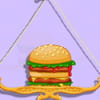
The first time you see the scale in Get the weight, it looks harmless. Two pans, a mysterious object on one side, a handful of chunky metal weights on the other. No timer screaming at you, no explosions, just quiet pressure and a very simple question: how heavy is this thing, really? That calm is a trap. Two clicks later you are deep in a tiny obsession, nudging numbers, swapping weights and muttering that cannot be heavier than a football, come on.
This game is built around one elegant idea: balance the beam. On the left, an unknown object, maybe a ball, a box, a strange shape you swear should not weigh that much. On the right, a collection of standard weights in different sizes. Your goal is to place, remove and rearrange those weights until the beam hangs perfectly level. No hint shouting the answer, no calculator built into the UI. Just you, your logic and the stubborn personality of a piece of metal that refuses to sit straight until you get the math right.
It starts simple. Early puzzles feel like warmups: a light object, a couple of small weights, and a solution you can almost guess without thinking. You drop a one-unit weight on the pan, watch the beam barely twitch. Add another. Too far. Remove one, switch to a bigger weight, and suddenly the bar lines up in that perfect horizontal line that feels more satisfying than it has any right to be. In that moment, it is not just a balance scale. It is a scoreboard for your brain.
As you progress, things get messier in the best way. The game introduces larger weights, more combinations, trickier objects and setups where the obvious guess fails instantly. You start doing quick mental arithmetic without realising it, calculating differences, estimating how far off you are, and treating every small tilt as an honest piece of feedback. A slight dip tells you you are close; a massive tilt tells you you missed by a mile. There is no need for complicated menus when gravity itself is the judge.
One of the most charming parts of Get the weight is how physical it feels despite being a browser puzzle on Kiz10. Dropping a weight onto the pan has a tactile satisfaction, like placing a real chunk of metal and waiting for the mechanism to react. You can almost hear the tiny creak of the scale as it decides whether you were right or wrong. Watching the beam swing, overshoot, wobble and finally settle into balance turns each attempt into a miniature story of “almost” and “too much” and “finally”.
Behind the jokes and the funny premise there is real logic training hiding in plain sight. Every puzzle teaches you to break a problem down into smaller pieces. You look at the tilt, estimate the difference, and think in terms of combinations. Maybe you overshoot by three units; can you swap a five for a two and a one? Maybe you are short by just one small unit, so you add a tiny weight and watch the beam straighten like it just reluctantly admitted you were right. Without any textbook in sight you are playing with ideas like equivalence, sums, differences and approximation.
The difficulty curve has that good kind of bite. The game rarely feels unfair, but it absolutely punishes lazy guessing. Spam random weights on the pan and you will end up with a wildly seesawing beam that tells you nothing useful. Take a second to actually read what the scale is doing and suddenly each move becomes information. You learn to change one thing at a time instead of rearranging everything, so you can understand exactly which weight is causing trouble. That mindset is what turns the game from a toy into a proper brain workout.
Get the weight also nails the tempo. Levels are short enough to finish in a minute or less once you know what you are doing, but dense enough to feel meaningful. It is perfect for quick sessions: open the game, balance a handful of scales, feel smarter than you did five minutes ago, then hop back to whatever you were doing. Or ignore the clock completely and sink into a longer run where each puzzle feels like a tiny puzzle book page you actually enjoy solving, instead of something forced.
There is a playful side to the presentation too. The objects on the scale change, giving you visual variety and a steady sense of progress. Some items look obviously heavier; others look deceptively light. You start developing little headcanon weight charts in your mind. This one must be big but hollow. That one looks small but dense. The visuals do not tell you the exact answer, but they give you just enough context to start guessing, which makes each solution feel like a combination of intuition and proof.
If you are into puzzle games that respect your intelligence, Get the weight is exactly the kind of quiet challenge that sticks with you. There is no overcomplicated plot, no unnecessary clutter. It is pure, focused gameplay: balance, think, adjust, solve. It is also surprisingly replayable. Come back later and try to solve puzzles using fewer moves or relying more on mental calculation instead of brute-force experimentation. The mechanics are simple enough for kids to understand and deep enough for adults to enjoy as a warmup for their brain.
On Kiz10, this little scale puzzle fits perfectly among other logic and physics games. It loads quickly in your browser, works on desktop or mobile, and feels right at home next to other brainteasers that reward patience over speed. Whether you treat it as a light educational game, a calming math snack or a way to see who can solve each level in the fewest moves among friends, Get the weight turns a basic balance scale into a surprisingly engaging playground for your logic.











 4.8 (100 votes)
 Share
Share
 Embed
Embed