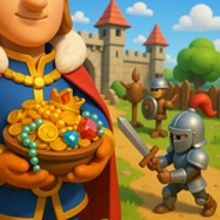
Knight Academy: From rookie to legend isn’t the kind of fantasy game where you swing the sword yourself and pose on a cliff. You’re the person behind the curtain, the ruler of the academy, the one who decides what gets built, who gets trained, who gets upgraded, and who gets fused into something terrifyingly efficient. It starts off almost innocent. A small school, a few awkward rookies, basic training gear that looks like it creaks when you touch it. Then the loop bites you, and suddenly you’re thinking like a medieval CEO with a crown on and a notebook full of “just one more upgrade” lies. 😅🏰
⚔️🏫 The academy is your weapon
The whole place is a system, not a backdrop. Buildings aren’t decoration, they’re levers. You upgrade a structure and it changes the pace of everything. Gold starts flowing faster, training becomes smoother, new options open up, and your academy goes from “tiny camp” to “powerhouse” without a dramatic cutscene. The drama is in the numbers moving and the momentum building. It’s like watching a slow engine catch fire in the best possible way, the good kind of fire that powers a furnace, not the kind that burns your kitchen down. 🔥
At first, you’ll probably play a little messy. That’s normal. You place equipment, you buy something because it looks useful, you hire a few knights because you want the roster to feel alive. It’s fun and chaotic. Then you notice bottlenecks. Training is too slow. Income can’t keep up. You’ve got too many weak recruits clogging your space. The moment you notice that, the game changes. Now you’re not just clicking upgrades. Now you’re building a plan, even if that plan is mostly held together with optimism and caffeine. ☕😈
🧑🎓🛡️ Rookies that turn into monsters
Hiring knights is the heartbeat. These recruits start as rookies, the kind of warriors that look like they’d apologize to a training dummy before hitting it. But the game gives you a simple, addictive promise: if you invest in them, they evolve. They become stronger, more valuable, more profitable. You can feel the improvement in a way that’s weirdly satisfying, because you’re not only making fighters, you’re making an economy. Stronger knights don’t just win harder, they earn more. More earnings means more upgrades. More upgrades means even stronger knights. It’s a loop with teeth.
And the funny part is how quickly you get attached to the process, not the individual. You’ll stop thinking “this knight is cool” and start thinking “this tier is efficient.” You’ll chase higher ranks like they’re rare collectibles, and when you finally fuse up into a stronger warrior, you get that little spark of victory that feels way bigger than it should. Like, congrats, you combined two helmeted dudes into one helmeted dude, why are you grinning? Because it works. Because it’s progress. Because your academy is becoming a legend, one merge at a time. ⚔️✨
🔀⚡ Merging is cleaning, but violent
The merge mechanic is the secret sauce. It’s simple on paper: combine matching knights to create a stronger one. In reality it becomes the most satisfying kind of “tidying up.” Your roster fills, you line up equivalents, you merge, and suddenly your clutter turns into power. It feels efficient, almost soothing, like you just organized a chaotic desk and discovered it also doubled your income.
Merging also forces a new kind of strategy. You don’t only hire for numbers, you hire with intent. You want chains. You want upgrades that keep recruitment flowing so merges keep happening. Because when your merge engine is running smoothly, the game accelerates. Everything starts feeding everything else. You get more gold faster, which lets you upgrade buildings faster, which lets you hire better, which lets you merge higher. The academy turns into a machine that doesn’t stop unless you mess something up… and you will mess something up, because humans love touching the wrong upgrade button at the worst moment. 😅🧠
🧱🏰 Buildings, gear, and the art of not wasting money
The fun tension is deciding where your gold goes. You can spend it on structures that boost income, equipment that improves training, expansions that give breathing room, or direct upgrades that push your knight power up right now. The game doesn’t lock you into one correct route. It dares you to choose and then live with the consequences.
If you go heavy on power early, you’ll feel strong quickly. It’s exciting. You’ll punch through progression like a battering ram. But you might also run into the classic management trap: your infrastructure can’t support your ambition. You’ll want to recruit more, but you can’t afford it consistently. Or you’ll have tons of rookies but not enough training speed to make them valuable. Or you’ll have great training but not enough space, so your flow jams and you sit there staring at a full roster thinking, okay… now what?
If you go heavy on economy and buildings early, it feels slower at first, but when it kicks in, it kicks in hard. Suddenly upgrades don’t feel expensive. They feel inevitable. That’s the moment where you become dangerous, because now you’re not struggling to grow, you’re deciding how fast to grow, and your biggest enemy becomes your own greed. 💰😈
🗺️🌲 Expanding territory makes it feel like a kingdom
The academy doesn’t stay in one tiny corner forever. As you progress, you discover new territories and unlock more possibilities. That expansion is important because it changes the vibe: you’re not just managing a school, you’re extending influence. New land feels like new chapters. It’s a fresh layer of motivation because it gives you goals beyond “upgrade everything.” It’s more like: upgrade so you can reach that next area, because the next area means better returns, new content, and a bigger sense of scale.
And scale is what this game sells. You start small. You end big. The transformation is the story. It’s not delivered by long dialogue, it’s delivered by the way your academy evolves from a modest training yard into a chivalric empire that prints elite warriors like it’s nothing. 🏰⚔️
😵💫🧠 The moment you feel in control is when you make a mistake
There’s a specific mood shift that happens. Your systems start working. Your upgrades are clicking. Your income is steady. Your merge flow is clean. You feel confident. Then you do something slightly wrong and everything wobbles. Maybe you invest too much into one building and neglect recruiting. Maybe you merge too aggressively and end up with not enough units to keep the chain going. Maybe you expand late and choke your roster. It’s not a disaster, but it’s a slowdown, and you feel it immediately.
That’s where Knight Academy becomes genuinely engaging, because it rewards observation. You upgrade, you watch what changes, you correct the bottleneck. It’s a cycle of tuning. Like you’re adjusting a medieval engine, tightening bolts, feeding fuel, making sure the whole machine runs smooth. When you start playing like that, you stop feeling like you’re clicking. You start feeling like you’re ruling. 👑✨
⚔️🔥 The “legend” part isn’t a title, it’s a feeling
By the time the academy is rolling, you don’t just have stronger knights. You have momentum. Your earnings climb, your options widen, your upgrades stack, and the whole thing becomes this satisfying spiral upward. The game hits that sweet spot where progress is fast enough to feel exciting but structured enough to feel earned. You’re always chasing the next tier, the next upgrade, the next territory. You keep thinking you’re one step away from “perfect.” Then the game offers you another improvement and your brain goes, okay, fine, one more. Just one. 😅
Knight Academy: From rookie to legend on Kiz10 is for players who love growth games that feel alive: recruiting, merging, upgrading, expanding, and planning a progression path that turns a humble school into an unstoppable order. It’s cozy at the start, greedy in the middle, and proudly overpowered at the end. And if you catch yourself whispering “I’ll stop after this upgrade,” just know the academy heard you… and it’s smiling. ⚔️🏰💰








 Share
Share
 Embed
Embed


