🛬 Fire, salt, and a heartbeat in the wreckage
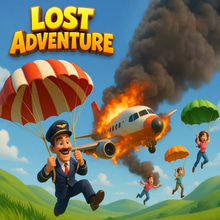
The engine coughs one last spark, the wings kiss treetops, and silence lands harder than the plane. Lost Adventure begins in that breath after disaster, when the world goes very still and every sound matters: wind in palms, gulls heckling from the cliffs, your pulse drumming like a flare that didn’t fire. You’re a pilot with scraped knuckles, a torn map, and a responsibility bigger than the crash site. Passengers are missing in the jungle’s green mouth. Supplies are scattered like confetti after a party you didn’t plan. And the island—beautiful, moody, deeply inconvenient—has a puzzle hidden inside every rock face and tide pool. Survive, sure. But more than that, think. Build. Guide. Rescue.
🧭 Survival with a brain: the loop that hooks you
Lost Adventure balances the grit of survival with the sweetness of problem-solving. You’ll scavenge wire, canvas, and rope from the fuselage, then trade those for tools that turn the landscape into an ally. A broken prop becomes a lever. A shard of cockpit glass becomes a makeshift lens that lights a fire when the sun cooperates. Freshwater trickles through limestone into a pool you can channel with a rock dam so a pressure plate triggers a bridge. The best moments feel earned, not handed to you: a quiet click, a sliding door, a path that didn’t exist until you noticed the pattern in the lichen.
🗺️ The island isn’t scenery—it’s a machine you can read
Nothing here is random. The beach talks in tides and drift lines. The jungle hides switchbacks in its roots. Cliffs hold pictographs that double as voltage diagrams for a wind-up generator you’ll definitely jury-rig. Mangrove channels braid like a maze, but watch the crabs; they walk the safe sandbars at low tide, and if you mirror them you’ll cross without sinking. A canyon hums at dusk; follow the sound and you’ll find a cave where wind turns chimes into a combination lock. The more you look, the more the place feels intentional—like the island wants to be solved.
🛠️ Crafting that respects your time (and your cleverness)
Recipes aren’t chores; they’re tiny stories. Vine plus branch plus shard equals a makeshift machete that opens the green without burning daylight. Cloth plus resin plus ash becomes a sturdy water filter; the first time you fill your canteen and don’t regret it five minutes later, you’ll toast the sky. Scrap wire and a hand crank, anchored to a driftwood axle, produce a generator that powers a lamp just long enough to map a ruin mural. You’re not grinding; you’re iterating, solving bottlenecks with objects that feel scrappy and right.
🧩 Puzzles that cooperate with physics, not against it
Every obstacle is a conversation with reality. A boulder sits on a ledge; balance a plank as a lever and use a sandbag you stitched from canvas to nudge it just enough to free the path. A waterfall hides a passage; redirect a trickle with stacked shells and the weight of your pack, lower the flow, step through. A ravine gapes, smug; build a rope bridge one anchor at a time, then tighten it by walking backward with the line around your waist like an alpine guide. The solution feels physical because it is—no arbitrary keys, just mechanics you can test with your hands.
🧑✈️ You’re not alone—rescue is the mission
Passengers are marooned by luck and geography: a botanist on a terrace gardened by accident, a kid hiding in a driftwood fort, an accountant loudly negotiating with a coconut tree. Each has a fear, a skill, and a puzzle you must solve to earn their trust. The botanist knows which vines won’t poison your breakfast. The kid can wriggle into vents you can’t. The accountant counts waves and realizes the tides run on a pattern you can exploit like a schedule. You guide them back to camp, then rearrange that camp as your miniature city of survival—pots over coals, a hammock triangle that keeps spirits up, a lantern that turns night from enemy to compromise.
⏳ Time is the real antagonist
The sun keeps its own score. Day brings visibility, warmth, and wandering. Night brings cold, fog, and the uneasy chorus of things with teeth. Weather matters: storms refill cisterns but rip down rope bridges; wind lifts your kite signal but steals tents if you ignore pegs. A countdown hums behind every choice—not a harsh timer, but an awareness that “later” costs more than “now.” Spend the daylight on distance, save dusk for camp craft, and leave the risky climbing for mornings when your hands don’t shake.
🌄 Biomes that shake up your thinking
Shoreline puzzles favor water logic—float, dam, siphon, ferry. The rainforest asks for machete math—clear, stack, brace, listen for birds that hint at safe ridges. Karst caverns transform light into tool; you’ll bounce sunbeams off polished shells into prisms that unlock hatches like a gentle heist. The plateau is wind country: pinwheels, kites, and weather vanes become keys in a mechanical song you learn by ear. Each region forces a new craft habit, then slyly tests whether you remember the old ones under pressure.
🧠 Choices with a pulse: strategy under stress
Lost Adventure plays fair but tough. Triage matters. Do you spend sap and cloth on a sturdy torch for a cave you’re not sure exists, or sew a second water skin so your next trek lasts longer? Do you rescue the louder survivor first because they’re closer, or the injured one deeper inland because time is a cruel accountant? The game never scolds, but outcomes ripple. Save the botanist early and your food choices expand; delay, and you’ll live on roasted roots longer than anyone prefers. It’s not morality theater; it’s logistics with feelings.
🧰 Tools that evolve with you
Your kit upgrades in ways you feel in your fingers. The first hook is clumsy; later you craft a piton set that lets you place anchors mid-climb. Your map begins as a smudged sketch; add charcoal notes and shell inlays for landmarks, and it becomes a living document that tilts when you tilt your head. Even your pack changes: rearrange straps and suddenly you can carry the extra coil of rope that turns a “no” into a “yes” on a north face. Progress is practical, not abstract.
🎧 Sound and sight that quietly coach
The jungle clicks in triplets when the katydids wake; that means fog is coming and you should light camp early. Waves slap the reef in a seven-count during spring tide; that’s your window to cross the shoal. A creaking vine signals bad tensile strength before it snaps; a taut hum in your rope means your anchor is good. Visuals are candid: wear on planks equals weakness, chalk marks equal safe handholds, bird flight paths equal hidden routes. Nothing lies; you just have to listen.
📝 Tiny field notes from a nervous optimist
Make your first filter before you’re thirsty; the island respects foresight. Travel light in the morning and heavy in the evening when paths are familiar. Pack one luxury—tea, a photo, a joke—because morale is a tool you can’t craft. When a puzzle refuses to blink, change the lens: crouch to see low angles, climb for air maps, or watch shadows at noon to reveal alignments that morning hid. And talk to your people. They carry hints in their stories, and they remember details your adrenaline forgot.
🥾 Why it belongs on Kiz10
Lost Adventure threads a perfect needle: survival that matters, puzzles that delight, and rescue stakes that turn every success into a warm exhale. It’s readable, replayable, and rich with those tiny, human victories that linger after you close the browser—the hiss of a new flame, the first clean sip, the sight of camp lights winking through palms because you built them. If you crave brainy exploration with heart, a world that rewards careful eyes, and a mission where crafting a tool can save a life, this is your island. Bring courage. Pack curiosity. The rest you’ll make on the way.





 2 (240 votes)
 Share
Share
 Embed
Embed


