🏰 Upward, angry, and already on fire
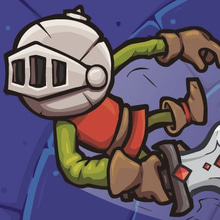
Nightmare in the Tower is the kind of game that does not believe in gentle beginnings. It throws a knight into a cannon, points him straight at disaster, and basically says, good luck up there. That is the mood from the first second. On Kiz10, this fast vertical action game is all about blasting upward through a tower packed with monsters, danger, and the kind of rising lava that really ruins your plans if you stop paying attention for even a moment. The basic loop is immediate and brilliant: launch, slice, bounce higher, keep climbing, do not fall apart mentally.
What makes it hit so hard is the movement. This is not a slow platform game where you carefully line up jumps and politely explore corners. No. Nightmare in the Tower is upward panic with style. You fly, dip, strike, rebound, and try to stay alive while the screen keeps asking one rude question after another. Can you keep the combo going. Can you hit enough enemies to maintain height. Can you outrun the lava. Can you rescue the princess before gravity, monsters, and your own terrible decision-making form a coalition against you.
And somehow, through all that chaos, the game stays weirdly elegant. Everything revolves around momentum. Lose it, and things go ugly fast. Keep it, and the whole tower starts to feel like a vertical dance of steel, risk, and very poor safety regulations. That feeling is what makes the game so easy to love. You are not just surviving. You are climbing like a maniac, building a run out of impact, timing, and increasingly suspicious confidence.
⚔️ Monsters below, princesses above, lava everywhere
The fantasy here is delightfully ridiculous, which is exactly why it works. You are not creeping through the tower room by room like some cautious hero with a map and a backup plan. You are launching yourself upward like a medieval missile and cutting through every creature unlucky enough to be between you and the next rescue. It is heroic in the most chaotic possible way.
That rescue angle matters more than it first seems. A lot of action games give you motion without purpose. Here, every climb has a target. There are princesses trapped higher and higher in the tower, and your job is to reach them before the whole run turns into a lava-soaked tragedy. That simple structure gives the action a heartbeat. You are not climbing for abstract points alone. You are pushing upward because there is always something just out of reach. Another captive. Another section. Another chance to go farther than last time.
The lava, meanwhile, is basically the world’s least patient supervisor. It does not care about your upgrades, your intentions, or your dramatic inner monologue. It rises. Constantly. Relentlessly. Beautiful mechanic, honestly. It keeps the whole game from ever becoming passive. You cannot just hang in the air and admire your own swordsmanship. The tower is not a museum. It is a vertical emergency.
That pressure is what gives Nightmare in the Tower its personality. Without the lava, it would still be fun. With the lava, it becomes frantic, urgent, and just a little bit cruel. In the best way. The game knows that speed is not exciting unless failure is breathing down your neck. Here, failure is molten and climbing fast.
🪙 Coins, upgrades, and the sweet science of getting ridiculous
Then comes the dangerous part: progression. Because once a game gives you coins and upgrades, your brain stops being normal. Suddenly every run is not just a run. It is an investment. You start thinking like a deranged tower economist. Maybe one more attempt gets enough gold for a stronger launch. Maybe better armor helps. Maybe sharper weapons mean cleaner kills and better bounce control. Maybe this time the whole run changes because one upgrade finally clicks.
That system is a huge part of why the game becomes so addictive. Nightmare in the Tower is not only about reflexes. It is also about growth. Each failure feeds the next attempt. Each near-success feels useful. You crash, burn, collect your reward, buy a little power, then come back angrier and faster. Perfect loop. Browser games live and die by loops like that, and this one is excellent.
The upgrades also create a very satisfying emotional arc. Early on, you feel scrappy. Barely in control. Desperately trying to chain hits together before the lava turns your heroic mission into soup. Later, once your knight becomes stronger, launches harder, and stays airborne longer, the whole tower begins to feel different. Not easier, exactly, but more possible. You stop surviving moment to moment and start attacking the climb with intention.
And that change feels fantastic. Progress in a game like this should feel physical. Heavier launch. Better strikes. More confidence. More reach. The tower still fights back, but now you are answering with upgraded nonsense of your own. Excellent. Fair. Medieval. Sort of.
🐉 Why every run feels like a tiny action movie
The best thing about Nightmare in the Tower is how cinematic it feels without needing long scenes or big speeches. The action itself tells the story. You launch upward. A monster appears. You slash through it. Another one becomes your next stepping stone. The lava creeps closer. A princess waits higher up. Somewhere in the middle of all this, your brain stops processing it like a game and starts treating it like a desperate airborne rescue sequence directed by chaos.
That is rare. A lot of browser games are fun, but not many feel dramatic in motion. This one does. A good run has rhythm. Lift, strike, bounce, collect, dodge, climb. It is frantic but readable. Wild but not random. When things go well, it feels like you are improvising brilliance in real time. When they go badly, it feels like gravity itself got offended and filed a complaint.
There is also something deeply funny about how much pressure the game can create from such a clear idea. Go up. Hit enemies. Rescue princesses. Avoid lava. That is basically it. Yet within that structure, the tension becomes real. Miss one opportunity and you drop lower than you wanted. Drop lower and the lava starts looking personal. Suddenly your fingers matter, your timing matters, your route matters. Tiny mistakes grow teeth.
That is what keeps players in the loop. Not only the spectacle, but the knowledge that the next run could be cleaner. The next run could be the one where you never lose control. The next run could be glorious instead of embarrassing. Probably glorious. Maybe.
👑 Built for players who like speed with consequences
Nightmare in the Tower on Kiz10 is a perfect fit for players who enjoy vertical action games, knight adventures, monster-slaying arcade runs, and upgrade systems that turn repeated attempts into real progression. If you like games that move fast but still reward timing and decision-making, this one lands beautifully. If you enjoy that constant “one more run” feeling, it is practically engineered to ruin your schedule.
It also has that rare quality of feeling simple and deep at the same time. The controls and objective are easy to understand, but the rhythm of mastering launches, chaining kills, and maximizing airtime keeps pulling you back in. You always feel like there is another better version of your run waiting just ahead. Slightly cleaner. Slightly faster. Slightly less tragic.
So yes, Nightmare in the Tower is loud, frantic, heroic, and wonderfully unreasonable. It takes a knight, a tower, a sword, a stack of monsters, several kidnapped princesses, and a deeply aggressive amount of lava, then somehow turns all of that into one of the most satisfying upward action loops around. Launch high, cut clean, and do not look down. There is absolutely nothing good happening below.





 Share
Share
 Embed
Embed


