Red and blue on the same battlefield 🟥🟦
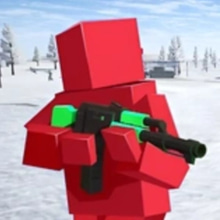
Red Blue Leader feels like someone took an old school military shooter, plugged an AI brain into it and then painted the whole battlefield in two loud colors so you can never forget who is winning. You drop into the map not as a lone hero but as part of a squad, surrounded by teammates and enemies whose blood literally marks the ground in red or blue stains. Every splatter tells a story about where someone tried to push and where someone died trying. It looks a little chaotic and a little funny at the same time, because that is exactly the tone of the game.
Under all the color and noise, the goal is brutally simple. Your team and the enemy team are locked in a score race. You win if your side gets far enough ahead, or if you completely crush the other lane and steal every spawn point they have. It is a classic concept dressed in modern behavior. The AI does not just stand there waiting for you. It uses cover, rushes objectives and reacts when fights shift, so even if you are playing solo against bots the battlefield never feels empty.
From boots to rotors to waves 🚶♂️🚙🚁🛥️
One of the first things you notice is how many ways you can be present on the map. On foot, you feel every corner and wall. You peek, crouch with C to make yourself smaller, run with Shift when you need to cross open ground and try not to get picked off in the middle of a bad idea. Movement with WASD and the mouse feels familiar, like any classic shooter, but the ragdoll physics add just enough weirdness that every fall and every hit looks unique.
Then you slide into a vehicle and the mood shifts. Maybe you jump into a car, hit the seat and tap F to take control, roaring down a lane your team was struggling to hold. Maybe you lift off in a helicopter and suddenly the same map looks tiny under your rotors, lanes crossing far below while tracers climb toward you. Or you take a boat and skim over water that used to be a hard boundary, turning rivers and coastlines into surprise flanking routes.
This mix of infantry and vehicles is where a lot of the fun lives. You might start a match trading shots in alleys, then five minutes later you are gunning from a chopper trying to cover a teammate who is stealing a flag on the ground. Switching roles mid match keeps your brain awake and makes the map feel bigger than it really is.
Flags, multipliers and the language of score 🚩📊
Red Blue Leader is not just about kills. Every time you capture a flag you change the math of the entire match. Flags are not simple trophies. Each one raises your team’s flag multiplier and adds another spawn point you can use to return to the fight. That means every future kill your side gets is worth more points and every future death happens closer to the action.
You start to see the map as a network of pressure points. A flag near the center is not just a symbol of control, it is a lever. Hold it long enough and the score lanes at the top of the screen start to bend in your favor. Ignore it and you might win a lot of local duels while still losing the overall war. The team score lanes are there to keep you honest, quietly reminding you which color is actually ahead no matter how good your last streak felt.
Winning by killing the enemy is satisfying, but winning by suffocating their spawns feels just as brutal. When your side owns most of the flags, the other team slowly loses safe places to appear. Suddenly they are forced into predictable corners, and your attacks start feeling less like random fights and more like cleanup operations. On the other hand, playing from behind and managing to flip a key flag in the middle of a losing game can swing the multiplier so hard that you feel the momentum flip in your chest.
Active physics and ragdoll chaos 💥🧠
The game advertises itself as a ragdoll physics shooter, and you feel that claim the moment the first grenade goes off near a group of soldiers. Bodies do not just fall, they tumble, spin and crumple in ways that are half realistic and half ridiculous. A soldier shot on a staircase might roll all the way down, leaving a smear of team colored blood that acts as a warning sign for anyone who follows.
This physicality is not just cosmetic. Vehicles bump, slide and react to uneven ground. A car hitting a small obstacle at the wrong angle can send you drifting into a hail of bullets. Landing a helicopter too aggressively can turn a stylish entrance into a flaming wreck. Boats ride the water in a way that makes sudden turns feel risky but rewarding. All these little details make every skirmish slightly unpredictable, and that unpredictability is exactly what creates those memorable moments you retell later.
At the same time, there is strategy hidden beneath the ragdolls. Once you know how a truck handles or how far a body might fly from an explosion, you can start using those reactions to your advantage, blocking line of sight, turning vehicles into improvised cover or baiting enemies into bad positions. The physics provide comedy, but they also quietly reward observation.
Controls that stay out of your way ⌨️🖱️
Red Blue Leader keeps its inputs clean. Movement sits on the usual WASD keys, aim and fire live on the mouse, crouch is on C and running on Shift. You can tap the assigned seat key and F to get into or out of cars, boats and helicopters without wrestling with the interface. The in game menu sits on Q, E and Enter, so switching options or changing settings mid match is quick.
Because the basics are so familiar, you spend almost no mental energy remembering which finger does what. That leaves more brain space for map awareness and timing. You start thinking about when to sprint, when to crouch and how to adjust your aim to match recoil instead of fighting awkward button layouts. It feels like the game expects you to think like a player, not like a manual reader.
Team lane, team brain 🧠🔴🔵
The idea of a team score lane is simple but powerful. Instead of just showing two numbers, the game displays lanes that visually stretch and shrink as one side dominates. At a glance you can tell if you are barely ahead, barely behind or getting absolutely steamrolled. That immediate feedback changes how you behave.
If your lane is growing, you might decide to take more risks, pushing deeper into enemy territory to capture that last flag and end the match faster. If your lane is shrinking, you feel the urgency to regroup, defend key points and stop feeding the other team free multipliers. Even without voice chat, those lanes become a kind of silent communication between players. Everyone can see the same problem in real time, and good teams react without needing to type a single word.
Every time you drag the lane back in your favor with a clutch flag capture or a streak of clean kills, it feels like physically pulling your team out of a hole. Every time you watch it slide away because you chased kills and forgot the objective, it stings enough that you promise yourself not to make the same mistake next round.
Why this style of shooter works so well 🎯😈
At its core, Red Blue Leader works because it hits a rare balance. It is approachable enough that beginners can jump in, understand the controls and have fun shooting AI enemies without feeling lost. At the same time it is layered enough that experienced players can chew on strategy, positioning, objective control and vehicle usage for hours.
You have room for silly moments ragdolls flying, cars flipping, wild helicopter crashes where everyone laughs and respawns. You also have room for serious plays timing a flag capture when the enemy is distracted, using vehicles to cut off reinforcements, or setting up crossfire in lanes where the physics will funnel enemies toward your guns.
That mixture of brain and chaos is what keeps the formula from going stale. Even when you are just messing around, the game quietly teaches you how to read lanes, how to value spawn points, how to respect the multiplier. And when you switch over to other shooters with similar objective modes, all those habits come with you.
If you enjoy AI driven shooters that feel like classic arena battles but with modern physics, vehicles and score based objectives, Red Blue Leader sits right in that sweet spot. It lets you stomp around as infantry, roar across the map in metal monsters, contest flags that actually matter and watch the whole story of the match written in red and blue on the ground beneath your feet.



 4.5 (57 votes)
 Share
Share
 Embed
Embed


