SHAPES AT WAR, AND YOU’RE THE ONLY ONE WITH PERMISSION TO TOUCH THEM 🟥🟦😬
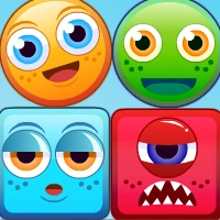
Shapeformers looks like a calm little puzzle at first glance. Cute shapes, bright colors, a clean screen, the kind of setup that whispers, “Relax, this is simple.” And then the game hits you with the real rule: red is trouble. Not “red is slightly annoying,” but red is the enemy, the thing you must remove, the bad presence that needs to disappear… while you keep the good shapes alive and visible. Sounds easy, right? Yeah. It’s easy in the way that balancing a cup on your forehead is “easy” until you take one step.
On Kiz10, this is a physics puzzle that lives in that sweet space between logic and panic. You don’t solve it by being fast. You solve it by being deliberate, but not too deliberate, because some levels quietly demand quick reactions too. You click shapes to transform them, and each click feels like flipping a switch on reality. A square becomes something that rolls. A stable stack becomes a slippery mess. A red shape that looked harmless suddenly turns into a bowling ball with murder on its mind. And the funniest part is how quickly your mood changes from “I’ll just try a level” to “Okay, no, I need to beat THIS level, specifically, because it just embarrassed me.”
CLICK, TRANSFORM, REGRET, REPEAT 🖱️⚙️😵💫
The main mechanic is pure trouble: click to transform a shape. That’s it. No complicated inventory, no long list of tools, just your mouse and the power to reshape objects in a physics space. But the consequences are where the game gets sharp. When you transform something, you’re not just changing its look, you’re changing how it behaves. You’re altering weight distribution, rolling potential, stability, friction vibes (in your head, at least), and how it interacts with everything else on the screen.
So you start thinking in cause-and-effect chains. If I click this red square and it turns into a circle, it might roll off and be eliminated, great. But what if it rolls into a good shape and knocks it away? What if the good shape falls off-screen and I instantly fail? What if the red shape doesn’t fall off at all and just sits there like it owns the place? That’s the core loop: you make one choice, the level responds, and you learn. Sometimes you learn the solution. Sometimes you learn what not to do ever again.
THE REAL PUZZLE IS BALANCE, NOT COLORS ⚖️🧠🟩
There’s a moment that happens in Shapeformers where you stop thinking “remove red shapes” and start thinking “control the entire system.” Because the screen is a tiny ecosystem. Every shape is a piece of a structure, even when it doesn’t look like one. A harmless-looking blue block might be the only thing preventing a red shape from rolling into disaster. A friendly shape might be holding up a corner, acting like a support beam in a tiny cardboard building. Remove the wrong thing, and gravity becomes the villain, loudly.
That’s why the game feels satisfying when it clicks. You’re not just guessing. You’re engineering. In your own chaotic way. You’re building a mental model of the level: which shapes are load-bearing, which ones are bait, which ones can be safely transformed early, and which ones must be left alone until the last second. Sometimes the best solution is gentle: one clean click and the red shapes fall away like they were waiting for permission. Other times it’s messy: a chain reaction where things tumble, collide, roll, and somehow you end up with the right shapes still on screen and the red ones gone. You don’t celebrate because it was pretty. You celebrate because it worked.
LEVELS THAT FEEL LIKE A TRICK QUESTION 🧩🤨🟥
Shapeformers has a mean little talent for presenting a level that seems obvious, then punishing the obvious solution. You’ll see a red piece on a ledge and think, easy, I’ll just turn it into something that rolls off. And then it rolls off… taking a good shape with it. Or it rolls off too early, and the remaining shapes shift, and now a good piece falls, and the game stares at you like: yes, physics. Welcome.
So you start doing the “puzzle gamer stare.” The one where you’re not clicking, you’re just watching the shapes like they might confess the answer if you glare hard enough. You measure angles. You imagine trajectories. You consider the weird possibility that the solution involves transforming a good shape first, even though your instincts scream that touching good shapes is risky. And sometimes your instincts are right. Sometimes they’re wrong. That uncertainty is the fun. It keeps the game from turning into a mechanical checklist.
And yes, some stages sneak in speed. Not constant speed, not frantic action, but quick timing moments where you need to click before a shape rolls into the wrong place, or before a structure settles into an unfixable position. That’s when you get the little adrenaline spike: you’re doing a puzzle, but your hands are moving like it’s an arcade moment.
MY PERSONAL RULEBOOK (THAT I BREAK ALL THE TIME) 📜😅🟦
If you want to play smarter, you’ll eventually build a few rules in your head. Like: don’t click randomly. Like: don’t transform something just because it looks transformable. Like: always keep at least one safe “platform” for the good shapes. Like: think about where things will roll, not where they are now.
But then you’ll break your own rules because you’ll get impatient. You’ll see a red shape and go, I can solve this right now, watch me. Then you click, the entire stack shifts, and you instantly regret your confidence. And the game isn’t cruel about it. It’s just honest. It’s the kind of honest that makes you laugh at yourself and restart instead of rage quitting, because deep down you know you did something silly.
The coolest part is how the game trains your brain without lecturing you. After a few levels, you start recognizing patterns: red shapes placed as rolling hazards, good shapes that are secretly supports, single-click solutions hidden behind “scary” moves, levels where the correct answer is to do almost nothing until the right moment. You’ll also start appreciating the simplicity of the mechanic. The game isn’t trying to overwhelm you with features. It’s trying to make you think harder about one feature. And that’s why it sticks.
WHY IT’S SO REPLAYABLE ON Kiz10 🔁🎮🧠
Shapeformers is built for that classic replay itch. Levels are short enough that failure doesn’t feel like punishment, it feels like information. You try a click, it fails, you learn something, you try again, you refine. The loop is quick and satisfying, and because it’s physics-based, the solution often feels like a tiny performance. You’re not just “answering.” You’re triggering. You’re nudging the world into behaving the way you want.
If you love puzzle games where every move matters, where one click can change everything, and where the difference between success and failure is usually a single careless decision, this one hits hard. It’s clever, compacts, and occasionally rude in the best way. Come for the cute shapes, stay because your brain refuses to leave a level unsolved. 🟥🟦✨



 4.1 (9 votes)
 Share
Share
 Embed
Embed


