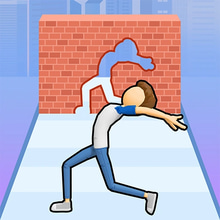
The wall is coming. Its cutout looks almost friendly from far away, like a postcard silhouette you could copy without thinking. Then it grows, the edges glow, and your brain starts sketching possibilities faster than your thumbs can agree. Through the Wall 3D takes the silly joy of striking a pose and turns it into a rhythm of problem solving you feel in your wrists. This is not just about stretching arms and knees. It is about reading negative space, predicting angles, and deciding—right now—if that lunge will carry you through clean or bounce you backward with a slap and a laugh. One moment you are a dancer, the next a geometry student, the next a street mime trying to fit into a window that keeps arguing with physics. And somehow it is all smooth, colorful, and oddly relaxing, even when it is rude.
🧩 Negative Space, Positive Decisions
What makes the first minutes click is how quickly your eyes learn to treat the hole in the wall as the true object. You stop seeing your character as the thing you control and start seeing the empty shape as the thing you need to become. A star outline means splayed hands and a tidy lean. A rectangle demands tight elbows and a clean line through the middle. The game teaches this without a single lecture. Miss by an inch and the impact says more than any tooltip. Make it through and the whoosh is a tiny congratulations you will chase for the rest of the night.
🎛️ Simple Inputs With Delicious Depth
Controls are direct: drag to twist the torso, swipe to tilt, tap to commit when the timing feels right. But just like learning to ride a bike, the depth hides in balance. If you over rotate the hips you will clip a corner. If you tuck the shoulder too early you will lose alignment when the wall arrives. The best runs come from small, confident adjustments. You begin a pose, breathe for half a second, and then nudge it into exactness. That pause, that gentle correction, is the difference between a scrape and a glide.
⏱️ Timing Is Its Own Puzzle
Reflexes help, but timing in Through the Wall 3D is about rhythm as much as speed. Walls roll in on tracks, rise up from the floor, or descend from overhead. Some slow down just before contact to trick your impulse to lock too soon. Others accelerate, asking for faith in a late snap. You start counting under your breath, not numbers but beats: set set click. When you get the cadence, the level becomes a moving song, and your poses stitch across it like notes.
🧠 Strategy In A Game That Looks Like Party Chaos
The visuals are loud and cheerful, but there is quiet strategy underneath. Each stage seeds a sequence of shapes that echo each other. If you notice that three consecutive walls share a left arm angle, you keep that limb primed and save precious adjustment time for the tricky hip rotation. Levels sometimes pair a simple pose with a mean timing window, or a complicated pose with a generous approach. The right answer is rarely brute force; it is noticing what part of the problem can stay still while you fix the rest.
🎨 3D Readability That Respects Your Brain
Depth can be confusing in fast games, but the camera helps without calling attention to itself. Subtle parallax says where the wall truly lives in space. Highlights trace edges so your silhouette pops against the cutout. When the world theme switches—neon arcade, misty canyon, chrome studio—the readability stays. Color here is not just decoration; it is a design language telling you which edges matter right now.
💡 Powers And Perks That Shape Your Line
As you progress, light-touch mechanics spice the flow. A brief slow-mo charge lets you fine tune a pose in the last half second. A positional “ghost” projects a faint outline of your current silhouette on the wall so you can see the mismatch clearly. Rare stages flip gravity, asking you to think about poses upside down—surprisingly funny, surprisingly teachable. These tools never erase the challenge; they translate panic into control, which is exactly what a good puzzle game should do.
😂 Failure That Feels Like Comedy Not Punishment
Missing a pose looks ridiculous in the best way. Your character pancaking against foam is slapstick without cruelty. Restart is instant, so learning loops are snappy. You will laugh at your own hubris when you try to thread a star with ballerina ankles and forget about elbows entirely. That laughter matters. It keeps the stakes comfortable while your skill quietly climbs.
🏆 Modes That Change The Mood
Arcade mode feeds walls in playful patterns, perfect for quick sessions. Challenge routes stack trick shapes with awkward timing so precision matters more than instinct. A Zen playlist slows everything down and warms the colors; suddenly you are practicing form like tai chi with neon. Daily ladders remix favorite walls with odd rules—mirror poses, one limb locked, camera tilt—for a fresh brain stretch that never feels like homework.
🔊 The Language Of Sound And Feel
Cues are crisp. A soft “tick” when your pose is stable. A rising chime as the match tightens. A low swoop the instant you pass through and the tension drops out of your shoulders. If your device vibrates, the haptic pulse lands exactly when it should: a tiny buzz for minor clips, a satisfying thump for a perfect. Over time you react to the audio almost before you react to the picture, and that is the point—the game wants your senses braided, not competing.
🧭 Learning Without Realizing You Are Learning
Your first hour is full of messy improvisation. Your second is quieter because you have a plan. You begin to pre visualize. The moment a wall appears you sketch a pose in your head and move toward it, leaving only the last two degrees for adjustment. You also discover a personal toolkit: a reliable “T stance” that transitions quickly, a quick hip pivot you trust under pressure, a shoulder tuck that rescues late decisions. That vocabulary turns chaos into choreography.
🌍 Worlds That Invite Flow Over Frustration
Each environment has its own personality. A glassy studio loves clean shapes—a lesson in precision. A cliffside stage uses gusts to wobble your balance, teaching correction. A carnival level distracts you with playful lights, a test of attention more than mechanics. The difficulty curve respects your time: new tricks arrive one at a time, combine for a storm, then ease off so your hands can breathe. By the time the credits roll on a world, you will not be the same player who entered it.
🎮 Why You Keep Hitting Restart
Because progress is visible and personal. Because you can feel your brain switching from “what shape is that” to “I know the first 80 percent of this, let me nail the last 20.” Because a perfect pass is not loud—it is clean—and that quiet victory is addicting. Because Through the Wall 3D makes something as silly as posing into a surprisingly thoughtful dance with timing and space. And because Kiz10 makes the loop instant: quick loads, quick retries, quick wins that invite one more run even when you promised yourself bedtime three walls ago.
Open Through the Wall 3D on Kiz10, soften your shoulders, and treat every obstacle like a question only your next pose can answer. When the whoosh arrives and the world slips past without a scrape, do not be surprised if you smile at the screen like you just solved a riddle with your whole body.





 Share
Share
 Embed
Embed


