🏔️🎿 A START LINE THAT FEELS LIKE A DARE
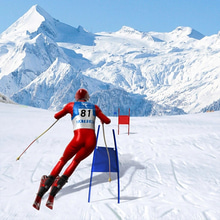
Slalom Ski Simulator doesn’t ease you into anything. One moment you’re standing on a slope that looks almost peaceful, the next you’re staring down a run full of gates like the mountain personally scheduled your stress. On Kiz10, it plays as a time-attack ski racing experience with one clear obsession: get downhill fast, thread every gate cleanly, and stop losing time to tiny mistakes that somehow feel gigantic. You’re not exploring. You’re not sightseeing. You’re hunting milliseconds, and the slope is absolutely not impressed by your excuses.
The first seconds are deceptive. Your skier glides, the snow feels smooth, and your brain goes “okay, I’ll just steer left and right.” Then the gates begin to stack closer, the angles sharpen, and suddenly you’re not “steering,” you’re carving. Carving is a different mindset. Carving is committing to a line and living with it. Carving is watching your own mistake form in slow motion and still not being able to stop it. 😅
⛷️💨 CARVE LINES, NOT PANIC ZIGZAGS
This is the heart of the game: rhythm. If you treat Slalom Ski Simulator like an arcade dodge game where you jerk left-right as fast as possible, the mountain punishes you instantly. You’ll clip gates, drift wide, or lose that clean flow that makes your run actually fast. The faster way is weirdly calmer. You set up early. You approach a gate with a plan. You let the skier arc smoothly instead of snapping like a startled cat. It feels slower at first, but it’s quicker in reality because smooth lines preserve speed and reduce those ugly corrections that eat time like a vacuum.
You’ll notice it when it clicks. Your turns become quieter. You stop oversteering. You begin to aim for the space after the gate, not the gate itself. That’s a tiny mental shift, but it changes everything. Suddenly the course feels readable instead of chaotic. You’re not reacting late, you’re preparing early. And when that happens, you start getting that delicious “I’m actually skiing” feeling instead of “I’m surviving.” 🎿✨
🚦🧊 GATES AREN’T OBSTACLES, THEY’RE A TEST OF NERVE
Each gate is a little checkpoint of discipline. You’re not just passing through a hoop, you’re proving you can hold a line under pressure. Some gates arrive in gentle rhythm, almost like the game is giving you room to breathe. Then you get a nasty section: a quick left into an immediate right, the slope tilts, your speed spikes, and your eyes go wide because you can already see the gate you’re going to miss if you keep turning the way you’re turning. This is where the game feels cinematic in a very cruel way. The mountain isn’t loud, but it’s dramatic. One mistake doesn’t just slow you down, it breaks your flow, and losing flow feels like losing control.
The funny part is how emotional a missed gate can be. You don’t just think “oops.” You think “noooo I had that run.” You feel it in your stomach. You restart. You swear you’ll be patient this time. Then you push too hard again because your pride wants revenge. 😭
⏱️🔥 THE CLOCK IS A QUIET MONSTER
Time-attack games hit different because the enemy is invisible. In Slalom Ski Simulator, the clock is always there, quietly measuring everything you do. A wide turn doesn’t look like a disaster until you realize it cost you a chunk of time you’ll never get back. A small clip on a gate feels harmless until it forces a correction, and that correction becomes another correction, and suddenly you’re late for the next gate and your run is unraveling like a scarf in a wind tunnel. 🧣💨
What makes this satisfying is that improvement is real and immediate. You can feel your runs getting cleaner. You can sense where you’re losing speed. You can identify that one section where you always drift too far outside. The game becomes a personal rivalry with your previous best time. Not with other players, not with some storyline villain. Just you versus the ghost of you who did slightly better yesterday. And that ghost is smug. Extremely smug. 😈
🎮🧤 CONTROL FEELS SIMPLE… UNTIL IT DOESN’T
The controls are approachable, which is why it’s easy to start on Kiz10, but “easy to start” is not the same as “easy to master.” The skill ceiling is hidden inside small decisions. When do you begin the turn? How much do you commit? Do you cut tight and risk clipping, or go safer and risk drifting wide? It’s a constant negotiation between aggression and control.
There’s also a special kind of mistake that only happens in slalom games: turning for the current gate and forgetting the next one. You focus too hard on squeezing through, and by the time you exit, you’re out of position for what’s coming. The course is basically a chain of setup moves. You’re always preparing the next turn while finishing the current one. Once you understand that, the slope feels less like random gates and more like a flowing path. 🏔️➡️
🥶🎥 THE “ONE CLEAN RUN” FANTASY
Every slalom player knows the dream. The perfect run. No clips. No wide drifts. No weird late corrections. Just pure flow, like you’re floating through gates with the confidence of someone who definitely doesn’t crash three times per minute in real life. And Slalom Ski Simulator feeds that fantasy hard, because it’s always almost within reach. You’ll have a run where the first half is flawless, and you start smiling like an idiot. Then you get to a tricky gate pattern, you rush a micro-correction, your skier slides just a bit too far, and the dream explodes. The betrayal is immediate. The restart is immediate. 🔁😅
And yet, that chase is exactly why the game is so sticky. Each attempt teaches you something. You begin to memorize the rhythm of the course. You learn where you can take tighter lines and where you must stay disciplined. You stop guessing and start anticipating. The game turns into a loop of tiny upgrades to your own technique, and those upgrades feel earned because the slope never hands you anything for free.
🧠❄️ LITTLE SECRETS THAT MAKE YOU FASTER
Here’s where players quietly get better: they stop trying to be fast and start trying to be clean. Clean equals fast. If you enter a gate calmly, your exit is better. If your exit is better, your setup for the next gate is cleaner. If your setup is cleaner, you stop making desperate corrections. And desperate corrections are the real time killers.
You also learn to trust gentle input. Most crashes and missed gates come from panic steering. The moment you feel behind, you slam the controls, and the skier overreacts, and now you’re even more behind. The fix is annoying because it’s simple: breathe, make a smaller correction, and accept that your run is not dead just because it isn’t perfect. Perfection is rare. Consistency is what builds best times. 😌⏱️
🏁✨ WHY IT’S A PERFECT KIZ10 SKI CHALLENGE
Slalom Ski Simulator is the kind of winter sports game that feels good in short bursts and even better when you fall into the time-chasing trance. It has that classic slalom energy: precision, speed, and nerves. It’s not about flashy tricks, it’s about carving a line you can actually hold. If you enjoy ski racing, gate slalom, 3D sports challenges, and the pure satisfaction of shaving time off a run through cleaner control, this one fits perfectly on Kiz10.
And when you finally get that run where everything aligns, where the gates feel wide and friendly for once, where your turns are smooth and confident… you’ll probably celebrate for half a second and then immediately press restart because you know you can do even better. That’s the curse. That’s the fun. 🎿😈





 Share
Share
 Embed
Embed