⚔️ Steel, shouting, and a very bad dungeon plan
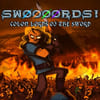
SWOOOORDS! Colon Lords of the Sword has the kind of title that already tells you subtlety is dead. This is not a quiet fantasy stroll with gentle music and polite goblins waiting their turn. It is a dungeon-crawling brawler built around close combat, aggressive movement, and that wonderful old-school sense that the next room is definitely full of trouble. Public descriptions of the game consistently describe it as a cooperative dungeon-crawling brawler inspired by games like Gauntlet, Golden Axe, Bastion, and Spiral Knights.
That description fits the mood perfectly. The game feels like a medieval action game that wants you in the mess immediately. Swords out, enemies in your face, danger arriving from directions that looked safe half a second earlier. On Kiz10, that kind of game lands beautifully because the appeal is instant. You do not need ten paragraphs of lore to understand the assignment. Enter dungeon. Swing weapon. Survive the swarm. Try not to look foolish while doing it.
Of course, looking foolish is part of the journey.
That is actually one of the best things about SWOOOORDS! It captures that rough, energetic fantasy of dungeon fighting where every encounter is a little untidy. You are not delicately fencing in a moonlit courtyard. You are hacking through dangerous spaces full of monsters, pressure, and the very real possibility of getting cornered because you believed too strongly in your own heroism. The combat energy is broad and physical. It feels like a brawler first, which gives the whole game a heavier, louder personality than a more careful action RPG.
🛡️ The joy of fighting slightly too many enemies
A good dungeon brawler lives or dies by how it handles pressure, and SWOOOORDS! sounds built for pressure. Since public descriptions frame it as a co-op brawler for up to four players, the core identity is not about one perfect duel. It is about group chaos, surrounding threats, and the constant need to keep moving while attacking at the right moment.
That matters because it changes the feeling of combat completely.
In a one-on-one sword game, timing is everything. In a dungeon brawler, timing still matters, but so do spacing, awareness, and crowd control. You are not asking whether you can beat one enemy cleanly. You are asking whether you can survive the room before the room decides it hates you personally. That creates a much more frantic kind of action, and honestly, it is great fun. You move, slash, dodge, reposition, then realize three more threats have entered the screen like they pay rent there.
This is where the game’s chaotic fantasy tone really starts to sing. Every battle has that little sense of improvisation. Plans fall apart. Tight situations become looser or worse in seconds. You tell yourself you are in control, then a group of enemies disagrees very loudly. There is a raw arcade charm in that. It keeps the action from becoming too polished. You are not expected to float through the dungeon like some invincible legend. You are expected to fight hard, adapt quickly, and maybe survive with your dignity only partially intact 😅.
And that is good. That is human. That is exactly the sort of rough-edged action that players remember.
🏰 Dungeons should feel dangerous, not decorative
One thing SWOOOORDS! seems to understand very well is that a dungeon should not just be a pretty fantasy backdrop. It should feel like a hostile place. Since the game is explicitly described as a dungeon-crawling brawler, the environment is part of the pressure loop, not just scenery between fights.
That gives the entire experience a stronger pulse.
Dungeon games work best when every room feels like a test. Not always a puzzle in the formal sense, but a test of readiness. Can you enter, read the situation, and respond fast enough before everything becomes chaos? SWOOOORDS! clearly leans into that old-school fantasy dungeon spirit where danger is not delayed for dramatic effect. It is already waiting. The corridor looks simple, the next chamber looks manageable, and then suddenly the screen is alive with enemies and your survival instincts wake up like someone hit a gong.
That is the good stuff.
It also makes the fantasy setting feel more physical. You are not drifting through generic medieval wallpaper. You are pushing through spaces that exist to challenge you. Every step deeper into the dungeon suggests more resistance, more combat, more nonsense. In a great brawler, that constant forward motion becomes addictive because the next room is always a promise and a threat at the same time.
You want to see what is next, even when you know what is next is probably violence.
👥 Better with allies, still messy without them
Because SWOOOORDS! is publicly described as a cooperative brawler, one of its most appealing qualities is the sense that it was built for shared action rather than lonely perfection. Up to four players can fight together, which tells you a lot about the intended rhythm: overlapping attacks, crowded fights, rescue moments, and the kind of teamwork that looks very strategic from a distance and very panicked up close.
Co-op changes everything in a game like this. Suddenly combat becomes louder, more playful, more unpredictable. One player rushes ahead. Another gets boxed in. Somebody probably swings too early. Somebody else somehow saves the situation and immediately acts like it was part of the plan. That social chaos is part of the appeal of classic dungeon brawlers. They are not elegant. They are memorable.
Even when you imagine the game in solo terms, that co-op DNA still gives it flavor. It suggests a battlefield design built around groups, pressure, and overlapping threats rather than careful isolated encounters. That kind of design tends to create a more energetic, more replayable flow. You are always reacting to density, not emptiness. Always fighting through something, not waiting for the action to arrive.
And that rhythm fits Kiz10 very well. Fast entry, clear objective, immediate conflict. No wasted motion.
🔥 Why the old-school brawler formula still works
The real strength of SWOOOORDS! Colon Lords of the Sword is that it leans into a classic action formula without making it feel dusty. Public sources connect it to Gauntlet and Golden Axe for a reason. Those influences point to a style of game where melee combat, enemy waves, dungeon progression, and simple but satisfying action loops do most of the work.
That formula still works because it speaks directly to instinct.
See enemy. Hit enemy. Avoid disaster. Move forward. Repeat until the screen looks manageable or you do. There is almost no friction between intention and play, and that makes the game easy to enjoy immediately. But the simplicity is deceptive. Underneath it, there is always a nice layer of judgment. Where should you stand? When should you commit? Which enemies are actually dangerous? How much risk can you take before the rooms punishes your optimism?
That combination of direct controls and subtle survival choices is what gives dungeon brawlers staying power. They are easy to start, but they keep producing little moments of tension and triumph. A clean clear feels fantastic. A narrow survival feels even better. And a messy win where everything nearly collapsed? Honestly, sometimes that is the best outcome of all.
🗡️ Final thoughts from the sword pile
SWOOOORDS! Colon Lords of the Sword is exactly the kind of fantasy action game that wins through momentum. It is loud, aggressive, and built around the timeless pleasure of entering a dangerous dungeon and solving your problems with steel. Public descriptions consistently define it as a co-op dungeon-crawling brawler inspired by some of the most recognizable names in arcade fantasy action, and that lineage makes sense the moment you picture the combat loop.
On Kiz10, it fits perfectly as a medieval combat game for players who enjoy melee action, dungeon survival, co-op chaos, and old-school fantasy brawlers with a rough, energetic edge. It does not want to be delicate. It wants to be exciting.







 Share
Share
 Embed
Embed


