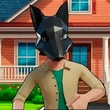
The Sheep Hunter is the kind of game that starts with a very simple idea and then quietly turns it into a weird little stealth comedy with teeth. Kiz10’s page makes the setup clear right away: a wild wolf wants to steal all the sheep without calling the farmer’s attention, and your job is to help him hide and take as many as possible. That single premise is already doing a lot of work. It is funny, mischievous, and just dangerous enough to make every move feel like a tiny crime scene waiting to happen.
What makes this game instantly fun is the role reversal. In most farm-themed animal games, the sheep are the soft center of the story. Here, they are the target, and you are playing as the problem. Not a glorious fantasy hero, not a noble protector, just a very determined wolf trying to commit increasingly suspicious acts of sheep theft without getting caught. That is excellent browser-game energy. It is simple, readable, and a little ridiculous in exactly the right way.
And honestly, that is the charm of The Sheep Hunter. It does not need a huge system to work. It only needs one strong tension: greed versus detection. You want more sheep. The farmer wants his sheep to remain sheep-shaped and present. Somewhere between those goals is the gameplay. Every move becomes a quiet little test of nerve. Can you steal one more without alerting anyone? Can you hide well enough to stay in control? Can you behave like a shadow in a place full of fluffy evidence? Great concept. Very suspicious. Very fun.
The stealth angle is what gives the game its bite. Kiz10’s own description is not about speed alone or random action. It is about hiding and stealing while avoiding attention. That means the pressure comes from restraint just as much as movement. You are not charging through the field like a maniac. You are choosing your moment. Reading the space. Waiting for the right opening. And when a game makes a wolf behave like a cautious criminal instead of a loud predator, it becomes instantly more memorable.
That is where the best moments happen too. Not only when you grab a sheep, but when you grab one cleanly. The kind of move that feels smart, almost elegant, before the situation inevitably starts getting messier. Because of course it does. Games like this thrive on that emotional slide from “I am in full control” to “okay, maybe the farm knows something is wrong.” One well-timed steal feels great. Two starts to feel greedy. Three makes the whole field feel tense in that deliciously silly way browser stealth games do so well.
There is also something great about how animal games change when mischief becomes the core mechanic. The Sheep Hunter is still playful. It still lives in a farm-and-sheep visual space. But the objective warps that softness into tension. The field is no longer cozy. It is a hunting ground. The sheep are no longer harmless background fluff. They are moving objectives. The player starts treating the whole level as a system of risk, visibility, and timing. That transformation is what keeps the concept from feeling flat.
And because the title is so direct, the game benefits from immediate clarity. You know what you are here to do before the first real decision. Hunt sheep. Avoid the farmer. Stay hidden. The whole structure is clean, which is exactly why it can become addictive. Browser games work best when they hand the player a single strong conflict and let the details create the fun. The Sheep Hunter absolutely has that. One predator. One farm. One constant need to take a little more than is probably safe.
The funny thing is that stealth games often become more exciting when the map is small and the rules are simple. That is very likely why this one sticks. A giant open world would be overkill. A compact farm, a few sheep, a farmer who should not notice, that is enough. It means every route matters more. Every hiding place matters more. The difference between success and exposure can be one short mistake, which gives even a tiny session that satisfying “one more try” feeling.
There is also a strong rhythm to games built around sneaking and collecting. Move, wait, act, hide, repeat. Once that rhythm clicks, the game becomes difficult to leave because the player starts feeling the flow of danger more clearly. You stop acting randomly and begin acting like the wolf actually has a plan. Those are the best runs. The ones where the field starts feeling readable, the farmer starts feeling predictable, and the sheep... well, the sheep start looking alarmingly collectible.
Of course, confidence is dangerous. A game called The Sheep Hunter should absolutely punish overconfidence. That is half the reason the stealth setup is funny. The player gets one clean theft and instantly starts thinking like a mastermind. Then the next move goes wrong and the whole operation becomes awkwardly public. Beautiful. Necessary. That swing between control and exposure is the heart of the experience. Without it, the game would just be a weird animal errand. With it, the game becomes a small but memorable stealth challenge.
On Kiz10, The Sheep Hunter fits naturally beside sheep-themed animal games and lighter farm-style action titles. The site already has real sheep-related pages like Home Sheep Home 2, Sheepwith, Sheep: HurrDurr, Pretty Sheep Run, and Dolly The Sheep, which makes it easy to place this game inside a broader fluffy-but-chaotic corner of the catalog. The difference is that The Sheep Hunter adds that mischievous predator twist, which gives it a stronger identity than a plain sheep platformer or puzzle title.
If you enjoy animal games with a sneaky objective, light stealth pressure, and that satisfying loop of grabbing one more target before the whole level notices, The Sheep Hunter is a strong fit on Kiz10. It is funny, simple, and sharper than it first looks. You start as a hungry wolf in a quiet field. A little later, you are treating every sheep like a tactical decision and every hiding place like a personals investment. Which, really, is exactly the kind of nonsense that makes browser games memorable.




















 Share
Share
 Embed
Embed


