🔫🩸 Noise first, thinking later
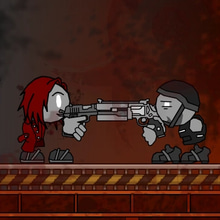
Thing Thing 4 doesn’t ease you in. It shoves you into a grimy little warzone and immediately asks a rude question: can you keep moving while everything tries to delete you? It’s a run and gun action shooter with that classic flash-era attitude—fast, violent, relentless, and weirdly satisfying in the way only a game can be when it’s basically built out of recoil, panic, and timing. On Kiz10, it hits like an old-school adrenaline shot: short missions, hard pushes, quick deaths, faster retries, and that constant urge to play one more stage because you were so close to clearing it clean.
The first thing you feel is pressure. Not story pressure, not “save the world” pressure. More like survival pressure. Enemies appear in places that punish hesitation. Bullets arrive in lines that punish standing still. Every corridor becomes a small decision: push forward now, or wait and risk getting pinned? Jump for position, or stay low and keep control? Swap weapons, or cling to the one you trust even though it’s clearly underpowered now? The game keeps you in that delicious stress zone where you’re always half-planning and half-reacting, and somehow that’s exactly the fun.
🧠⚙️ The movement is your real weapon
If you play Thing Thing 4 like a static shooter, you’ll get cooked. The whole design loves movement. You’re not meant to sit and trade shots like a turret. You’re meant to flow. Step out, fire, step back. Jump to break a line of sight. Drop down to avoid a burst. Slide into a better angle. The moment you accept that movement is offense, the game starts feeling less like chaos and more like a rhythm. A brutal rhythm, sure, but still a rhythm.
It’s also the kind of shooter where “position” isn’t a fancy esports concept, it’s immediate reality. If you’re stuck in a corner, you feel it. If you’re in open space, you feel it too, because open space means you’re exposed. The best spot is usually the one that lets you see enemies without letting them see too much of you, and Thing Thing 4 keeps forcing you to find that spot over and over. You’ll get good at it without meaning to. Your hands will start doing the smart thing automatically, which is honestly a little creepy when you notice it. 😅
🔫💥 Guns aren’t just tools, they’re mood swings
One of the most addictive parts is the weapon feel. Different guns change how you play. A fast weapon makes you aggressive and twitchy. A heavier gun makes you deliberate, choosing moments to commit because the reload and recoil demand respect. When you pick up a stronger weapon, it’s not just “more damage,” it’s a shift in confidence. You stop feeling like prey for a second. You start pushing harder. Then the game reminds you that confidence is temporary, because enemies scale up, situations tighten, and your ammo will absolutely run out at the worst possible moment.
That ammo stress is part of the flavor. You learn to fire in bursts. You learn to aim instead of spray. You learn to conserve a heavier weapon for messy clusters. And when you do spray, it’s because you chose the chaos, not because you were clueless. That choice matters, because it makes you feel in control even when the screen looks like a riot.
🏚️🧟 The vibe is gritty, but the pace is arcade
Thing Thing 4 isn’t trying to be realistic. It’s exaggerated and raw in a way that feels like a comic book that got stained with engine oil. The environments feel hostile. The enemies feel like they exist solely to keep your heart rate up. Yet the pacing stays arcadey—missions are built to be replayed, improved, cleaned up. You can brute-force some parts, but the game secretly rewards players who get efficient. Who clear rooms with fewer mistakes. Who stop taking unnecessary hits. Who keep moving forward without turning every encounter into a desperate scramble.
And yeah, it can get messy. You’ll have moments where you barely survive with a sliver of health, and suddenly every sound feels louder. Your hands get tense. You start moving like your character is made of glass. Then you find a better weapon or a safer angle, and you recover. That emotional swing is half the fun: calm control, sudden panic, relief, repeat.
🧩🎯 Combat is a puzzle you solve with bullets
Underneath the violence, there’s a surprisingly puzzle-like structure to fights. Enemies come from predictable directions. Cover exists, but it’s never perfect. The room layout pushes you toward certain choices. If you take the wrong route, you get flanked. If you push too far, you trigger more enemies while you’re still dealing with the first wave. So you start learning timing as a skill. Not just aiming timing, but encounter timing. When to advance. When to clear behind you. When to reload safely. When to commit to a risky push because staying put will get you boxed in anyway.
That’s what makes Thing Thing 4 feel “smart” even though it’s loud. You can actually feel yourself improving. Your first run through a mission might be a disaster. Your third run becomes smoother. By the fifth, you’re clearing enemies almost automatically, not because the game got easier, but because your brain finally mapped the danger zones. That improvement is addicting because it’s honest. It’s not a stat bar. It’s you.
😬🩹 Health feels like a fragile contract
In a lot of run and gun games, you can tank a hit or two and still keep your swagger. Thing Thing 4 makes you respect damage. Health isn’t just a number, it’s your permission slip to be bold. When you’re full, you take chances. When you’re low, you suddenly become a careful little ghost, peeking and retreating, counting enemy shots like you’re doing math homework under gunfire. The game does this on purpose. It creates two versions of you: the brave version and the cautious version. And it forces you to switch between them mid-mission.
You’ll notice something funny: most deaths don’t happen because you “couldn’t aim.” They happen because you got impatient. You pushed when you should have reset the fight. You chased a kill into a bad angle. You reloaded at the wrong time. Thing Thing 4 punishes impatience like it’s a personal mission, which is why it also trains discipline. You start playing cleaner because you’re tired of dying in embarrassing ways.
🎬⚡ The cinematic moment is when everything lines up
There’s a point in every good run where you feel it click. You’re moving smoothly, swapping weapons confidently, clearing enemies without taking stupid hits, and the mission feels like a fast action scene that you’re directing. That’s the payoff. Not a cutscene, not a story twist, but a feeling: I’m controlling the chaos. And because the game is fast and replayable on Kiz10, you can chase that feeling again and again. Each time you get closer to that “perfect run” where you don’t just survive, you dominate.
Then you enter a new mission, the enemy placement changes, the pressure spikes, and you’re humbled again. Which is good, honestly. A run and gun that never humbles you turns boring. Thing Thing 4 stays sharp because it keeps demanding attention.
🧊🧠 A small mindset that makes you instantly better
Stop trying to win by standing still. Treat every fight like a moving problem. Clear one angle, relocate, clear the next. Don’t reload in the open unless you’re desperate. If you’re low on health, stop pushing for “one more kill” and instead push for “one safer position.” And when you find a weapon that feels strong, don’t waste it on single targets out of excitement—save it for the ugly moments where the screen fills up and you need control fast.
Thing Thing 4 is brutal, but it’s fair in that old arcade way: it rewards calm, punishes greed, and makes you feel like a legend the moment you finally stop panicking and start playing with intention. On Kiz10, it’s pure run and gun energy—loud, fast, and impossibles to leave alone once you decide you want a cleaner clear.





 4.9 (36 votes)
 Share
Share
 Embed
Embed