🧪😵 The drip starts innocent… then it becomes your whole life
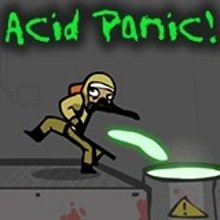
Acid Panic is one of those arcade games that looks like a tiny joke and plays like a full-blown stress ritual. You’ve got a factory-like setup, acid falling from above, containers below, and a simple job that sounds easy until your hands start moving: catch the acid before it hits the ground, manage your container before it overfills, and dump it into the right place without turning the whole screen into a toxic accident. On Kiz10, it’s pure reaction gameplay with a small brain puzzle hiding inside the chaos, because it’s not only about being fast. It’s about being fast at the right moments, then being calm when your instincts want to panic.
The first seconds teach you the basic rhythm. Acid falls. You move. You catch. You feel clever. Then the game starts tightening the screws, not with a complicated new mechanic, but with pressure. More drops, worse timing windows, and that nasty little feeling of “I’m one mistake away from a chain reaction.” The weird magic of Acid Panic is that it’s a simple loop, yet your attention never relaxes. You’re always watching the next drip while also tracking your current capacity, like your brain is juggling two clocks at once.
🛢️⚠️ Your bucket is not a weapon, it’s a responsibility
A lot of arcade games give you a tool that feels powerful. Acid Panic gives you a tool that feels like a chore you can fail publicly. The container you use to catch the acid is basically a moving problem. If you keep catching without dumping, you overflow. If you dump too early, you lose time and position. If you dump too late, you carry danger. And if you dump at the wrong moment, you miss the next drop and everything spirals into that “oh no oh no” rhythm where your hands go faster and your decisions get worse.
That’s what makes it fun, honestly. You’re not just reacting to falling acid, you’re managing risk. You’re making micro-decisions like a tiny crisis manager: do I stay under the drip line for one more catch, or do I break away and dump now while it’s still safe? The game rewards players who treat dumping as a planned action, not as a desperate “save me” button. Because once you dump out of desperation, you’re already late.
⏱️🧠 The real gameplay is timing with a side of nerve
Acid Panic doesn’t need fancy animations to create tension. It uses timing like a trap. The acid drop pattern forces you to commit. If you move too early, you lose your best position. If you move too late, you miss the catch. If you hesitate halfway, you get nothing and feel silly. Over time, you stop thinking in single actions and start thinking in sequences. Catch, shift, catch, dump, return. That sequence becomes your heartbeat.
And yes, you’ll notice how quickly your body learns the game. After a few tries, you start pre-moving before a drip even lands, because you can sense the next placement. That’s when the game becomes addictive, when it stops being “I’m reacting” and becomes “I’m predicting.” Predicting feels good. Predicting also makes you arrogant, and arrogance is how you overflow your container because you thought you had time for one more catch. 😅
🧪🔥 Panic is loud, control is quiet
The funniest thing about Acid Panic is that the best runs look boring. Not to you, your heart is doing a drum solo, but visually it’s clean. Small movements, steady catches, timely dumps, no drama. The worst runs look dramatic. You’re zigzagging, trying to save missed drops, dumping in a rush, taking risky repositioning, and the screen starts feeling like it’s moving faster than it should. That contrast is the whole skill curve. The game teaches you to stop being dramatic and start being efficient.
There’s a moment most players hit where they realize their biggest enemy isn’t the acid, it’s the urge to fix everything at once. You miss one drop, you try to “make up for it” by rushing the next, then you overflow, then you dump too late, then you miss again. That’s the spiral. The way out is the most annoying advice that’s also true: slow your brain down, not your hands. Make the next correct decision instead of trying to erase the last mistake. That’s how you stabilize a run.
🧯🌀 When the pace ramps up, it becomes a mini survival game
As the difficulty increases, Acid Panic starts feeling like survival. Not survival with zombies, survival with probability. Drops come faster, your decision window shrinks, and suddenly “being in the right place” is half the battle. The game forces you to respect positioning. If you drift too far from the drip zone, you waste time returning. If you camp too hard under one lane, you risk getting caught with a full container when you should be dumping.
And that’s where strategy sneaks in. Smart players create a route in their head. Not a big plan, just a practical loop: I’ll catch here until this threshold, then I’ll dump, then I’ll return on the shortest path. It’s like managing a production line. If your workflow is clean, the game feels fair. If your workflow is messy, the game feels cruel, even though nothing changed except your order of actions.
😈🧊 Greed is the fastest way to melt your run
You’ll learn this quickly: one extra catch can be a trap. The container gets close to full, you’re still under the drip, and your brain goes, “One more and then I’ll dump.” That one more is where the game punishes you, either by overflowing or by forcing a late dump that makes you miss the next catch. Acid Panic is basically a greed detector. It doesn’t care how fast you are if your decision-making is greedy. It cares how consistent you are.
And once you accept that, the game becomes a lot more satisfying. You start dumping earlier than your instincts want. You start prioritizing clean cycles over hero saves. Your streak improves, not because you got faster, but because you stopped gambling with your own capacity.





 4.4 (6 votes)
 Share
Share
 Embed
Embed