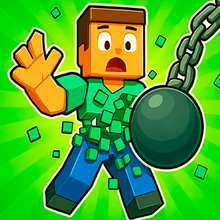
The first time you arm the charge, the room goes quiet in a very particular way. Dust hangs in the light like it is waiting for your cue. Nubik stands there with that goofy confidence only cubes can pull off, and the puzzle stares back, daring you to think instead of mash. Blow up Nubik 3D is not about chaos for its own sake. It is about designing little exhibitions of cause and effect, then hitting the button and watching your idea turn into motion, sound, and an explosion that blooms like a firework with a secret.
💥 Gentle explosions and loud ideas
Every level is a tiny stage. A balcony of breakable planks. A column that pretends to be polite. A platform that looks solid until you see the hairline crack. You place a charge, angle a launcher, maybe prop a crate at a mischievous tilt, and suddenly the whole room feels alive. The fun isn’t just the kaboom. It’s the two seconds before, when your brain runs the scene in fast forward and decides, yes, this is going to be beautiful.
🧠 Blueprints that reward curiosity
Rushing rarely works here. Take a breath, trace a route with your eyes, then build a plan that uses the room’s own bad habits against it. Hinged beams become levers. Suspicious barrels become accelerants. A thin railing becomes the nudge that turns Noob’s fall into the exact arc you wanted. When a solution clicks, it feels less like you solved a riddle and more like you finally listened to what the geometry was whispering all along.
🎥 Slow motion you actually direct
Flip slow-mo at the peak of a launch and you can steer a shoulder, trim an angle, or nudge a crate midair so a ricochet lands perfectly. It’s not a gimmick. It’s your editor’s desk. You’ll start saving slow-mo for the last delicate adjustment, right before a plank gives way or a fuse kisses a barrel. Then you let time resume, and the payoff lands with a grin you can’t help.
🧨 Tools with sensible personality
Charges behave consistently, so you learn their grammar. Small puck bombs push, not pulverize. Heavy blocks deliver momentum like punctuation. Spring pads gift a comic bounce that becomes surgical when placed just so. You’ll discover that two modest blasts with a good angle can outperform one greedy nuke. That’s the game’s quiet thesis: intention beats force.
🎯 Ten levels that escalate without being cruel
The ramp is respectful. Level one teaches that direction matters. Two introduces fragile surfaces you can repurpose. By four you’re stitching chain reactions through three props while aiming for a precise landing tile. The back half asks for patience and cleverness, not perfection. When you fail, the why is obvious and the retry is quick, which keeps momentum friendly and ideas flowing.
🌈 A toy-box world with real weight
Bright, chunky 3D art keeps the mood playful, but the physics have authority. Planks flex before breaking. Debris spins with believable heft. Noob cartwheels like a happy accident until a platform says stop. That blend—cheerful look, honest feel—makes experiments satisfying. You can feel when a support will fold or when a barrel is too far to matter, long before numbers confirm it.
🔎 Read the room like a detective
The best players don’t hunt pixels. They read tells. Dustier boards are weaker. Braced beams hide an extra hinge. A suspiciously placed coin is basically a wink that says try your arc through here. Start by solving the obvious route, then replay to shave steps and craft a cleaner chain. Your second solutions will look like magic to the you from fifteen minutes ago.
😅 Comedy is part of the physics
Not every plan lands gracefully. Sometimes Noob does three perfect flips and faceplants on an intact plank like a chalk outline in training. Sometimes a barrel you ignored becomes the hero by wobbling into position just in time. The game quietly celebrates these oops moments. The camera lingers. The particles sparkle a little extra. You’ll laugh, adjust one object by a thumb’s width, and nail it on the next try.
🎮 Feels great on mouse or thumb
On desktop, placing charges and dragging vectors is crisp, with tiny adjustments that actually stick. On mobile, your thumb lines feel like you’re sketching the explosion’s path. Haptics offer a soft tick when a charge snaps to a good surface and a deeper thump when a chain reaction completes. Audio sells the moment: a fuse hiss, a board groan, a tidy bloom that leaves the room politely rearranged.
📈 Small habits that make you look brilliant
Rotate the camera before you commit so hidden supports don’t ruin your chain. Think in pairs: push, then guide. Use light taps in slow-mo rather than big swipes; small corrections preserve momentum. If a level has coins, let them teach you a cleaner line—they’re rarely decorative. And when in doubt, move the first blast closer to the action. Energy wasted on empty space is the enemy of elegance.
🏆 Why “one more run” keeps happening
Because solving is only half the fun. The other half is polishing a messy win into a three-move masterpiece that looks inevitable. You’ll replay for style, for a faster chain, for a cleaner landing, or just to watch the same perfect plank collapse again in delicious slow motion. Ten levels is plenty of canvas when each one can hold two or three solutions that feel like yours.
📸 Your best moments will look like stunts
A crate tip that turns Noob into a pinball with manners. A double ricochet off two signs and a lamppost that shouldn’t have worked and somehow did. A single charge that pops a beam, flips a switch, and threads a landing onto a tile the size of a book. Screenshots don’t capture the sound, but you’ll take them anyway because the shape of the explosion is part of the brag.





 4 (154 votes)
 Share
Share
 Embed
Embed


