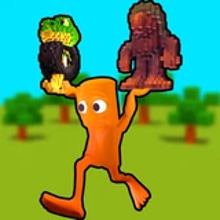
The first tree falls with a tidy crack and your workshop wakes up like a thought you were trying not to have. In Build My Brainrot the world is a box of blocks and your job is delightfully unhinged turn raw wood and mineral dyes into lovingly weird characters that look like the internet climbed out of your screen and asked to be arranged by color. You gather, you craft, you place, and somehow a pile of cubes becomes a face that grins back at you with the exact wrong energy in the exact right way. It should not make sense. That is why it does.
🪓 Wood chips, bright ideas
Chopping trees is the first rhythm your hands learn. WASD moves you through a patchwork forest, the camera tilts, the grid snaps, and every whack becomes a small drumbeat for the day’s plan. Logs stack fast, and with them the promise of frames, stands, scaffolds, and the simple skeletons of creatures you’ll fill with color later. That first armature feels like a pencil sketch—light, tentative, begging for a splash of paint. Soon you swing in a loop from tree line to bench and back, pockets filling, brain sorting pieces into possibilities before your feet finish turning.
🎨 Dye alchemy and the color that laughs
Colors are the second truth. You crush petals, simmer mineral dust, blend weird berries that absolutely stain, and your palette blooms like a party nobody RSVP’d to but everybody attended anyway. The game rewards reckless curiosity with honest results a drop of red tilts an orange, a scoop of blue deepens a shadow, a smudge of white lifts a highlight until a flat plate looks like cheek, knuckle, glare, or glint. You begin to think in swatches. “Three ticks of teal, one of gloom, done.” Every successful mix is a private recipe, and every near miss is a happy accident that finds a home on a different character an hour later.
🧱 Blocks with opinions
Blocks are simple and opinionated. They do not curve for you; they expect you to cheat the curve with clever stairs, diagonal stacks, and color illusions. That is half the game’s joy learning to imply a nose without a slope, hair without strands, menace without motion. You’ll discover that one extra cube turns a smirk into a sneer and that removing a single corner is the difference between cute chaos and chaotic chaos. When a silhouette finally reads at ten paces and still delights up close, the satisfaction is embarrassingly large for what is, technically, colored boxes behaving themselves.
⚙️ The workshop that gets faster because you do
Upgrades arrive like caffeine. Better axes shave seconds. Smarter benches craft pieces in batches. A dye rack with labeled vials stops you from mixing the same purple three times in a row because you forgot to write it down. Movement perks shrink the walk from forest to table and turn the whole loop into a glide. None of it breaks the spell. It respects it. You are still the artist the tools only move out of your way. And the moment you unlock a quick place mode that lets you stamp repeated shapes—eyes, studs, spikes—your output goes from “weekend hobbyist” to “menace with a catalog.”
🧠 Blueprints, memory, and happy sabotage
You can follow a blueprint or freehand from a brain that insists it knows the shape of a meme better than any guide. Blueprints are soothing—grid-aligned, stepwise, foolproof. Freehand is chaos and discovery. The game lets both coexist. Store a finished figure as a plan, drag it into the yard at larger scale, mutate it with a new palette, laugh at the result, keep it anyway. You’ll start sabotaging your own instructions on purpose—swap neon green for lemon, push an eye one block off center, exaggerate a jaw—and the character comes to life in a way the tidy version never could.
💎 Gems, goals, and the little economy that could
Gems drip in as you finish builds, tick off requests, and exhibit creations on pedestals. Spend them on faster benches, bigger carts, extra dye slots, and that one irresistible cosmetic the neon sign over the door that turns your workshop into a roadside attraction. The economy is playful but fair. You cannot buy taste. You can buy time. And time is what lets taste practice. One evening you realize your gem math has quietly funded an assembly line for eyes and hands, and your next three characters sail from skeleton to silly in minutes instead of an hour.
🧩 Quests that teach without lectures
A visitor asks for a tiny gremlin with a pompadour. Another demands a pink cube with a suspicious stare and a tie. A third wants “something that looks like regret but in chartreuse.” These prompts are puzzles disguised as errands. They nudge you to sculpt expression from barely anything, to chase mood with hue rather than geometry, to build faster under a soft clock. You will fail charmingly, adjust two blocks, change the dye by a whisper, and suddenly the request clicks. Learning lands with a chuckle, not a scold.
🤪 Chaos, but curated
The “brainrot” promise is not permission to quit caring; it is an invitation to care in the wrong direction until it becomes the right one. That duck should have teeth. That phone should have eyebrows. That cube should be wearing a cape and also shame. The game’s tone stays warm while your choices go strange, which is why new players feel brave fast and veterans keep finding fresh ways to be delightfully incorrect. Humor becomes a building material and sincerity the mortar that keeps ridiculous ideas standing.
📸 Showcase, share, flex
When a figure lands, you want to show someone. The courtyard doubles as a gallery where pedestals add light, plaques add names, and photo mode flatters every angle because it understands your grin matters, too. Arrange a wall of smalls—a dozen pocket sized horrors in coordinated tones—or place one huge centerpiece that watches the door like a mascot who won’t stop making eye contact. Even a messy workbench looks good in a shot when the palette is loud and the blocks catch sunset. The workshop becomes a place you curate as much as a place you craft.
🎧 Sounds of a busy brain
Audio threads through everything without begging for credit. Chop thunks line up like a metronome. Dye bottles clink with a soft chemistry that makes successes feel scientific. Placing a block lands a click so confident it might as well say “approved.” When a build completes, a little chime stacks with a sparkle that hits your spine like a reward for finishing a thought. Headphones make it cozy. Speakers keep it playful. Either way the soundscape becomes the hum of a day well spent.
📈 Progress you can point at
The best metric is not the gem count or the unlocked bench. It is how your fourth character stands next to your first and gently embarrasses it. Faces read clearer, colors sit calmer, silhouettes pop at distance. You start to trust negative space. You start to plan highlight passes before base coats. You begin to speak fluent cube. That is real progression—a craft getting sharper because you practiced joyfully and the game kept your path smooth.
🎮 Why it sings on Kiz10
It loads fast, forgives experiments, and rewards five-minute sessions with visible progress. You can gather a stack of wood on a break, mix a batch of dye at lunch, and drop a whole character after dinner when you’re feeling brave. No downloads, no ceremony, just tools that remember where you left them and a workshop that looks better every time you return. If you share a screenshot, expect a friend to send one back, and now you both have a new idea you swear you came up with first.
🏁 The build you’ll tell a story about
Picture a blank pedestal, three jars of dye you’re not entirely proud of, and a reference in your head that is more vibe than sketch. You frame a blocky head, widen the jaw, drop the eyes too low on purpose, add a single tooth because restraint is comedy, and then step back mid build because the silhouette already works. Ten minutes later the courtyard has a new resident with an aura that screams “post at your own risk.” The chime sings, gems tinkle, the sun hits the edge just right, and you realize the silly workshop produced something that feels like yours. You weren’t lucky. You were present. The cubes noticed.
Build My Brainrot turns gathering and crafting into a friendly kind of madness where taste improves by doing and every small upgrade buys you more room to be hilarious on purpose. Chop the tree. Mix the dye. Place the block. Miss a little, adjust a little, and keep going until the thing in your head waves back from a pedestal. When it does, your workshop will feel like a brain you built with your hands.





 2 (173 votes)
 Share
Share
 Embed
Embed


