🐾🎯 Neighbor war, but make it adorable and petty
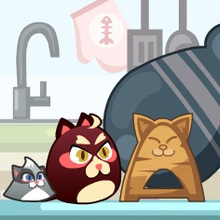
Cats against Dogs has a simple, beautiful premise: two neighbors, one fence, and a lifelong argument that cannot be solved with words. So… you solve it with projectiles. On Kiz10, it plays like a classic turn-based aim-and-shoot duel where a cat and a dog take turns lobbing “stuff” over the fence, trying to land clean hits while the wind quietly ruins your confidence. It’s not a serious war simulator. It’s a backyard feud with cartoon physics, the kind that makes you laugh right before you get hit in the face because you forgot wind exists. 😅
The first thing you notice is how easy it is to understand. Pick your angle, pick your power, launch the shot, watch what happens. That’s the loop. But the second thing you notice is how fast it becomes personal. One lucky hit and you feel like a tactical genius. One tiny misread and your shot sails into nothing while your opponent lines up a perfect arc and punishes you for being optimistic. The fence becomes the center of the universe, and every turn feels like a miniature cliffhanger: will this be a brilliant snipe, or a humiliating overshoot?
🌬️🐶 The wind is the third player and it plays dirty
This game doesn’t just ask you to aim. It asks you to aim in a world that’s actively shifting under your decision. Wind changes your shot’s arc, which means the same angle and power won’t always produce the same result. And honestly, that’s where the fun lives. You’re not memorizing one perfect line. You’re adapting. You’re reading the little wind indicator like it’s a weather report for your ego.
When the wind is light, you’ll feel bold. You’ll take cleaner shots, go for direct hits, try to win fast. When the wind pushes hard, you start playing like a cautious engineer. You add extra power to fight it, or you lower the angle to keep the projectile from drifting too far. Then you overcorrect, because you’re human, and now the shot drops short and you feel the sting of “I knew better.” The best part? You get another turn, and you can adjust again. It’s a game of correction, not perfection. 🌪️😤
🐱💢 Angle, power, and the art of not panicking
Cats against Dogs is basically a tiny math problem wearing a cute costume. Angle determines your arc. Power determines your distance. Wind decides whether those choices were brave or embarrassing. If you rush, you miss. If you hesitate too long, you still miss, just slower. So you develop this specific rhythm: test shot, adjust, punish. Your first attempt is often a range-finder. Your second attempt is the real message.
And that message can be mean. Because once you’ve dialed the distance, you can start aiming for consistency. You can stop lobbing random shots and start placing them. That’s when the game shifts from “silly backyard tossing” into “okay, I’m actually hunting you now.” It’s still playful, but the tension rises because both players can feel the skill taking shape. One clean arc becomes two, then three, and suddenly the duel has momentum. You’re not just trading turns, you’re trading confidence. 🧠🎯
🏡🧱 The fence is a wall, but it’s also a stage
There’s something hilarious about how much drama a fence can create. It blocks direct shots, forces high arcs, and makes every hit feel earned because you had to commit to a trajectory you couldn’t fully control once it launched. You release the shot and your hands are basically off the wheel. Now you watch. Now you pray. Now you pretend you meant to do that even if it was clearly an accident. 😂
And the moment you land a hit? That’s the payoff. It’s instant and satisfying because it’s the visible proof that your brain’s tiny calculation worked. Even if the calculation was mostly “eh, seems right.” The game rewards those little reads and makes misses feel fair in a frustrating-but-funny way, because you can usually trace the mistake: too much power, too little power, angle too steep, wind ignored, wind over-feared. The game is honest about why you failed, and that honesty is addictive.
😈🐾 The mind game: baiting, bluffing, and revenge shots
Once you’ve played a few turns, the duel stops being only physics and starts being psychology. You begin to notice patterns. Does your opponent always shoot high? Do they always underpower when the wind shifts? Do they panic when they miss once? You can exploit that. You can play safer to force them into risk. You can take a bold shot early to make them feel pressure. You can intentionally place a “warning” shot that lands close, just to make them flinch and rush their next turn. It’s petty strategy, and it’s perfect for this theme. 😼
The funniest moments come from revenge logic. You get hit, you immediately want to hit back harder, faster, louder. That’s how you miss. The player who wins more often isn’t the one who gets angrier, it’s the one who stays calm long enough to treat each turn like a small adjustment problem. You learn to breathe. You learn to stop trying to “make it dramatic.” You learn to make it accurate. That’s when the backyard becomes your range.
🎮🧩 Why it never feels “done”
A lot of quick games get stale because they’re solved quickly. Cats against Dogs doesn’t, because wind and turn-based pressure keep the duel fresh. Every match becomes its own little story. Sometimes you start strong and then lose focus. Sometimes you start sloppy and then dial in perfectly at the end. Sometimes you win with clean aim. Sometimes you win because your opponent got greedy with a power shot and launched it into the next zip code. The variety is natural, and it makes rematches feel meaningful.
It also has that perfect Kiz10 rhythm: quick to start, easy to replay, and satisfying in short bursts. You can play one match and leave. Or you can play ten because each match ends with the same dangerous thought: “I could’ve played that cleaner.” And once you think that, you’re already back in. 😅🔥
🐶🐱 Final vibe: cute feud, serious aim
Cats against Dogs is exactly what it promises: a funny animal rivalry turned into a physics duel where angle, power, and wind decide who gets bragging rights. It’s lighthearted, but it still rewards real skill: reading conditions, adjusting your shots, and staying calm when you miss. If you love quick 2 player games, turn-based artillery style aiming, or anything that turns a simple mechanics into a dramatic little battle, this one fits perfectly on Kiz10. Now go win the backyard. Or lose it spectacularly. Either way, it’ll be funny. 🐾💥





 Share
Share
 Embed
Embed


