🌌🛰️ A planet that’s basically screaming
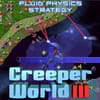
Creeper World 3: Abraxis doesn’t introduce an “enemy army.” It introduces a problem. A hungry, flowing, spreading nightmare that behaves like a liquid and treats your carefully planned base like a snack tray. You drop into a map that looks calm for about two seconds, then the creep starts oozing over hills, slipping into valleys, pooling around your defenses like it’s thinking, and suddenly you’re not “playing a strategy game”… you’re managing a crisis with lasers. On Kiz10, it’s one of those rare strategy experiences that feels urgent without feeling unfair, intense without requiring a million hotkeys, and dangerously addictive because every decision has visible consequences.
The core fantasy is simple and kind of terrifying: you are the line between “safe” and “submerged.” You build. You power up. You expand your network. You place weapons with purpose. Then you watch the tide push back, as if the map itself is breathing. And once you feel that rhythm, you start playing like a commander and a firefighter at the same time. Put out the flare-up on the left, stabilize the choke point in the middle, and please… PLEASE don’t let the right side collapse because it looked quiet five minutes ago. 😅
⚡🏗️ Power first, panic later
Abraxis is the kind of RTS where economy isn’t a background activity. It’s the backbone. Your energy network is your heartbeat, and you can feel it in every moment: when your defenses are firing smoothly, when your collectors are feeding the grid, when your construction pace feels confident. Then you overextend by one building, your energy dips, a key defense slows down, and the creep immediately senses weakness like it has a degree in predatory behavior. Suddenly your “just one more expansion” decision becomes “why is everything blinking at me.” 😭
That’s the magic, though. The game constantly pushes you to balance growth and survival. Do you fortify the current line, or do you push outward to grab more resources and higher ground? Do you build a thick wall of defenses, or do you build a smarter web that reacts faster? There’s no universal answer. Each map makes its own argument, and you respond with infrastructure, nerves, and a slightly shaky hand hovering over the next build choice.
🧠💣 Strategy that feels physical
A lot of strategy games live in menus and numbers. Abraxis lives on the terrain. Because the enemy flows. That means hills matter. Basins matter. Narrow passes are priceless. If you’ve ever looked at a map and thought, okay, if I hold this ridge I can control the whole area… this is your moment. The creep doesn’t politely walk into your kill zone. It spreads, it stacks, it piles into corners, and it finds weird routes you didn’t even consider until you see a sudden blob sneaking around your “safe” side like a mischievous cat. 🐈⬛
So you start thinking differently. You stop placing weapons “near the front” and start placing them where the flow will be forced, slowed, split, or drained. You begin to see the battlefield as shapes and pressure. A choke point is not just a choke point, it’s a promise: if you power it properly, it holds. If you neglect it for ten seconds too long, it becomes a doorway for disaster.
And then the truly satisfying part happens: you watch your plan work. Not because the game says “Good job,” but because the creep line physically recedes. Your weapons bite into the flood, your network stays stable, and the map breathes again. It’s such a simple feedback loop, but it hits hard. 😌
🚀🧯 The art of expanding without dying
There’s a very particular feeling Abraxis gives you: you want to expand, you know you need to expand, and you also know expansion is how you die. That tension is constant. Every new outpost is a risk. Every forward position needs support, power, and protection. Build too far ahead and you create a fragile bubble that gets popped. Build too slowly and the creep gains mass until it becomes a rolling catastrophe that no amount of “I’ll fix it later” can stop.
So you learn to play in waves. Stabilize. Push. Reinforce. Stabilize again. And when you get that rhythm right, it feels like you’re conducting a storm. You’re not just reacting, you’re shaping the fight. Your base becomes a living system: lines of energy, layers of defenses, tools that reach out and carve safe space out of the flood. There’s something oddly calming about it, even while you’re sweating. Like controlled chaos. Like building order in the middle of an apocalypse. 🌪️
🎯🌀 “One more upgrade” is a trap (and I fall for it)
Abraxis also nails the obsession factor. Because you can see what’s missing. You can feel how close you are to turning a shaky defense into a fortress. You start bargaining with yourself. Just one more reactor. Just one more cannon. Just one more collector and then I’ll reinforce the left side. But the map is alive, and it doesn’t wait for you to finish your shopping list.
That’s when the game becomes hilarious in a dark way. You’ll be calmly improving your network and suddenly notice a creeping spill has doubled behind a ridge you forgot existed. You’ll rush to fix it, drop emergency defenses, watch them sputter because power is low, then realize the real solution was something boring like “expand your energy grid earlier.” It’s humbling. It’s also weirdly motivating, because the learning curve feels earned. You didn’t lose because the game rolled a dice. You lost because you got greedy. Again. 😄
🏁🌠 Victory tastes like dry land
When you finally take control, it’s not a flashy cutscene that makes you feel powerful. It’s the moment the creep stops advancing. The moment your defenses don’t sound desperate anymore. The moment you can look at the map and think, okay, I’m not drowning right now. And in a strategy game, that’s a premium feeling.
Creeper World 3: Abraxis on Kiz10 is for players who like tactical pressure, base-building decisions that matter, and battles where the “enemy” feels like a force of nature rather than a scripted opponent. It rewards calm thinking, smarts expansion, and the ability to recover when your plan goes sideways. And it will go sideways. That’s part of the fun. 😅💧





 Share
Share
 Embed
Embed