🤠🧱 A blocky frontier with a very serious crime problem
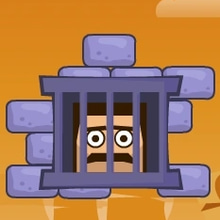
Cubestern looks like a cute little toy-town western… right up until you realize every wooden crate is basically a decision that can either save the day or open the jail door by accident. On Kiz10, this is a logic puzzle game dressed in dusty cowboy boots: you’re staring at a small board, a few characters, and a pile of crates, and your job is to remove the crates in the correct order so the bad guys end up trapped while the innocent folks stay safe. No fancy combos, no endless grinding. Just you, your cursor, and the terrifying power of a single click.
The first time you play, you’ll probably treat it like a casual brain teaser. “I’ll just remove this one.” Then the board shifts, someone slips free, and you immediately understand the true genre of Cubestern: consequences. It’s that delicious kind of puzzle where the solution is never about speed, it’s about seeing the chain reaction before it happens. Because once it happens, it’s too late, and the outlaws are basically laughing at your plan like it was a bedtime story. 😅
🌵👀 The real mechanic is prediction, not clicking
Cubestern doesn’t reward frantic tapping. It rewards a weird calm mindset where you pause, trace paths, imagine what opens up when a crate disappears, and only then commit. The board is a tiny ecosystem. A crate might be holding back an outlaw, sure, but it might also be the only thing preventing an innocent from getting exposed. Remove the wrong piece and the entire situation re-writes itself in one blink.
That’s what makes it feel so satisfying: the puzzle isn’t “find the crate that looks correct.” The puzzle is “find the order that keeps control.” Order is everything here. Think of it like pulling bricks from a wall while trying to keep the wall standing. You can remove a lot, but you can’t remove it randomly, and the game is not shy about showing you exactly how wrong you were.
🚔🪵 The sheriff fantasy, but made of boxes
There’s a funny cinematic feeling in Cubestern, even though it’s simple. Every level feels like a tiny standoff scene. The outlaws are positioned like they’re waiting for an opening. The townsfolk sit there like, “Please don’t mess this up.” And you, the player, become the sheriff who doesn’t have a gun… only carpentry decisions.
The levels are small, but they’re dramatic in the way puzzle boards become dramatic when a mistake is irreversible. You’ll hover over a crate and hesitate like you’re defusing something. Sometimes the correct move feels wrong because it looks like you’re opening a path for an outlaw. And that’s the mind game: Cubestern loves solutions that feel slightly risky, but only because they’re part of a bigger trap you’re building. When you finally pull it off, it’s satisfying in a smug, “I planned that” way… even if you definitely didn’t plan it the first three tries. 😭🤠
🧠✨ How a tiny board turns into a full mental map
After a few puzzles, something clicks in your brain. You stop staring at individual crates and start seeing structure. You notice choke points. You notice pockets where an outlaw can be forced to end up. You start identifying “must-stay” crates that should remain until the final moment because they’re secretly holding your whole plan together.
And then you get better at reading the board like a story. If you remove this crate first, the outlaw gets a straight path. If you remove that crate first, the outlaw gets redirected. If you remove the tempting crate, you create a disaster. If you remove the boring crate, you set up a trap. Cubestern has that wonderful puzzle magic where the correct answer often looks boring at first glance… until it becomes genius in hindsight.
🌙😈 The emotional rollercoaster of one wrong move
This is the kind of Kiz10 puzzle game that creates tiny emotional events. You’ll have that calm moment where you think you’ve solved it. You make the first click. It goes well. You make the second click. Still good. You start feeling confident. You make the third click… and suddenly everything collapses like you kicked the wrong chair in a saloon. The shame is instant. The restart is also instant. 😅
But that’s why it’s addictive. The game doesn’t waste your time with long resets or complicated menus. You’re back in the puzzle, back in the situation, immediately thinking, “Okay, not that one. I learned something.” Cubestern turns failure into information, and it does it fast, so you keep playing.
🔍🤠 The “cowboy logic” that makes solutions feel fair
Even when it’s tricky, Cubestern feels fair because the logic is visible. You can see where characters are. You can see how space opens. It’s not asking you to guess invisible rules. It’s asking you to be honest with yourself about what will happen if you remove a barrier. That clarity makes every win feel earned. When you solve a level, you feel like you understood it, not like you got lucky.
And the western theme is actually perfect for this. It gives the puzzles personality without getting in the way. Everything feels like a frontier setup: crude barriers, tight spaces, a town that can’t handle one more outlaw slipping through. It’s playful, but the puzzles still demand attention. You’re basically building miniature jail traps with nothing but wood and stubbornness. 🪵😈
🏆🧱 Why Cubestern is the perfect “one more level” game on Kiz10
Cubestern works because it’s compact. Each level is a bite-sized logic challenge with immediate feedback. You don’t need a long session to feel progress. You can solve one puzzle, get that satisfying “click,” and move on. Or you can do what most people do: keep going because the next board looks solvable, and your brain refuses to quit while there’s a clean solution hiding in plain sight.
It’s also a great puzzle for players who like planning without feeling overwhelmed. You’re not doing math. You’re not doing complicated crafting. You’re doing pure cause-and-effect. What happens if I remove this? What opens up? What closes? What becomes trapped? And once you start thinking that way, Cubestern becomes a steady stream of small victories, each one teaching you to be more patient, more precise, and slightly more suspicious of “obvious” moves.
If you love logic puzzles, crate-based strategy, and that satisfying feeling of solving a board by order and foresight, Cubestern on Kiz10 is a sharp little western brain duel. Just remember: the crate you want to remove first is usually the crate you should fear most. 🤠🧱



 4.4 (28 votes)
 Share
Share
 Embed
Embed